Tumor-Selective Gene Therapy: Using Hairpin DNA Oligonucleotides to Trigger Cleavage of Target RNA by Endogenous flap endonuclease 1 (FEN 1) Highly Expressed in Tumor Cells
Chunlu Wang, Chen Wang, Chenxin Xiao, Weijie Zhang, Yan Guo, Muqing Qu, Qinxin Song, Xiaole Qi, Bingjie Zou
{"title":"Tumor-Selective Gene Therapy: Using Hairpin DNA Oligonucleotides to Trigger Cleavage of Target RNA by Endogenous flap endonuclease 1 (FEN 1) Highly Expressed in Tumor Cells","authors":"Chunlu Wang, Chen Wang, Chenxin Xiao, Weijie Zhang, Yan Guo, Muqing Qu, Qinxin Song, Xiaole Qi, Bingjie Zou","doi":"10.1002/smll.202410146","DOIUrl":null,"url":null,"abstract":"<p>Nucleic acid drugs, which trigger gene silencing by hybridizing with target genes, have shown great potential in targeting those undruggable targets. However, most of the existing nucleic acid drugs are only sequence specific for target genes and lack cellular or tissue selectivity, which challenges their therapeutic safety. Here, the study proposes a tumor cell-specific gene silencing strategy by using hairpin DNA oligonucleotides to trigger target RNA degrading by highly expressed endogenous flap endonuclease 1 (FEN1) in tumor cells, for selective tumor therapy. Using <i>Kirsten rat sarcoma viral oncogene homolog</i> (<i>KRAS</i><sup>G12S</sup>) and <i>B-cell lymphoma 2</i> (<i>Bcl-2)</i> genes as targets, it is verified that the hairpin DNA oligonucleotides show cytotoxicity only to tumor cells but very low effects on normal cells. In addition, hairpin DNA oligonucleotides designed for <i>KRAS</i> inhibition, which are encapsulated in lipid nanoparticles, inhibit tumor growth in mice and demonstrate excellent antitumor efficacy in combination with gefitinib, but has little effect on normal tissues, suggesting that the proposed strategy enables highly selective tumor therapy and has the potential to give rise to a new class of nucleic acid drugs.</p>","PeriodicalId":228,"journal":{"name":"Small","volume":"21 20","pages":""},"PeriodicalIF":12.1000,"publicationDate":"2025-03-28","publicationTypes":"Journal Article","fieldsOfStudy":null,"isOpenAccess":false,"openAccessPdf":"","citationCount":"0","resultStr":null,"platform":"Semanticscholar","paperid":null,"PeriodicalName":"Small","FirstCategoryId":"88","ListUrlMain":"https://onlinelibrary.wiley.com/doi/10.1002/smll.202410146","RegionNum":2,"RegionCategory":"材料科学","ArticlePicture":[],"TitleCN":null,"AbstractTextCN":null,"PMCID":null,"EPubDate":"","PubModel":"","JCR":"Q1","JCRName":"CHEMISTRY, MULTIDISCIPLINARY","Score":null,"Total":0}
引用次数: 0
Abstract
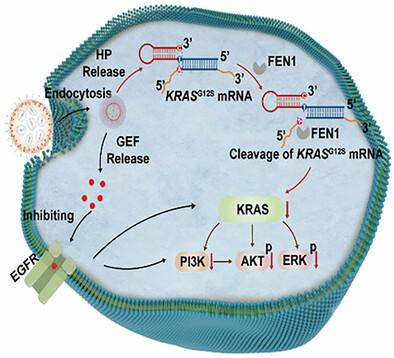
Nucleic acid drugs, which trigger gene silencing by hybridizing with target genes, have shown great potential in targeting those undruggable targets. However, most of the existing nucleic acid drugs are only sequence specific for target genes and lack cellular or tissue selectivity, which challenges their therapeutic safety. Here, the study proposes a tumor cell-specific gene silencing strategy by using hairpin DNA oligonucleotides to trigger target RNA degrading by highly expressed endogenous flap endonuclease 1 (FEN1) in tumor cells, for selective tumor therapy. Using Kirsten rat sarcoma viral oncogene homolog (KRASG12S) and B-cell lymphoma 2 (Bcl-2) genes as targets, it is verified that the hairpin DNA oligonucleotides show cytotoxicity only to tumor cells but very low effects on normal cells. In addition, hairpin DNA oligonucleotides designed for KRAS inhibition, which are encapsulated in lipid nanoparticles, inhibit tumor growth in mice and demonstrate excellent antitumor efficacy in combination with gefitinib, but has little effect on normal tissues, suggesting that the proposed strategy enables highly selective tumor therapy and has the potential to give rise to a new class of nucleic acid drugs.
核酸药物通过与靶基因杂交引发基因沉默,在针对那些无法药物治疗的靶点方面显示出巨大潜力。然而,现有的核酸药物大多只对靶基因具有序列特异性,缺乏细胞或组织选择性,这对其治疗安全性提出了挑战。本研究提出了一种肿瘤细胞特异性基因沉默策略,利用发夹DNA寡核苷酸触发肿瘤细胞中高表达的内源性瓣膜内切酶1(FEN1)降解靶RNA,从而实现肿瘤的选择性治疗。以 Kirsten 大鼠肉瘤病毒癌基因同源物(KRASG12S)和 B 细胞淋巴瘤 2(Bcl-2)基因为靶点,验证了发夹 DNA 寡核苷酸只对肿瘤细胞具有细胞毒性,而对正常细胞的影响非常小。此外,为抑制 KRAS 而设计的发夹 DNA 寡核苷酸被封装在脂质纳米颗粒中,与吉非替尼联合使用可抑制小鼠肿瘤生长,并显示出卓越的抗肿瘤疗效,但对正常组织的影响很小,这表明所提出的策略可实现高度选择性的肿瘤治疗,并有可能催生一类新的核酸药物。
期刊介绍:
Small serves as an exceptional platform for both experimental and theoretical studies in fundamental and applied interdisciplinary research at the nano- and microscale. The journal offers a compelling mix of peer-reviewed Research Articles, Reviews, Perspectives, and Comments.
With a remarkable 2022 Journal Impact Factor of 13.3 (Journal Citation Reports from Clarivate Analytics, 2023), Small remains among the top multidisciplinary journals, covering a wide range of topics at the interface of materials science, chemistry, physics, engineering, medicine, and biology.
Small's readership includes biochemists, biologists, biomedical scientists, chemists, engineers, information technologists, materials scientists, physicists, and theoreticians alike.




 京公网安备 11010802042870号
京ICP备2023020795号-1
京公网安备 11010802042870号
京ICP备2023020795号-1

 分享
分享
 求助内容:
求助内容: 应助结果提醒方式:
 扫码关注我们
