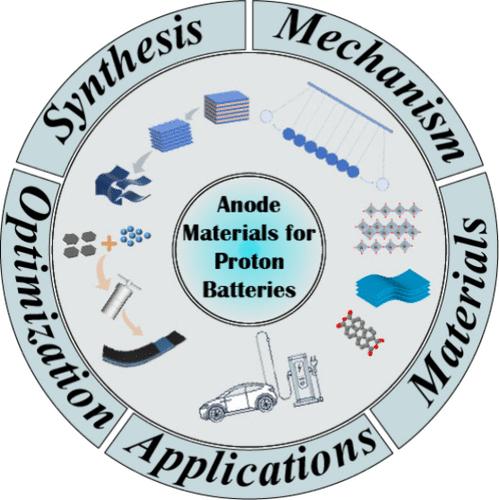
{"title":"Anode Materials for Proton Batteries: Progress and Prospects","authors":"Zhongxi Li, Zhi Zhang, Huanyi Liao, Yifan Zheng, Yihua Gao","doi":"10.1021/acsnano.5c00143","DOIUrl":null,"url":null,"abstract":"A proton battery is considered as a promising energy storage solution with the merits of fast kinetics, high safety, low cost, and environmental benignity. The realization of these merits depends on the exploration of the appropriate and high-performance electrode materials. Although many anode materials of proton batteries have been reported, a dedicated summary of the progress, challenges, and prospects of anode materials for proton batteries has not been reported. Through discussions on the proton storage mechanisms, advantages and limitations of various anode materials, optimization strategies to boost their proton storage capability, and their potential applications, this review seeks to provide a comprehensive theoretical foundation and practical guidance for future research and development of proton battery technology. First, the preparation methods and proton storage mechanism of anode materials have been discussed. Then, the limitations and optimization strategies have been summarized. After that, the next section elaborately focuses on the proton storage performance of different types of anode materials. Finally, the challenges and prospects of anode materials for proton batteries have been proposed. This review aims to provide insight into the efficient design and optimization of anode materials for practical applications of proton batteries.","PeriodicalId":21,"journal":{"name":"ACS Nano","volume":"23 1","pages":""},"PeriodicalIF":16.0000,"publicationDate":"2025-03-29","publicationTypes":"Journal Article","fieldsOfStudy":null,"isOpenAccess":false,"openAccessPdf":"","citationCount":"0","resultStr":null,"platform":"Semanticscholar","paperid":null,"PeriodicalName":"ACS Nano","FirstCategoryId":"88","ListUrlMain":"https://doi.org/10.1021/acsnano.5c00143","RegionNum":1,"RegionCategory":"材料科学","ArticlePicture":[],"TitleCN":null,"AbstractTextCN":null,"PMCID":null,"EPubDate":"","PubModel":"","JCR":"Q1","JCRName":"CHEMISTRY, MULTIDISCIPLINARY","Score":null,"Total":0}
引用次数: 0
Abstract
A proton battery is considered as a promising energy storage solution with the merits of fast kinetics, high safety, low cost, and environmental benignity. The realization of these merits depends on the exploration of the appropriate and high-performance electrode materials. Although many anode materials of proton batteries have been reported, a dedicated summary of the progress, challenges, and prospects of anode materials for proton batteries has not been reported. Through discussions on the proton storage mechanisms, advantages and limitations of various anode materials, optimization strategies to boost their proton storage capability, and their potential applications, this review seeks to provide a comprehensive theoretical foundation and practical guidance for future research and development of proton battery technology. First, the preparation methods and proton storage mechanism of anode materials have been discussed. Then, the limitations and optimization strategies have been summarized. After that, the next section elaborately focuses on the proton storage performance of different types of anode materials. Finally, the challenges and prospects of anode materials for proton batteries have been proposed. This review aims to provide insight into the efficient design and optimization of anode materials for practical applications of proton batteries.
期刊介绍:
ACS Nano, published monthly, serves as an international forum for comprehensive articles on nanoscience and nanotechnology research at the intersections of chemistry, biology, materials science, physics, and engineering. The journal fosters communication among scientists in these communities, facilitating collaboration, new research opportunities, and advancements through discoveries. ACS Nano covers synthesis, assembly, characterization, theory, and simulation of nanostructures, nanobiotechnology, nanofabrication, methods and tools for nanoscience and nanotechnology, and self- and directed-assembly. Alongside original research articles, it offers thorough reviews, perspectives on cutting-edge research, and discussions envisioning the future of nanoscience and nanotechnology.



 京公网安备 11010802042870号
京ICP备2023020795号-1
京公网安备 11010802042870号
京ICP备2023020795号-1

 分享
分享
 求助内容:
求助内容: 应助结果提醒方式:
 扫码关注我们
