Electromagnetic-mechanical collaborative design of high-performance electromagnetic sandwich metastructure by machine learning based genetic optimization
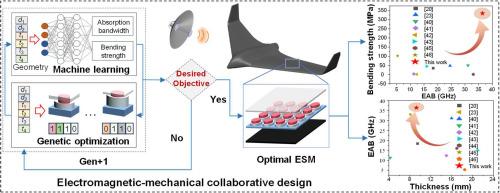
{"title":"Electromagnetic-mechanical collaborative design of high-performance electromagnetic sandwich metastructure by machine learning based genetic optimization","authors":"Mengfei Feng, Guanjie Yu, Kaifu Zhang, Yuan Li, Hui Cheng, Biao Liang","doi":"10.1016/j.jmst.2025.01.063","DOIUrl":null,"url":null,"abstract":"Electromagnetic sandwich metastructure (ESM) consisting of different functional layers, has gained increasing attention in radiation prevention and radar stealth. However, the current ESM design is primarily based on the separation design method, ignoring electromagnetic-mechanical interactions between layers. Thus, subject to thin thickness constraint of ESM, it is a great challenge to achieve broadband microwave absorption (MA) and excellent mechanical performance simultaneously. To address this issue, an electromagnetic-mechanical collaborative design approach was proposed for ESM. The relations of geometric-electromagnetic and geometric-mechanical of ESM were first identified by machine learning. They were then integrated with the heuristic genetic optimization algorithm to perform the highly efficient design. The designed ESM can achieve 36.4 GHz effective absorption bandwidth (EAB, RL ≤ −10 dB), 334.3 MPa equivalent bending strength and 83 MPa compressive strength with a thickness of 9.3 mm, possessing the widest EAB and highest bending strength within the current available MA structures (thickness less than 9.5 mm). The proposed approach provides an efficient tool for the design of electromagnetic-mechanical optimal ESM.","PeriodicalId":16154,"journal":{"name":"Journal of Materials Science & Technology","volume":"72 1","pages":""},"PeriodicalIF":14.3000,"publicationDate":"2025-03-29","publicationTypes":"Journal Article","fieldsOfStudy":null,"isOpenAccess":false,"openAccessPdf":"","citationCount":"0","resultStr":null,"platform":"Semanticscholar","paperid":null,"PeriodicalName":"Journal of Materials Science & Technology","FirstCategoryId":"88","ListUrlMain":"https://doi.org/10.1016/j.jmst.2025.01.063","RegionNum":1,"RegionCategory":"材料科学","ArticlePicture":[],"TitleCN":null,"AbstractTextCN":null,"PMCID":null,"EPubDate":"","PubModel":"","JCR":"Q1","JCRName":"MATERIALS SCIENCE, MULTIDISCIPLINARY","Score":null,"Total":0}
引用次数: 0
Abstract
Electromagnetic sandwich metastructure (ESM) consisting of different functional layers, has gained increasing attention in radiation prevention and radar stealth. However, the current ESM design is primarily based on the separation design method, ignoring electromagnetic-mechanical interactions between layers. Thus, subject to thin thickness constraint of ESM, it is a great challenge to achieve broadband microwave absorption (MA) and excellent mechanical performance simultaneously. To address this issue, an electromagnetic-mechanical collaborative design approach was proposed for ESM. The relations of geometric-electromagnetic and geometric-mechanical of ESM were first identified by machine learning. They were then integrated with the heuristic genetic optimization algorithm to perform the highly efficient design. The designed ESM can achieve 36.4 GHz effective absorption bandwidth (EAB, RL ≤ −10 dB), 334.3 MPa equivalent bending strength and 83 MPa compressive strength with a thickness of 9.3 mm, possessing the widest EAB and highest bending strength within the current available MA structures (thickness less than 9.5 mm). The proposed approach provides an efficient tool for the design of electromagnetic-mechanical optimal ESM.
期刊介绍:
Journal of Materials Science & Technology strives to promote global collaboration in the field of materials science and technology. It primarily publishes original research papers, invited review articles, letters, research notes, and summaries of scientific achievements. The journal covers a wide range of materials science and technology topics, including metallic materials, inorganic nonmetallic materials, and composite materials.



 京公网安备 11010802042870号
京ICP备2023020795号-1
京公网安备 11010802042870号
京ICP备2023020795号-1

 分享
分享
 求助内容:
求助内容: 应助结果提醒方式:
 扫码关注我们
