Molecular docking–QSAR–Kronecker-regularized least squares-based multiple machine learning for assessment and prediction of PFAS–protein binding interactions
Lihui Zhao , Zixuan Zhang , Hailei Su , Wenjun Zhang , Jiaqi Sun , Yunxia Li , Miaomiao Teng
{"title":"Molecular docking–QSAR–Kronecker-regularized least squares-based multiple machine learning for assessment and prediction of PFAS–protein binding interactions","authors":"Lihui Zhao , Zixuan Zhang , Hailei Su , Wenjun Zhang , Jiaqi Sun , Yunxia Li , Miaomiao Teng","doi":"10.1016/j.jhazmat.2025.138069","DOIUrl":null,"url":null,"abstract":"<div><div>Ubiquitous per- and poly-fluoroalkyl substances (PFAS) threaten human's health and attract worldwide attention. PFAS-mediated toxicity involves adverse effects of PFAS on proteins, and assessment of PFAS–protein binding interactions helps to explain PFAS’ adverse effects on human health. In-silico modeling can generate information and decrease experimental costs. Accordingly, in this study, molecular docking was used to determine the binding affinities of 430 PFAS with human serum albumin (HSA), peroxisome proliferator-activated receptor gamma (PPARγ), and transthyretin (TTR). Specifically, analytic hierarchy process, fuzzy comprehensive evaluation, and quantitative structure–activity relationship model were used to assess and predict the binding affinities between PFAS and HSA, PPARγ, and TTR. The binding patterns were determined by defining “PEOE_RPC-, E_vdw, MNDO_LUMO, and vsurf features” as key factors related to charge, energy and shape characteristic of PFAS. Finally, Kronecker-regularized least squares (Kron-RLS) model was applied to predict the binding affinities between PFAS– and G protein-coupled receptor 40 (GPR40), as a new target for prediction. Results showed that the Kron-RLS model exhibited good performance and generated precise predictions (R<sup>2</sup> = 0.94). In conclusion, this study demonstrated that computational simulations could be used to aid the scientific management of the growing number of PFAS, and could be broadened to include a wide range of environmental contaminations.</div></div>","PeriodicalId":361,"journal":{"name":"Journal of Hazardous Materials","volume":"492 ","pages":"Article 138069"},"PeriodicalIF":11.3000,"publicationDate":"2025-07-15","publicationTypes":"Journal Article","fieldsOfStudy":null,"isOpenAccess":false,"openAccessPdf":"","citationCount":"0","resultStr":null,"platform":"Semanticscholar","paperid":null,"PeriodicalName":"Journal of Hazardous Materials","FirstCategoryId":"93","ListUrlMain":"https://www.sciencedirect.com/science/article/pii/S0304389425009847","RegionNum":1,"RegionCategory":"环境科学与生态学","ArticlePicture":[],"TitleCN":null,"AbstractTextCN":null,"PMCID":null,"EPubDate":"2025/3/29 0:00:00","PubModel":"Epub","JCR":"Q1","JCRName":"ENGINEERING, ENVIRONMENTAL","Score":null,"Total":0}
引用次数: 0
Abstract
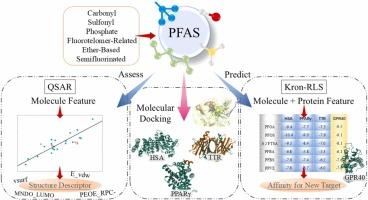
Ubiquitous per- and poly-fluoroalkyl substances (PFAS) threaten human's health and attract worldwide attention. PFAS-mediated toxicity involves adverse effects of PFAS on proteins, and assessment of PFAS–protein binding interactions helps to explain PFAS’ adverse effects on human health. In-silico modeling can generate information and decrease experimental costs. Accordingly, in this study, molecular docking was used to determine the binding affinities of 430 PFAS with human serum albumin (HSA), peroxisome proliferator-activated receptor gamma (PPARγ), and transthyretin (TTR). Specifically, analytic hierarchy process, fuzzy comprehensive evaluation, and quantitative structure–activity relationship model were used to assess and predict the binding affinities between PFAS and HSA, PPARγ, and TTR. The binding patterns were determined by defining “PEOE_RPC-, E_vdw, MNDO_LUMO, and vsurf features” as key factors related to charge, energy and shape characteristic of PFAS. Finally, Kronecker-regularized least squares (Kron-RLS) model was applied to predict the binding affinities between PFAS– and G protein-coupled receptor 40 (GPR40), as a new target for prediction. Results showed that the Kron-RLS model exhibited good performance and generated precise predictions (R2 = 0.94). In conclusion, this study demonstrated that computational simulations could be used to aid the scientific management of the growing number of PFAS, and could be broadened to include a wide range of environmental contaminations.
期刊介绍:
The Journal of Hazardous Materials serves as a global platform for promoting cutting-edge research in the field of Environmental Science and Engineering. Our publication features a wide range of articles, including full-length research papers, review articles, and perspectives, with the aim of enhancing our understanding of the dangers and risks associated with various materials concerning public health and the environment. It is important to note that the term "environmental contaminants" refers specifically to substances that pose hazardous effects through contamination, while excluding those that do not have such impacts on the environment or human health. Moreover, we emphasize the distinction between wastes and hazardous materials in order to provide further clarity on the scope of the journal. We have a keen interest in exploring specific compounds and microbial agents that have adverse effects on the environment.




 京公网安备 11010802042870号
京ICP备2023020795号-1
京公网安备 11010802042870号
京ICP备2023020795号-1

 分享
分享
 求助内容:
求助内容: 应助结果提醒方式:
 扫码关注我们
