Wei-Guo Wang , Ming-Jun Yang , Zhu-Bo Sheng , Li-Ming Tao , Wen-Ping Xu , Yang Zhang
{"title":"Avermectin induces photoreceptor functional impairment and color vision deficits in zebrafish (Danio rerio)","authors":"Wei-Guo Wang , Ming-Jun Yang , Zhu-Bo Sheng , Li-Ming Tao , Wen-Ping Xu , Yang Zhang","doi":"10.1016/j.jhazmat.2025.138085","DOIUrl":null,"url":null,"abstract":"<div><div>The effects of avermectin on the visual function of nontarget organisms, particularly aquatic organisms, require further evaluation. Avermectin can come into direct contact with the eyes of nontarget organisms through air or water. However, few studies have investigated the safety of avermectin in the eyes of nontarget organisms. Therefore, it is important to assess its safety in the eyes of nontarget organisms. The results demonstrate that avermectin induces ocular morphological abnormalities, retinal structural damage, and decreased locomotor behavior in zebrafish larvae. Further analyses indicate that avermectin-induced ocular toxicity in zebrafish larvae is associated with the thyroid hormone and retinoic acid signaling pathways. The evaluation of the effect of avermectin on the visual function of adult zebrafish reveals that avermectin induces changes in the sensitivity of adult zebrafish to different light wavelengths and colors. Male adult zebrafish showed greater variation, suggesting possible sex differences. These results indicate that avermectin induces ocular developmental damage in zebrafish larvae and visual behavioral abnormalities in adult zebrafish.</div></div>","PeriodicalId":361,"journal":{"name":"Journal of Hazardous Materials","volume":"492 ","pages":"Article 138085"},"PeriodicalIF":11.3000,"publicationDate":"2025-07-15","publicationTypes":"Journal Article","fieldsOfStudy":null,"isOpenAccess":false,"openAccessPdf":"","citationCount":"0","resultStr":null,"platform":"Semanticscholar","paperid":null,"PeriodicalName":"Journal of Hazardous Materials","FirstCategoryId":"93","ListUrlMain":"https://www.sciencedirect.com/science/article/pii/S0304389425010003","RegionNum":1,"RegionCategory":"环境科学与生态学","ArticlePicture":[],"TitleCN":null,"AbstractTextCN":null,"PMCID":null,"EPubDate":"2025/3/29 0:00:00","PubModel":"Epub","JCR":"Q1","JCRName":"ENGINEERING, ENVIRONMENTAL","Score":null,"Total":0}
引用次数: 0
Abstract
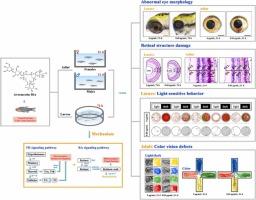
The effects of avermectin on the visual function of nontarget organisms, particularly aquatic organisms, require further evaluation. Avermectin can come into direct contact with the eyes of nontarget organisms through air or water. However, few studies have investigated the safety of avermectin in the eyes of nontarget organisms. Therefore, it is important to assess its safety in the eyes of nontarget organisms. The results demonstrate that avermectin induces ocular morphological abnormalities, retinal structural damage, and decreased locomotor behavior in zebrafish larvae. Further analyses indicate that avermectin-induced ocular toxicity in zebrafish larvae is associated with the thyroid hormone and retinoic acid signaling pathways. The evaluation of the effect of avermectin on the visual function of adult zebrafish reveals that avermectin induces changes in the sensitivity of adult zebrafish to different light wavelengths and colors. Male adult zebrafish showed greater variation, suggesting possible sex differences. These results indicate that avermectin induces ocular developmental damage in zebrafish larvae and visual behavioral abnormalities in adult zebrafish.
期刊介绍:
The Journal of Hazardous Materials serves as a global platform for promoting cutting-edge research in the field of Environmental Science and Engineering. Our publication features a wide range of articles, including full-length research papers, review articles, and perspectives, with the aim of enhancing our understanding of the dangers and risks associated with various materials concerning public health and the environment. It is important to note that the term "environmental contaminants" refers specifically to substances that pose hazardous effects through contamination, while excluding those that do not have such impacts on the environment or human health. Moreover, we emphasize the distinction between wastes and hazardous materials in order to provide further clarity on the scope of the journal. We have a keen interest in exploring specific compounds and microbial agents that have adverse effects on the environment.



 京公网安备 11010802042870号
京ICP备2023020795号-1
京公网安备 11010802042870号
京ICP备2023020795号-1

 分享
分享
 求助内容:
求助内容: 应助结果提醒方式:
 扫码关注我们
