Gabriela Castro , Victoria Fernández-Fernández , Miguel Cobo-Golpe , María Ramil , Enrique Blázquez-Blázquez , María L. Cerrada , I. Bernabé , J. Martínez Urreaga , M.U. de la Orden , Isaac Rodriguez
{"title":"The fingerprint of pesticides in agricultural used polyethylene","authors":"Gabriela Castro , Victoria Fernández-Fernández , Miguel Cobo-Golpe , María Ramil , Enrique Blázquez-Blázquez , María L. Cerrada , I. Bernabé , J. Martínez Urreaga , M.U. de la Orden , Isaac Rodriguez","doi":"10.1016/j.wasman.2025.114767","DOIUrl":null,"url":null,"abstract":"<div><div>The widespread use of polyethylene (PE) materials in agriculture through mulch films, tunnels, greenhouse covers, irrigation pipes and tying tapes has been instrumental in increasing crop productivity and reducing water demand. However, it raised concerns regarding the interaction between PE and pesticides sprayed on crops. This research strives to study the fingerprint of pesticides in agricultural PE by analyzing new items, end-of-life agricultural plastics and a range of samples corresponding to the recycling of aged PE, from sized and washed flakes to second-hand pellets and plant protection tubes elaborated from recycled plastic. Total concentrations determined for a selection of fungicides and insecticides in the abovementioned materials varied between 4.7 ng g<sup>−1</sup> and 4179 ng g<sup>−1</sup>, with the fungicides cyprodinil and difenoconazole showing the highest concentrations. Furthermore, transformation products of pesticides phased out more than 40 years ago, e.g., <em>p,p’</em>-DDE, were found in some PE items. The survival of pesticides at temperatures above the melting point of this polymer was confirmed in laboratory-scale melting experiments, as well as through the analysis of second-hand pellets. Experiments carried out using pesticide-polluted dripline pipes confirmed the migration of these compounds from PE to flowing water.</div></div>","PeriodicalId":23969,"journal":{"name":"Waste management","volume":"200 ","pages":"Article 114767"},"PeriodicalIF":7.1000,"publicationDate":"2025-03-29","publicationTypes":"Journal Article","fieldsOfStudy":null,"isOpenAccess":false,"openAccessPdf":"","citationCount":"0","resultStr":null,"platform":"Semanticscholar","paperid":null,"PeriodicalName":"Waste management","FirstCategoryId":"93","ListUrlMain":"https://www.sciencedirect.com/science/article/pii/S0956053X25001783","RegionNum":2,"RegionCategory":"环境科学与生态学","ArticlePicture":[],"TitleCN":null,"AbstractTextCN":null,"PMCID":null,"EPubDate":"","PubModel":"","JCR":"Q1","JCRName":"ENGINEERING, ENVIRONMENTAL","Score":null,"Total":0}
引用次数: 0
Abstract
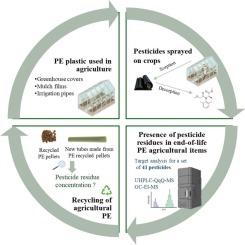
The widespread use of polyethylene (PE) materials in agriculture through mulch films, tunnels, greenhouse covers, irrigation pipes and tying tapes has been instrumental in increasing crop productivity and reducing water demand. However, it raised concerns regarding the interaction between PE and pesticides sprayed on crops. This research strives to study the fingerprint of pesticides in agricultural PE by analyzing new items, end-of-life agricultural plastics and a range of samples corresponding to the recycling of aged PE, from sized and washed flakes to second-hand pellets and plant protection tubes elaborated from recycled plastic. Total concentrations determined for a selection of fungicides and insecticides in the abovementioned materials varied between 4.7 ng g−1 and 4179 ng g−1, with the fungicides cyprodinil and difenoconazole showing the highest concentrations. Furthermore, transformation products of pesticides phased out more than 40 years ago, e.g., p,p’-DDE, were found in some PE items. The survival of pesticides at temperatures above the melting point of this polymer was confirmed in laboratory-scale melting experiments, as well as through the analysis of second-hand pellets. Experiments carried out using pesticide-polluted dripline pipes confirmed the migration of these compounds from PE to flowing water.
聚乙烯(PE)材料通过地膜、隧道、温室覆盖物、灌溉管道和捆扎带广泛应用于农业,在提高作物产量和减少水需求方面发挥了重要作用。然而,聚乙烯与喷洒在农作物上的杀虫剂之间的相互作用也引起了人们的关注。这项研究通过分析新产品、报废农用塑料和一系列回收利用旧聚乙烯的样品,从规格和洗涤片材到二手颗粒和用回收塑料制成的植物保护管,努力研究农用聚乙烯中的杀虫剂指纹。在上述材料中测定的部分杀菌剂和杀虫剂的总浓度介于 4.7 ng g-1 和 4179 ng g-1 之间,其中杀菌剂环丙唑醇和苯醚甲环唑的浓度最高。此外,在一些 PE 物品中还发现了 40 多年前淘汰的杀虫剂的转化产物,如 p,p'-DDE。在实验室规模的熔化实验中,以及通过对二手颗粒的分析,证实了杀虫剂在高于这种聚合物熔点的温度下仍能存活。使用受杀虫剂污染的滴管进行的实验证实,这些化合物会从聚乙烯迁移到流水中。
期刊介绍:
Waste Management is devoted to the presentation and discussion of information on solid wastes,it covers the entire lifecycle of solid. wastes.
Scope:
Addresses solid wastes in both industrialized and economically developing countries
Covers various types of solid wastes, including:
Municipal (e.g., residential, institutional, commercial, light industrial)
Agricultural
Special (e.g., C and D, healthcare, household hazardous wastes, sewage sludge)



 京公网安备 11010802042870号
京ICP备2023020795号-1
京公网安备 11010802042870号
京ICP备2023020795号-1

 分享
分享
 求助内容:
求助内容: 应助结果提醒方式:
 扫码关注我们
