Faryal Shaukat , Samee-Ullah , Muhammad Bilal , Muhammad Asim , Tausif Ahmad , Anam Farid , Pengwei Zhang , Yemin Guo , Xia Sun
{"title":"Graphene oxide-enhanced FRET aptasensor: Precision detection of ertapenem residues in milk","authors":"Faryal Shaukat , Samee-Ullah , Muhammad Bilal , Muhammad Asim , Tausif Ahmad , Anam Farid , Pengwei Zhang , Yemin Guo , Xia Sun","doi":"10.1016/j.snb.2025.137545","DOIUrl":null,"url":null,"abstract":"<div><div>Ertapenem (ER), a β-lactam antibiotic categorized as a carbapenem, is recognized for its broad-spectrum antibacterial efficacy against both Gram-negative and Gram-positive bacteria, making it an important therapeutic agent for treating various bacterial infections. Recent studies have reported carbapenem-resistant bacteria and their corresponding resistance genes in raw milk samples. In this study, graphene oxide (GO)-SELEX was employed to rapidly elute target-bound sequences and identify high affinity aptamers specific to ER from an ssDNA library. The 81 nucleotides (81-mer) aptamer ER-3 was selected for its highest affinity, with a Kd value of 77.69 ± 4.16 nM, as determined by the carboxyfluorescein (FAM) labeled fluorescence method. The original aptamer was truncated to ER3-T2, which enhanced both its affinity and selectivity, with a K<sub>d</sub> value of 1.84 ± 0.07 nM. A Förster Resonance Energy Transfer (FRET)-based aptasensor was developed by incorporating both the original and the truncated aptamer to establish an accurate calibration plot. The aptasensor demonstrated a significant linear relationship between fluorescence intensity (FI) and ER concentration, ranging from 1 to 100 nM, with a limit of detection (LOD) of 1.72 nM for the aptamer ER3-T2. These results highlight the FRET-based aptasensor as a promising, sensitive, and efficient analytical platform for the rapid detection of ER in milk samples.</div></div>","PeriodicalId":425,"journal":{"name":"Sensors and Actuators B: Chemical","volume":"436 ","pages":"Article 137545"},"PeriodicalIF":3.7000,"publicationDate":"2025-03-30","publicationTypes":"Journal Article","fieldsOfStudy":null,"isOpenAccess":false,"openAccessPdf":"","citationCount":"0","resultStr":null,"platform":"Semanticscholar","paperid":null,"PeriodicalName":"Sensors and Actuators B: Chemical","FirstCategoryId":"92","ListUrlMain":"https://www.sciencedirect.com/science/article/pii/S092540052500320X","RegionNum":1,"RegionCategory":"化学","ArticlePicture":[],"TitleCN":null,"AbstractTextCN":null,"PMCID":null,"EPubDate":"","PubModel":"","JCR":"Q1","JCRName":"CHEMISTRY, ANALYTICAL","Score":null,"Total":0}
引用次数: 0
Abstract
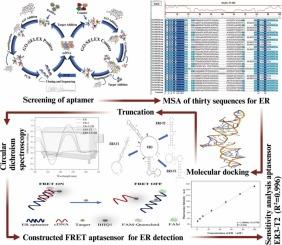
Ertapenem (ER), a β-lactam antibiotic categorized as a carbapenem, is recognized for its broad-spectrum antibacterial efficacy against both Gram-negative and Gram-positive bacteria, making it an important therapeutic agent for treating various bacterial infections. Recent studies have reported carbapenem-resistant bacteria and their corresponding resistance genes in raw milk samples. In this study, graphene oxide (GO)-SELEX was employed to rapidly elute target-bound sequences and identify high affinity aptamers specific to ER from an ssDNA library. The 81 nucleotides (81-mer) aptamer ER-3 was selected for its highest affinity, with a Kd value of 77.69 ± 4.16 nM, as determined by the carboxyfluorescein (FAM) labeled fluorescence method. The original aptamer was truncated to ER3-T2, which enhanced both its affinity and selectivity, with a Kd value of 1.84 ± 0.07 nM. A Förster Resonance Energy Transfer (FRET)-based aptasensor was developed by incorporating both the original and the truncated aptamer to establish an accurate calibration plot. The aptasensor demonstrated a significant linear relationship between fluorescence intensity (FI) and ER concentration, ranging from 1 to 100 nM, with a limit of detection (LOD) of 1.72 nM for the aptamer ER3-T2. These results highlight the FRET-based aptasensor as a promising, sensitive, and efficient analytical platform for the rapid detection of ER in milk samples.
期刊介绍:
Sensors & Actuators, B: Chemical is an international journal focused on the research and development of chemical transducers. It covers chemical sensors and biosensors, chemical actuators, and analytical microsystems. The journal is interdisciplinary, aiming to publish original works showcasing substantial advancements beyond the current state of the art in these fields, with practical applicability to solving meaningful analytical problems. Review articles are accepted by invitation from an Editor of the journal.



 京公网安备 11010802042870号
京ICP备2023020795号-1
京公网安备 11010802042870号
京ICP备2023020795号-1

 分享
分享
 求助内容:
求助内容: 应助结果提醒方式:
 扫码关注我们
