Enhancing the decomposition and composting of food waste by in situ directional enzymatic hydrolysis: performance, ARGs removal and engineering application
Rongkun Du , Lihui Cui , Yizhuo Feng , Xiangbo Lv , Yehan Gao , Aipeng Li , Qunhui Wang , Yingqun Ma
{"title":"Enhancing the decomposition and composting of food waste by in situ directional enzymatic hydrolysis: performance, ARGs removal and engineering application","authors":"Rongkun Du , Lihui Cui , Yizhuo Feng , Xiangbo Lv , Yehan Gao , Aipeng Li , Qunhui Wang , Yingqun Ma","doi":"10.1016/j.wasman.2025.114774","DOIUrl":null,"url":null,"abstract":"<div><div>This research utilized food waste (FW) as substrate, innovatively developed a directional multienzyme applied for accelerating FW hydrolysis and composting, and an in situ enzymatic hydrolysis combining in composting has been developed to manage FW. Results showed that the composting was achieved at 4 days and the humification index was increased by 2.60 compared with that of without enzymatic hydrolysis. FTIR analysis revealed that following multienzyme pretreatment, the primary constituents of FW, including protein, starch and lipid, underwent structural breakdown, among which protein exhibited the higher susceptibility to multienzyme action and was the first to disintegrated, and the structure also became looser. Moreover, the total antibiotic resistance gene (ARGs) was reduced more than 90 % in the proposed composting process. Analysis of microbial communities and metagenomes showed that multienzyme pretreatment reshaped microbial communities towards favoring FW hydrolysis and humification. The engineering application analysis further implied that the proposed composting approach is scale flexible, engineering applicable, economic viability and environmentally sustainability. It was anticipated that this study has the potential to trigger a paradigm shift in future in-situ treatment of FW to achieve full resource recovery towards zero solid discharge.</div></div>","PeriodicalId":23969,"journal":{"name":"Waste management","volume":"200 ","pages":"Article 114774"},"PeriodicalIF":7.1000,"publicationDate":"2025-03-30","publicationTypes":"Journal Article","fieldsOfStudy":null,"isOpenAccess":false,"openAccessPdf":"","citationCount":"0","resultStr":null,"platform":"Semanticscholar","paperid":null,"PeriodicalName":"Waste management","FirstCategoryId":"93","ListUrlMain":"https://www.sciencedirect.com/science/article/pii/S0956053X25001850","RegionNum":2,"RegionCategory":"环境科学与生态学","ArticlePicture":[],"TitleCN":null,"AbstractTextCN":null,"PMCID":null,"EPubDate":"","PubModel":"","JCR":"Q1","JCRName":"ENGINEERING, ENVIRONMENTAL","Score":null,"Total":0}
引用次数: 0
Abstract
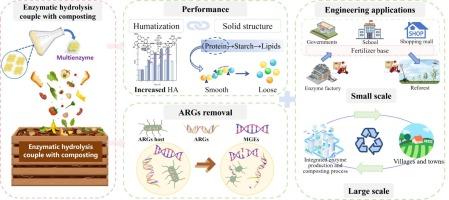
This research utilized food waste (FW) as substrate, innovatively developed a directional multienzyme applied for accelerating FW hydrolysis and composting, and an in situ enzymatic hydrolysis combining in composting has been developed to manage FW. Results showed that the composting was achieved at 4 days and the humification index was increased by 2.60 compared with that of without enzymatic hydrolysis. FTIR analysis revealed that following multienzyme pretreatment, the primary constituents of FW, including protein, starch and lipid, underwent structural breakdown, among which protein exhibited the higher susceptibility to multienzyme action and was the first to disintegrated, and the structure also became looser. Moreover, the total antibiotic resistance gene (ARGs) was reduced more than 90 % in the proposed composting process. Analysis of microbial communities and metagenomes showed that multienzyme pretreatment reshaped microbial communities towards favoring FW hydrolysis and humification. The engineering application analysis further implied that the proposed composting approach is scale flexible, engineering applicable, economic viability and environmentally sustainability. It was anticipated that this study has the potential to trigger a paradigm shift in future in-situ treatment of FW to achieve full resource recovery towards zero solid discharge.
期刊介绍:
Waste Management is devoted to the presentation and discussion of information on solid wastes,it covers the entire lifecycle of solid. wastes.
Scope:
Addresses solid wastes in both industrialized and economically developing countries
Covers various types of solid wastes, including:
Municipal (e.g., residential, institutional, commercial, light industrial)
Agricultural
Special (e.g., C and D, healthcare, household hazardous wastes, sewage sludge)



 京公网安备 11010802042870号
京ICP备2023020795号-1
京公网安备 11010802042870号
京ICP备2023020795号-1

 分享
分享
 求助内容:
求助内容: 应助结果提醒方式:
 扫码关注我们
