{"title":"PBK-TD modelling of the gonadotropic axis: Case study with two azole fungicides in female zebrafish","authors":"Tu-Ky Ly , Edith Chadili , Olivier Palluel , Karyn Le Menach , Hélène Budzinski , Cleo Tebby , Nathalie Hinfray , Rémy Beaudouin","doi":"10.1016/j.aquatox.2025.107337","DOIUrl":null,"url":null,"abstract":"<div><div>Endocrine disruptors (EDs) can disrupt the gonadotropic axis, which consists of the Hypothalamus-Pituitary-Gonads (HPG), notably by altering aromatase (cyp19a), a key enzyme regulating the endocrine system and reproductive function in fish. The effects of EDs can be predicted by integrating both toxicokinetic (TK) and toxicodynamic (TD) processes in order to relate adverse outcomes to external exposures. In this study, we developed a physiologically based kinetic-toxicodynamic model to simulate the disruption of the HPG axis (PBK-TD, hereafter named PBK-HPG) in female zebrafish exposed to either of two aromatase inhibitors, imazalil or prochloraz. The model was calibrated using Bayesian methods and supported by novel experimental data, including measurements of vitellogenin, 17β-estradiol, and 11-ketotestosterone levels, along with in vivo monitoring of the cyp19a1a gene in transgenic cyp19a1a-GFP ebrafish. Seamless integration of a PBK model within a TD model of the HPG-axis, provided the link between external exposure and internal levels of imazalil and prochloraz in key organs, allowing for mechanistic predictions of their inhibitory effects on gonadal aromatase. Our PBK-HPG model accurately predicted both baseline homeostasis and the effects of aromatase inhibition, with all endocrine endpoints including reproductive disruption, i.e., decreased egg production, falling within a twofold range of both experimental and literature data. Therefore, our PBK-HPG model could further support the development of a mechanistic qAOP with TK considerations. The model offers significant potential for improving environmental risk assessments of EDs and possibly other stressors across species.</div></div>","PeriodicalId":248,"journal":{"name":"Aquatic Toxicology","volume":"283 ","pages":"Article 107337"},"PeriodicalIF":4.3000,"publicationDate":"2025-03-25","publicationTypes":"Journal Article","fieldsOfStudy":null,"isOpenAccess":false,"openAccessPdf":"","citationCount":"0","resultStr":null,"platform":"Semanticscholar","paperid":null,"PeriodicalName":"Aquatic Toxicology","FirstCategoryId":"93","ListUrlMain":"https://www.sciencedirect.com/science/article/pii/S0166445X2500102X","RegionNum":2,"RegionCategory":"环境科学与生态学","ArticlePicture":[],"TitleCN":null,"AbstractTextCN":null,"PMCID":null,"EPubDate":"","PubModel":"","JCR":"Q1","JCRName":"MARINE & FRESHWATER BIOLOGY","Score":null,"Total":0}
引用次数: 0
Abstract
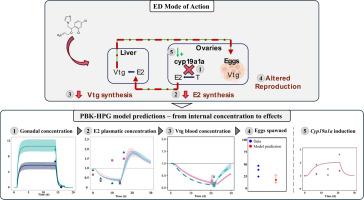
Endocrine disruptors (EDs) can disrupt the gonadotropic axis, which consists of the Hypothalamus-Pituitary-Gonads (HPG), notably by altering aromatase (cyp19a), a key enzyme regulating the endocrine system and reproductive function in fish. The effects of EDs can be predicted by integrating both toxicokinetic (TK) and toxicodynamic (TD) processes in order to relate adverse outcomes to external exposures. In this study, we developed a physiologically based kinetic-toxicodynamic model to simulate the disruption of the HPG axis (PBK-TD, hereafter named PBK-HPG) in female zebrafish exposed to either of two aromatase inhibitors, imazalil or prochloraz. The model was calibrated using Bayesian methods and supported by novel experimental data, including measurements of vitellogenin, 17β-estradiol, and 11-ketotestosterone levels, along with in vivo monitoring of the cyp19a1a gene in transgenic cyp19a1a-GFP ebrafish. Seamless integration of a PBK model within a TD model of the HPG-axis, provided the link between external exposure and internal levels of imazalil and prochloraz in key organs, allowing for mechanistic predictions of their inhibitory effects on gonadal aromatase. Our PBK-HPG model accurately predicted both baseline homeostasis and the effects of aromatase inhibition, with all endocrine endpoints including reproductive disruption, i.e., decreased egg production, falling within a twofold range of both experimental and literature data. Therefore, our PBK-HPG model could further support the development of a mechanistic qAOP with TK considerations. The model offers significant potential for improving environmental risk assessments of EDs and possibly other stressors across species.
期刊介绍:
Aquatic Toxicology publishes significant contributions that increase the understanding of the impact of harmful substances (including natural and synthetic chemicals) on aquatic organisms and ecosystems.
Aquatic Toxicology considers both laboratory and field studies with a focus on marine/ freshwater environments. We strive to attract high quality original scientific papers, critical reviews and expert opinion papers in the following areas: Effects of harmful substances on molecular, cellular, sub-organismal, organismal, population, community, and ecosystem level; Toxic Mechanisms; Genetic disturbances, transgenerational effects, behavioral and adaptive responses; Impacts of harmful substances on structure, function of and services provided by aquatic ecosystems; Mixture toxicity assessment; Statistical approaches to predict exposure to and hazards of contaminants
The journal also considers manuscripts in other areas, such as the development of innovative concepts, approaches, and methodologies, which promote the wider application of toxicological datasets to the protection of aquatic environments and inform ecological risk assessments and decision making by relevant authorities.



 京公网安备 11010802042870号
京ICP备2023020795号-1
京公网安备 11010802042870号
京ICP备2023020795号-1

 分享
分享
 求助内容:
求助内容: 应助结果提醒方式:
 扫码关注我们
