A re-assessment of archived (1989–2006) beluga liver from the North American Arctic with non-targeted analysis reveals brominated chemicals of emerging concern
Jacqueline Bangma , Chris Fuller , James McCord , Heather Whitehead , Richard Liberatore , Jason Boettger , Amanda Moors , Rebecca Pugh , Steven G. O'Connell , Jessica L. Reiner
{"title":"A re-assessment of archived (1989–2006) beluga liver from the North American Arctic with non-targeted analysis reveals brominated chemicals of emerging concern","authors":"Jacqueline Bangma , Chris Fuller , James McCord , Heather Whitehead , Richard Liberatore , Jason Boettger , Amanda Moors , Rebecca Pugh , Steven G. O'Connell , Jessica L. Reiner","doi":"10.1016/j.chemosphere.2025.144361","DOIUrl":null,"url":null,"abstract":"<div><div>In 2011, 68 archived beluga whale (<em>Delphinapterus leucas</em>) liver samples collected from Cook Inlet and the eastern Chukchi Sea from 1989 to 2006 were characterized for 12 per- and polyfluoroalkyl substances (PFAS) using targeted mass spectroscopy (MS) methods; however, at the time of the original analysis, high resolution MS (HRMS) methods were not readily available. This follow-up study utilizes both targeted as well as cutting-edge HRMS non-targeted analysis (NTA) techniques to screen for additional PFAS as well as potential contaminants of emerging concern (CECs) in the chemical space under investigation. Targeted analysis detected perfluorodecanesulfonic acid (PFDS) and perfluoroheptane sulfonic acid (PFHpS) in 10 % and 9 % of liver samples, respectively. PFDS detections were observed only in Cook Inlet whales while PFHpS was detected in whales from both locations. In addition, NTA identified four dibrominated pyrrole ring structures two with a sulfate (C<sub>8</sub>H<sub>11</sub>NBr<sub>2</sub>SO<sub>3</sub>, and C<sub>9</sub>H<sub>13</sub>NBr<sub>2</sub>SO<sub>3</sub>, Schymanski level 3), and two with either a sulfonate or a sulfate and hydroxy group (C<sub>8</sub>H<sub>11</sub>NBr<sub>2</sub>SO<sub>4</sub>, C<sub>9</sub>H<sub>13</sub>NBr<sub>2</sub>SO<sub>4</sub>, Schymanski level 4) in whales from the eastern Chukchi Sea. Literature search reveals similar brominated metabolites from marine bacteria, sponges, and other marine organisms, suggesting the brominated CECs are of marine origin.</div></div>","PeriodicalId":276,"journal":{"name":"Chemosphere","volume":"377 ","pages":"Article 144361"},"PeriodicalIF":8.1000,"publicationDate":"2025-05-01","publicationTypes":"Journal Article","fieldsOfStudy":null,"isOpenAccess":false,"openAccessPdf":"","citationCount":"0","resultStr":null,"platform":"Semanticscholar","paperid":null,"PeriodicalName":"Chemosphere","FirstCategoryId":"93","ListUrlMain":"https://www.sciencedirect.com/science/article/pii/S0045653525003030","RegionNum":2,"RegionCategory":"环境科学与生态学","ArticlePicture":[],"TitleCN":null,"AbstractTextCN":null,"PMCID":null,"EPubDate":"2025/3/30 0:00:00","PubModel":"Epub","JCR":"Q1","JCRName":"ENVIRONMENTAL SCIENCES","Score":null,"Total":0}
引用次数: 0
Abstract
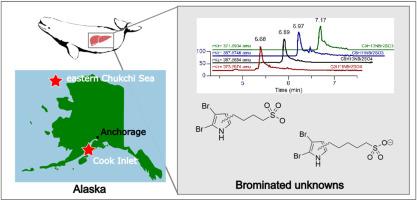
In 2011, 68 archived beluga whale (Delphinapterus leucas) liver samples collected from Cook Inlet and the eastern Chukchi Sea from 1989 to 2006 were characterized for 12 per- and polyfluoroalkyl substances (PFAS) using targeted mass spectroscopy (MS) methods; however, at the time of the original analysis, high resolution MS (HRMS) methods were not readily available. This follow-up study utilizes both targeted as well as cutting-edge HRMS non-targeted analysis (NTA) techniques to screen for additional PFAS as well as potential contaminants of emerging concern (CECs) in the chemical space under investigation. Targeted analysis detected perfluorodecanesulfonic acid (PFDS) and perfluoroheptane sulfonic acid (PFHpS) in 10 % and 9 % of liver samples, respectively. PFDS detections were observed only in Cook Inlet whales while PFHpS was detected in whales from both locations. In addition, NTA identified four dibrominated pyrrole ring structures two with a sulfate (C8H11NBr2SO3, and C9H13NBr2SO3, Schymanski level 3), and two with either a sulfonate or a sulfate and hydroxy group (C8H11NBr2SO4, C9H13NBr2SO4, Schymanski level 4) in whales from the eastern Chukchi Sea. Literature search reveals similar brominated metabolites from marine bacteria, sponges, and other marine organisms, suggesting the brominated CECs are of marine origin.
期刊介绍:
Chemosphere, being an international multidisciplinary journal, is dedicated to publishing original communications and review articles on chemicals in the environment. The scope covers a wide range of topics, including the identification, quantification, behavior, fate, toxicology, treatment, and remediation of chemicals in the bio-, hydro-, litho-, and atmosphere, ensuring the broad dissemination of research in this field.



 京公网安备 11010802042870号
京ICP备2023020795号-1
京公网安备 11010802042870号
京ICP备2023020795号-1

 分享
分享
 求助内容:
求助内容: 应助结果提醒方式:
 扫码关注我们
