Yeping Xie , Jiayu Tan , Shijian Fang , Zhuo Zheng , Lei Yao , Yang Xu , Jian Li , Yinghong Chen , Ning Chen , Li Li
{"title":"Highly toughening of PLLA-Based micropart via stretching induced stereocomplex crystal microstructure evolution","authors":"Yeping Xie , Jiayu Tan , Shijian Fang , Zhuo Zheng , Lei Yao , Yang Xu , Jian Li , Yinghong Chen , Ning Chen , Li Li","doi":"10.1016/j.matdes.2025.113862","DOIUrl":null,"url":null,"abstract":"<div><div>Polylactic acid (PLA) holds great potentials in biomedical applications, but its inherent brittleness restricts its versatility to a considerable degree. This study proposed a novel and heterogeneous modifier-free approach to enhance PLA’s toughness by leveraging the stretching induced evolution of stereocomplex crystal (SC) microstructures <em>in situ</em> formed during microinjection molding. By incorporating 10 wt% poly(D-lactic acid) (PDLA) into poly(L-lactic acid) (PLLA) through combining melt compounding and microinjection molding featuring extremely intense shear, we achieved a remarkable 10-fold increase in elongation at break (from 8.7 % to 87.2 %) while maintaining tensile strength (∼67 MPa). The structural analyses revealed a transition from phase-separated sea-island morphologies to deformable stereocomplex crystal PLA phase domains, which could serve as the physical crosslinking points facilitating stress transfer, and can be transformed into microfibril and shish-kebab structures upon drawing. Such the phase structure evolution could efficiently distribute stress and hence enhance toughness without sacrificing biodegradability or biocompatibility. This work develops a streamlined approach in simplifying conventional stereocomplex reinforcement strategies and thus offers a scalable method for developing fully biodegradable, and high-performance PLA-based materials suitable for diverse biomedical applications, such as bone tissue reconstruction.</div></div>","PeriodicalId":383,"journal":{"name":"Materials & Design","volume":"253 ","pages":"Article 113862"},"PeriodicalIF":7.9000,"publicationDate":"2025-03-26","publicationTypes":"Journal Article","fieldsOfStudy":null,"isOpenAccess":false,"openAccessPdf":"","citationCount":"0","resultStr":null,"platform":"Semanticscholar","paperid":null,"PeriodicalName":"Materials & Design","FirstCategoryId":"88","ListUrlMain":"https://www.sciencedirect.com/science/article/pii/S0264127525002825","RegionNum":2,"RegionCategory":"材料科学","ArticlePicture":[],"TitleCN":null,"AbstractTextCN":null,"PMCID":null,"EPubDate":"","PubModel":"","JCR":"Q1","JCRName":"MATERIALS SCIENCE, MULTIDISCIPLINARY","Score":null,"Total":0}
引用次数: 0
Abstract
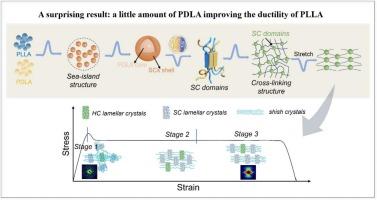
Polylactic acid (PLA) holds great potentials in biomedical applications, but its inherent brittleness restricts its versatility to a considerable degree. This study proposed a novel and heterogeneous modifier-free approach to enhance PLA’s toughness by leveraging the stretching induced evolution of stereocomplex crystal (SC) microstructures in situ formed during microinjection molding. By incorporating 10 wt% poly(D-lactic acid) (PDLA) into poly(L-lactic acid) (PLLA) through combining melt compounding and microinjection molding featuring extremely intense shear, we achieved a remarkable 10-fold increase in elongation at break (from 8.7 % to 87.2 %) while maintaining tensile strength (∼67 MPa). The structural analyses revealed a transition from phase-separated sea-island morphologies to deformable stereocomplex crystal PLA phase domains, which could serve as the physical crosslinking points facilitating stress transfer, and can be transformed into microfibril and shish-kebab structures upon drawing. Such the phase structure evolution could efficiently distribute stress and hence enhance toughness without sacrificing biodegradability or biocompatibility. This work develops a streamlined approach in simplifying conventional stereocomplex reinforcement strategies and thus offers a scalable method for developing fully biodegradable, and high-performance PLA-based materials suitable for diverse biomedical applications, such as bone tissue reconstruction.
期刊介绍:
Materials and Design is a multi-disciplinary journal that publishes original research reports, review articles, and express communications. The journal focuses on studying the structure and properties of inorganic and organic materials, advancements in synthesis, processing, characterization, and testing, the design of materials and engineering systems, and their applications in technology. It aims to bring together various aspects of materials science, engineering, physics, and chemistry.
The journal explores themes ranging from materials to design and aims to reveal the connections between natural and artificial materials, as well as experiment and modeling. Manuscripts submitted to Materials and Design should contain elements of discovery and surprise, as they often contribute new insights into the architecture and function of matter.



 京公网安备 11010802042870号
京ICP备2023020795号-1
京公网安备 11010802042870号
京ICP备2023020795号-1

 分享
分享
 求助内容:
求助内容: 应助结果提醒方式:
 扫码关注我们
