{"title":"Effect of magnetron sputtering Nb coating on fretting corrosion resistance of biomedical Ti6Al4V alloy","authors":"Zhangyue Qin , Xiaogang Zhang , Yali Zhang , Zhongmin Jin","doi":"10.1016/j.surfcoat.2025.132086","DOIUrl":null,"url":null,"abstract":"<div><div>By utilizing magnetron sputtering coating technology, a Nb coating was prepared on the surface of the Ti6Al4V substrate, and the basic properties of the Nb coating were thoroughly investigated. The Nb coating exhibited a dense structure, uniform elemental distribution, low surface roughness, good film quality, high adhesion strength between the coating and the substrate, and enhanced the microhardness of the Ti6Al4V alloy surface. Subsequently, fretting corrosion experiments were conducted to comprehensively analyze the influence of the Nb coating on the fretting corrosion characteristics of the Ti6Al4V substrate. The Nb coating significantly improved the fretting corrosion resistance of the Ti6Al4V alloy. Specifically, the introduction of the Nb coating reduced the tangential force, friction coefficient, total fretting energy, and frictional dissipation energy at the contact interface during the fretting process, thereby improving the fretting running characteristic of the Ti6Al4V alloy. Simultaneously, the Nb coating reduced the wear depth and wear volume of the Ti6Al4V alloy surface, altered the fretting damage features and mechanisms of the Ti6Al4V substrate surface, and enhanced the wear resistance of the material surface. Additionally, the Nb coating increased the open circuit potential and corrosion potential of the Ti6Al4V substrate, decreased the variation in open circuit potential (OCP) and corrosion current, thereby enhancing the corrosion resistance of the material surface.</div></div>","PeriodicalId":22009,"journal":{"name":"Surface & Coatings Technology","volume":"505 ","pages":"Article 132086"},"PeriodicalIF":6.1000,"publicationDate":"2025-03-26","publicationTypes":"Journal Article","fieldsOfStudy":null,"isOpenAccess":false,"openAccessPdf":"","citationCount":"0","resultStr":null,"platform":"Semanticscholar","paperid":null,"PeriodicalName":"Surface & Coatings Technology","FirstCategoryId":"88","ListUrlMain":"https://www.sciencedirect.com/science/article/pii/S0257897225003603","RegionNum":2,"RegionCategory":"材料科学","ArticlePicture":[],"TitleCN":null,"AbstractTextCN":null,"PMCID":null,"EPubDate":"","PubModel":"","JCR":"Q1","JCRName":"MATERIALS SCIENCE, COATINGS & FILMS","Score":null,"Total":0}
引用次数: 0
Abstract
By utilizing magnetron sputtering coating technology, a Nb coating was prepared on the surface of the Ti6Al4V substrate, and the basic properties of the Nb coating were thoroughly investigated. The Nb coating exhibited a dense structure, uniform elemental distribution, low surface roughness, good film quality, high adhesion strength between the coating and the substrate, and enhanced the microhardness of the Ti6Al4V alloy surface. Subsequently, fretting corrosion experiments were conducted to comprehensively analyze the influence of the Nb coating on the fretting corrosion characteristics of the Ti6Al4V substrate. The Nb coating significantly improved the fretting corrosion resistance of the Ti6Al4V alloy. Specifically, the introduction of the Nb coating reduced the tangential force, friction coefficient, total fretting energy, and frictional dissipation energy at the contact interface during the fretting process, thereby improving the fretting running characteristic of the Ti6Al4V alloy. Simultaneously, the Nb coating reduced the wear depth and wear volume of the Ti6Al4V alloy surface, altered the fretting damage features and mechanisms of the Ti6Al4V substrate surface, and enhanced the wear resistance of the material surface. Additionally, the Nb coating increased the open circuit potential and corrosion potential of the Ti6Al4V substrate, decreased the variation in open circuit potential (OCP) and corrosion current, thereby enhancing the corrosion resistance of the material surface.
期刊介绍:
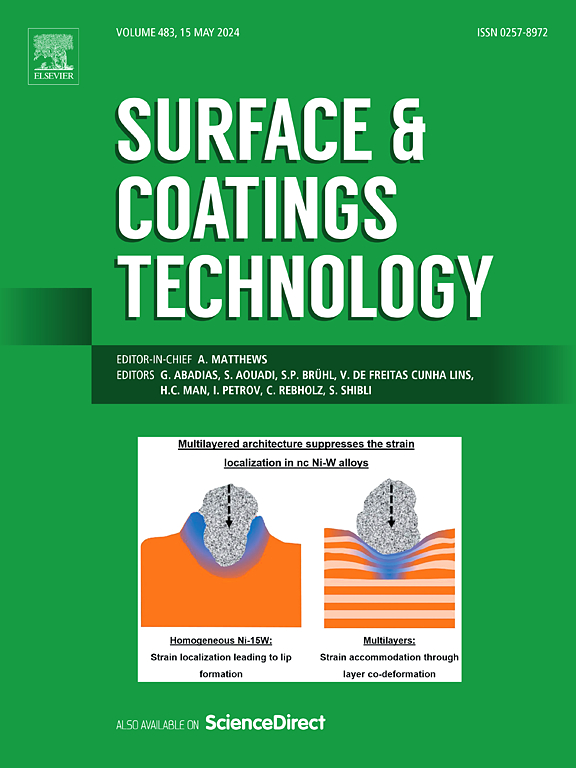
Surface and Coatings Technology is an international archival journal publishing scientific papers on significant developments in surface and interface engineering to modify and improve the surface properties of materials for protection in demanding contact conditions or aggressive environments, or for enhanced functional performance. Contributions range from original scientific articles concerned with fundamental and applied aspects of research or direct applications of metallic, inorganic, organic and composite coatings, to invited reviews of current technology in specific areas. Papers submitted to this journal are expected to be in line with the following aspects in processes, and properties/performance:
A. Processes: Physical and chemical vapour deposition techniques, thermal and plasma spraying, surface modification by directed energy techniques such as ion, electron and laser beams, thermo-chemical treatment, wet chemical and electrochemical processes such as plating, sol-gel coating, anodization, plasma electrolytic oxidation, etc., but excluding painting.
B. Properties/performance: friction performance, wear resistance (e.g., abrasion, erosion, fretting, etc), corrosion and oxidation resistance, thermal protection, diffusion resistance, hydrophilicity/hydrophobicity, and properties relevant to smart materials behaviour and enhanced multifunctional performance for environmental, energy and medical applications, but excluding device aspects.



 京公网安备 11010802042870号
京ICP备2023020795号-1
京公网安备 11010802042870号
京ICP备2023020795号-1

 分享
分享
 求助内容:
求助内容: 应助结果提醒方式:
 扫码关注我们
