{"title":"Simultaneous migration mechanism of Co-O couple toward spinel-like Co3O4 formation on LixCoO2 surfaces","authors":"Huu Duc Luong , Zizhen Zhou , Yoshitaka Tateyama","doi":"10.1016/j.jpowsour.2025.236854","DOIUrl":null,"url":null,"abstract":"<div><div>Degradation of battery cathode has been a crucial issue for battery durability. For Li<sub><em>x</em></sub>CoO<sub>2</sub>, a representative cathode material, the formation of harmful Co<sub>3</sub>O<sub>4</sub> spinel with Li deficiency induces capacity fading, resistivity increase, and safety concerns. Such degradation mode is usually initiated by the surface, whereas the role of surface O-ion migration on Co<sub>3</sub>O<sub>4</sub> formation is an open question. Herein, we analyze the initial processes of the Co<sub>3</sub>O<sub>4</sub> spinel formation, including O vacancy dynamics and Co-ion migration on representative surfaces (003), (104), and (110). We demonstrate that the O-ions migrate concurrently with Co-ion migration, accelerating the latter on the surfaces and playing a crucial role in the mechanism of Co<sub>3</sub>O<sub>4</sub> formation. Overall, it is confirmed that capturing the O-ions from surfaces is key to preventing Co<sub>3</sub>O<sub>4</sub> formation. To verify this, we examined the coating layer effect by using Li<sub>0.25</sub>CoO<sub>2</sub>||Li<sub>3</sub>NbO<sub>4</sub> as a test model and found that the formation energy of O vacancy at the contact becomes comparable to that obtained within the bulk structure Li<sub><em>x</em></sub>CoO<sub>2</sub>, indicating that effective suppression of the cathode surface degradation is another role of the coating layer in addition to suppressing solid electrolyte oxidation.</div></div>","PeriodicalId":377,"journal":{"name":"Journal of Power Sources","volume":"641 ","pages":"Article 236854"},"PeriodicalIF":7.9000,"publicationDate":"2025-06-15","publicationTypes":"Journal Article","fieldsOfStudy":null,"isOpenAccess":false,"openAccessPdf":"","citationCount":"0","resultStr":null,"platform":"Semanticscholar","paperid":null,"PeriodicalName":"Journal of Power Sources","FirstCategoryId":"5","ListUrlMain":"https://www.sciencedirect.com/science/article/pii/S0378775325006901","RegionNum":2,"RegionCategory":"工程技术","ArticlePicture":[],"TitleCN":null,"AbstractTextCN":null,"PMCID":null,"EPubDate":"2025/3/29 0:00:00","PubModel":"Epub","JCR":"Q1","JCRName":"CHEMISTRY, PHYSICAL","Score":null,"Total":0}
引用次数: 0
Abstract
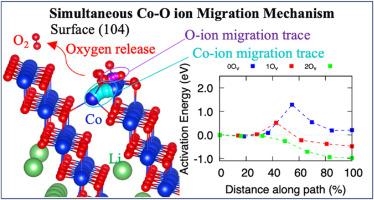
Degradation of battery cathode has been a crucial issue for battery durability. For LixCoO2, a representative cathode material, the formation of harmful Co3O4 spinel with Li deficiency induces capacity fading, resistivity increase, and safety concerns. Such degradation mode is usually initiated by the surface, whereas the role of surface O-ion migration on Co3O4 formation is an open question. Herein, we analyze the initial processes of the Co3O4 spinel formation, including O vacancy dynamics and Co-ion migration on representative surfaces (003), (104), and (110). We demonstrate that the O-ions migrate concurrently with Co-ion migration, accelerating the latter on the surfaces and playing a crucial role in the mechanism of Co3O4 formation. Overall, it is confirmed that capturing the O-ions from surfaces is key to preventing Co3O4 formation. To verify this, we examined the coating layer effect by using Li0.25CoO2||Li3NbO4 as a test model and found that the formation energy of O vacancy at the contact becomes comparable to that obtained within the bulk structure LixCoO2, indicating that effective suppression of the cathode surface degradation is another role of the coating layer in addition to suppressing solid electrolyte oxidation.
期刊介绍:
The Journal of Power Sources is a publication catering to researchers and technologists interested in various aspects of the science, technology, and applications of electrochemical power sources. It covers original research and reviews on primary and secondary batteries, fuel cells, supercapacitors, and photo-electrochemical cells.
Topics considered include the research, development and applications of nanomaterials and novel componentry for these devices. Examples of applications of these electrochemical power sources include:
• Portable electronics
• Electric and Hybrid Electric Vehicles
• Uninterruptible Power Supply (UPS) systems
• Storage of renewable energy
• Satellites and deep space probes
• Boats and ships, drones and aircrafts
• Wearable energy storage systems



 京公网安备 11010802042870号
京ICP备2023020795号-1
京公网安备 11010802042870号
京ICP备2023020795号-1

 分享
分享
 求助内容:
求助内容: 应助结果提醒方式:
 扫码关注我们
