Characteristics, outcome, and prognostic factors of young patients with central nervous system World Health Organization grade 3 oligodendrogliomas IDH-mutant and 1p/19q codeleted: A French POLA network study
Alexandre Bertucci MD, Ondine Dufour MD, Romain Appay MD, PhD, Vincent Harlay MD, François Ducray MD, PhD, Charlotte Bronnimann MD, Apolline Djelad MD, Elisabeth Cohen-Jonathan Moyal MD, PhD, Mario Campone MD, Olivier Langlois MD, Mathilde Ducloie MD, Elodie Vauleon MD, Nadia Younan MD, Christine Desenclos MD, Carole Ramirez MD, Mehdi Touat MD, PhD, Ahmed Idbaih MD, Céline Bequet, Dominique Figarella-Branger MD, PhD, Caroline Dehais MD, Olivier Chinot MD, Emeline Tabouret MD, PhD, for the POLA network
{"title":"Characteristics, outcome, and prognostic factors of young patients with central nervous system World Health Organization grade 3 oligodendrogliomas IDH-mutant and 1p/19q codeleted: A French POLA network study","authors":"Alexandre Bertucci MD, Ondine Dufour MD, Romain Appay MD, PhD, Vincent Harlay MD, François Ducray MD, PhD, Charlotte Bronnimann MD, Apolline Djelad MD, Elisabeth Cohen-Jonathan Moyal MD, PhD, Mario Campone MD, Olivier Langlois MD, Mathilde Ducloie MD, Elodie Vauleon MD, Nadia Younan MD, Christine Desenclos MD, Carole Ramirez MD, Mehdi Touat MD, PhD, Ahmed Idbaih MD, Céline Bequet, Dominique Figarella-Branger MD, PhD, Caroline Dehais MD, Olivier Chinot MD, Emeline Tabouret MD, PhD, for the POLA network","doi":"10.1002/cncr.35814","DOIUrl":null,"url":null,"abstract":"<div>\n \n \n <section>\n \n <h3> Background</h3>\n \n <p>Brain tumors represent one of the main causes of cancer-related mortality in young patients. Among them, oligodendrogliomas (OG) are adult-type diffuse gliomas with the best prognosis. Nevertheless, characterization of these tumors in the young population remains poorly documented. Our objective was to characterize the population of young adults under 40 years of age with grade 3 OG in the POLA cohort.</p>\n </section>\n \n <section>\n \n <h3> Methods</h3>\n \n <p>Clinical data prospectively collected for all patients registered with grade 3 OG between April 2009 and August 2021 were extracted from the national POLA database. This study compared the patient subgroup <40 years of age to the one >40 years of age.</p>\n </section>\n \n <section>\n \n <h3> Results</h3>\n \n <p>The authors included 111 patients <40 years old and 363 patients ≥40 years old. Treatment received did not differ significantly between the two subgroups. Temporal location was more frequent in older patients (<i>p</i> = .009). Patients <40 years old presented more often seizure as initial symptom (<i>p</i> = .003). They had less frequent chromosome 9p loss (<i>p</i> < .001) and less <i>CDKN2A</i> homozygous deletion (<i>p</i> = .024). Median progression-free survival (PFS) was 123 months (range, 86–not reached [NR]) versus 88 months (range, 67–117) (<i>p</i> = .082) and median overall survival (OS) was not reached (range, 147–NR) versus 163 months (range, 137–NR) (<i>p</i> < .001) in younger and older subgroups, respectively. In multivariate analysis, complete or subtotal resection (<i>p</i> = .014) and seizure at diagnosis (<i>p</i> = .032) were associated with better OS.</p>\n </section>\n \n <section>\n \n <h3> Conclusion</h3>\n \n <p>Young patients with grade 3 OG have distinct clinical presentation, molecular features, and outcomes compared to the older patients.</p>\n </section>\n </div>","PeriodicalId":138,"journal":{"name":"Cancer","volume":"131 7","pages":""},"PeriodicalIF":5.1000,"publicationDate":"2025-03-30","publicationTypes":"Journal Article","fieldsOfStudy":null,"isOpenAccess":false,"openAccessPdf":"https://onlinelibrary.wiley.com/doi/epdf/10.1002/cncr.35814","citationCount":"0","resultStr":null,"platform":"Semanticscholar","paperid":null,"PeriodicalName":"Cancer","FirstCategoryId":"3","ListUrlMain":"https://acsjournals.onlinelibrary.wiley.com/doi/10.1002/cncr.35814","RegionNum":2,"RegionCategory":"医学","ArticlePicture":[],"TitleCN":null,"AbstractTextCN":null,"PMCID":null,"EPubDate":"","PubModel":"","JCR":"Q1","JCRName":"ONCOLOGY","Score":null,"Total":0}
引用次数: 0
Abstract
Background
Brain tumors represent one of the main causes of cancer-related mortality in young patients. Among them, oligodendrogliomas (OG) are adult-type diffuse gliomas with the best prognosis. Nevertheless, characterization of these tumors in the young population remains poorly documented. Our objective was to characterize the population of young adults under 40 years of age with grade 3 OG in the POLA cohort.
Methods
Clinical data prospectively collected for all patients registered with grade 3 OG between April 2009 and August 2021 were extracted from the national POLA database. This study compared the patient subgroup <40 years of age to the one >40 years of age.
Results
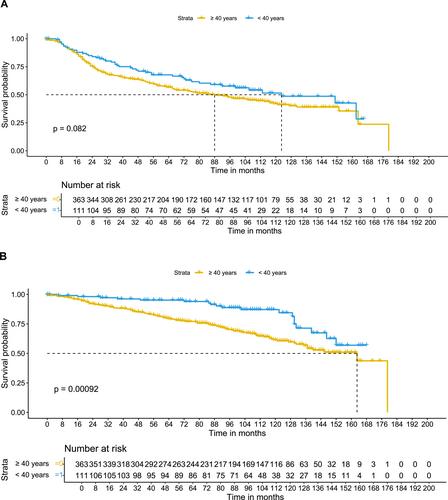
The authors included 111 patients <40 years old and 363 patients ≥40 years old. Treatment received did not differ significantly between the two subgroups. Temporal location was more frequent in older patients (p = .009). Patients <40 years old presented more often seizure as initial symptom (p = .003). They had less frequent chromosome 9p loss (p < .001) and less CDKN2A homozygous deletion (p = .024). Median progression-free survival (PFS) was 123 months (range, 86–not reached [NR]) versus 88 months (range, 67–117) (p = .082) and median overall survival (OS) was not reached (range, 147–NR) versus 163 months (range, 137–NR) (p < .001) in younger and older subgroups, respectively. In multivariate analysis, complete or subtotal resection (p = .014) and seizure at diagnosis (p = .032) were associated with better OS.
Conclusion
Young patients with grade 3 OG have distinct clinical presentation, molecular features, and outcomes compared to the older patients.
期刊介绍:
The CANCER site is a full-text, electronic implementation of CANCER, an Interdisciplinary International Journal of the American Cancer Society, and CANCER CYTOPATHOLOGY, a Journal of the American Cancer Society.
CANCER publishes interdisciplinary oncologic information according to, but not limited to, the following disease sites and disciplines: blood/bone marrow; breast disease; endocrine disorders; epidemiology; gastrointestinal tract; genitourinary disease; gynecologic oncology; head and neck disease; hepatobiliary tract; integrated medicine; lung disease; medical oncology; neuro-oncology; pathology radiation oncology; translational research





 京公网安备 11010802042870号
京ICP备2023020795号-1
京公网安备 11010802042870号
京ICP备2023020795号-1

 分享
分享
 求助内容:
求助内容: 应助结果提醒方式:
 扫码关注我们
