Bin Li, Xiao Meng Yang, Xiong Ming Zhou, Yuan Qing Huang
{"title":"Effect of pyrroloquinoline quinone on skin aging in Bmi-1 KO mice and underlying mechanisms.","authors":"Bin Li, Xiao Meng Yang, Xiong Ming Zhou, Yuan Qing Huang","doi":"10.1371/journal.pone.0319770","DOIUrl":null,"url":null,"abstract":"<p><p>To investigate the effect of pyrroloquinoline quinone (PQQ) on skin aging in the Bmi-1 KO mice and its underlying mechanisms, we administered a normal diet to both Wild type mice (WT) and Bmi-1 KO mice, while supplementing the diet of Bmi-1 KO mice with PQQ (PQQ+Bmi-1 KO). Subsequently, we compared the thickness of the skin epidermis, dermis, pilosebaceous unit and collagen ratio using HE staining and Masson's trichrome. Additionally, immunohistochemical staining, Western blotting and electron microscopy were applied across all three groups. The results revealed that Bmi-1 KO mice exhibited premature aging phenotypes compared to the WT group; however, PQQ administration effectively delayed premature aging in Bmi-1 KO mice. Furthermore, reduced epidermal thickness, dermal thickness, pilosebaceous units count as well as collagen ratio were observed in Bmi-1 KO mice. Moreover, the PCNA positive cell percentage also decreased in Bmi-1 KO mice. Conversely, treatment with PQQ significantly increased epidermal thickness, dermal thickness, pilosebaceous unit count, collagen ratio and PCNA positive cell percentage when compared to Bmi-1 KO mice. In order to further investigate the anti-aging mechanism of PQQ, experiments have revealed that PQQ effectively suppressed the expression of cell cycle proteins p16, p19, and p53 in Bmi-1 KO mice. In addition, autophagy-related experiments demonstrated that compared to the WT group, Bmi-1 KO mice exhibited an increased number of autophagosomes along with decreased expression of Beclin-1 and LC3Ⅱ/LC3Ⅰratio, and increased expression of p62. However, supplementation with PQQ resulted in a reduction in the number of autophagosomes while increasing the expression of Beclin-1 and LC3Ⅱ/LC3Ⅰratio and decreasing the expression of p62. This study provides evidence that downregulation of Bmi-1 promotes skin aging, whereas PQQ delays skin aging in Bmi-1 KO mice by promoting cell proliferation, inhibiting the expression of p16, p19 and p53 and enhancing autophagy levels.</p>","PeriodicalId":20189,"journal":{"name":"PLoS ONE","volume":"20 3","pages":"e0319770"},"PeriodicalIF":2.6000,"publicationDate":"2025-03-28","publicationTypes":"Journal Article","fieldsOfStudy":null,"isOpenAccess":false,"openAccessPdf":"https://www.ncbi.nlm.nih.gov/pmc/articles/PMC11952206/pdf/","citationCount":"0","resultStr":null,"platform":"Semanticscholar","paperid":null,"PeriodicalName":"PLoS ONE","FirstCategoryId":"103","ListUrlMain":"https://doi.org/10.1371/journal.pone.0319770","RegionNum":3,"RegionCategory":"综合性期刊","ArticlePicture":[],"TitleCN":null,"AbstractTextCN":null,"PMCID":null,"EPubDate":"2025/1/1 0:00:00","PubModel":"eCollection","JCR":"Q1","JCRName":"MULTIDISCIPLINARY SCIENCES","Score":null,"Total":0}
引用次数: 0
Abstract
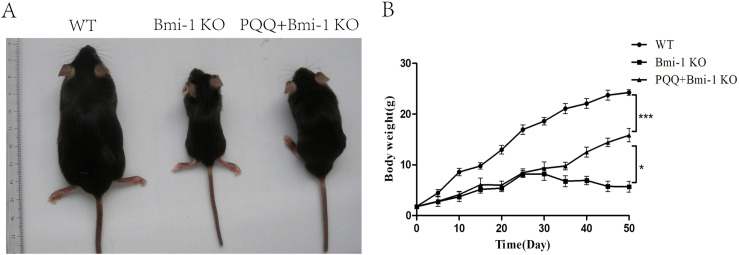
To investigate the effect of pyrroloquinoline quinone (PQQ) on skin aging in the Bmi-1 KO mice and its underlying mechanisms, we administered a normal diet to both Wild type mice (WT) and Bmi-1 KO mice, while supplementing the diet of Bmi-1 KO mice with PQQ (PQQ+Bmi-1 KO). Subsequently, we compared the thickness of the skin epidermis, dermis, pilosebaceous unit and collagen ratio using HE staining and Masson's trichrome. Additionally, immunohistochemical staining, Western blotting and electron microscopy were applied across all three groups. The results revealed that Bmi-1 KO mice exhibited premature aging phenotypes compared to the WT group; however, PQQ administration effectively delayed premature aging in Bmi-1 KO mice. Furthermore, reduced epidermal thickness, dermal thickness, pilosebaceous units count as well as collagen ratio were observed in Bmi-1 KO mice. Moreover, the PCNA positive cell percentage also decreased in Bmi-1 KO mice. Conversely, treatment with PQQ significantly increased epidermal thickness, dermal thickness, pilosebaceous unit count, collagen ratio and PCNA positive cell percentage when compared to Bmi-1 KO mice. In order to further investigate the anti-aging mechanism of PQQ, experiments have revealed that PQQ effectively suppressed the expression of cell cycle proteins p16, p19, and p53 in Bmi-1 KO mice. In addition, autophagy-related experiments demonstrated that compared to the WT group, Bmi-1 KO mice exhibited an increased number of autophagosomes along with decreased expression of Beclin-1 and LC3Ⅱ/LC3Ⅰratio, and increased expression of p62. However, supplementation with PQQ resulted in a reduction in the number of autophagosomes while increasing the expression of Beclin-1 and LC3Ⅱ/LC3Ⅰratio and decreasing the expression of p62. This study provides evidence that downregulation of Bmi-1 promotes skin aging, whereas PQQ delays skin aging in Bmi-1 KO mice by promoting cell proliferation, inhibiting the expression of p16, p19 and p53 and enhancing autophagy levels.
期刊介绍:
PLOS ONE is an international, peer-reviewed, open-access, online publication. PLOS ONE welcomes reports on primary research from any scientific discipline. It provides:
* Open-access—freely accessible online, authors retain copyright
* Fast publication times
* Peer review by expert, practicing researchers
* Post-publication tools to indicate quality and impact
* Community-based dialogue on articles
* Worldwide media coverage





 京公网安备 11010802042870号
京ICP备2023020795号-1
京公网安备 11010802042870号
京ICP备2023020795号-1

 分享
分享
 求助内容:
求助内容: 应助结果提醒方式:
 扫码关注我们
