Personalized mHealth Intervention (StepAdd) for Increasing Physical Activity in Japanese Patients With Type 2 Diabetes: Secondary Analysis of Social Cognitive Theory Measurements of a Single-Arm Pilot Study.
{"title":"Personalized mHealth Intervention (StepAdd) for Increasing Physical Activity in Japanese Patients With Type 2 Diabetes: Secondary Analysis of Social Cognitive Theory Measurements of a Single-Arm Pilot Study.","authors":"Kayo Waki, Syunpei Enomoto, Toshimasa Yamauchi, Masaomi Nangaku, Kazuhiko Ohe","doi":"10.2196/60221","DOIUrl":null,"url":null,"abstract":"<p><strong>Background: </strong>A 12-week pilot of the StepAdd mobile health (mHealth) behavior change intervention based on social cognitive theory (SCT) saw an 86.7% increase in mean daily step counts among patients with type 2 diabetes. Due to the lack of exploration of theoretical implications in mHealth intervention studies, there is a need to understand the mechanism underlying the behavioral change to inform the future design of digital therapeutics.</p><p><strong>Objective: </strong>This study aimed to examine the SCT drivers underlying the mean increase in exercise among Japanese patients with type 2 diabetes who participated in the StepAdd intervention.</p><p><strong>Methods: </strong>This is a post hoc analysis of data collected in the single-arm pilot study of the 32 patients who completed the StepAdd intervention. The StepAdd app uses self-mastery and coping strategies to increase self-efficacy and thus increase walking. Self-mastery was measured by the goal completion (GC) rate, which is the percentage of days in which patients met these adapting goals. The use of coping strategies was measured by the strategy implementation (SI) rate, which is the percentage of days in which patients applied their selected coping strategies. We assessed correlations between GC, SI, and self-efficacy to increase walking via linear regression and analyzed relationships via structural equation modeling.</p><p><strong>Results: </strong>We found statistically significant support for the SCT approach, including a correlation coefficient (ρ) of 0.649 between step increase and GC rate (P<.001); a ρ of 0.497 between the coping SI rate and self-efficacy increase (P=.004); a ρ of 0.446 between GC rate and self-mastery increase (P=.01); and a ρ of 0.355 between self-regulation increase and step increase (P=.046), giving us insight into why the behavior intervention succeeded. We also found significant correlations between self-efficacy for barriers and self-efficacy for task-specific behavior (ρ=0.358; P=.04), as well as self-regulation and self-efficacy for task-specific behavior (ρ=0.583; P<.001). However, a cross-lagged panel modeling analysis found no significant evidence that changes in self-efficacy preceded behavior changes in line with SCT.</p><p><strong>Conclusions: </strong>Self-mastery and coping strategies contributed to the walking behavior change in StepAdd, supporting the SCT model of behavior change. Future research is needed to better understand the causal pathways proposed by SCT.</p>","PeriodicalId":14841,"journal":{"name":"JMIR Formative Research","volume":"9 ","pages":"e60221"},"PeriodicalIF":2.0000,"publicationDate":"2025-03-28","publicationTypes":"Journal Article","fieldsOfStudy":null,"isOpenAccess":false,"openAccessPdf":"https://www.ncbi.nlm.nih.gov/pmc/articles/PMC11970563/pdf/","citationCount":"0","resultStr":null,"platform":"Semanticscholar","paperid":null,"PeriodicalName":"JMIR Formative Research","FirstCategoryId":"1085","ListUrlMain":"https://doi.org/10.2196/60221","RegionNum":0,"RegionCategory":null,"ArticlePicture":[],"TitleCN":null,"AbstractTextCN":null,"PMCID":null,"EPubDate":"","PubModel":"","JCR":"Q3","JCRName":"HEALTH CARE SCIENCES & SERVICES","Score":null,"Total":0}
引用次数: 0
Abstract
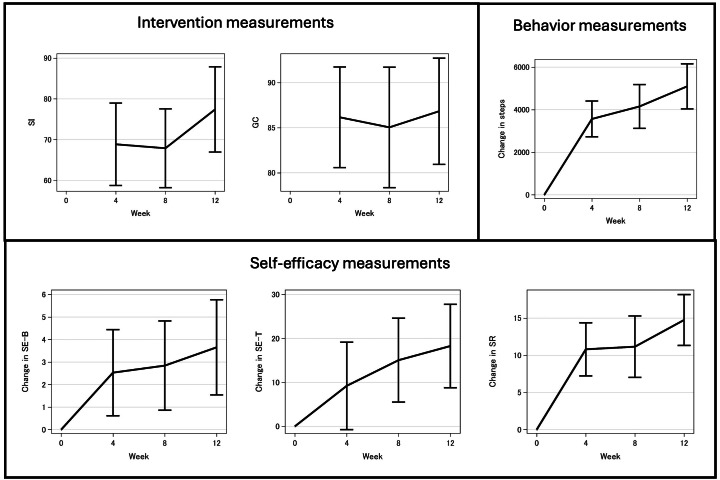
Background: A 12-week pilot of the StepAdd mobile health (mHealth) behavior change intervention based on social cognitive theory (SCT) saw an 86.7% increase in mean daily step counts among patients with type 2 diabetes. Due to the lack of exploration of theoretical implications in mHealth intervention studies, there is a need to understand the mechanism underlying the behavioral change to inform the future design of digital therapeutics.
Objective: This study aimed to examine the SCT drivers underlying the mean increase in exercise among Japanese patients with type 2 diabetes who participated in the StepAdd intervention.
Methods: This is a post hoc analysis of data collected in the single-arm pilot study of the 32 patients who completed the StepAdd intervention. The StepAdd app uses self-mastery and coping strategies to increase self-efficacy and thus increase walking. Self-mastery was measured by the goal completion (GC) rate, which is the percentage of days in which patients met these adapting goals. The use of coping strategies was measured by the strategy implementation (SI) rate, which is the percentage of days in which patients applied their selected coping strategies. We assessed correlations between GC, SI, and self-efficacy to increase walking via linear regression and analyzed relationships via structural equation modeling.
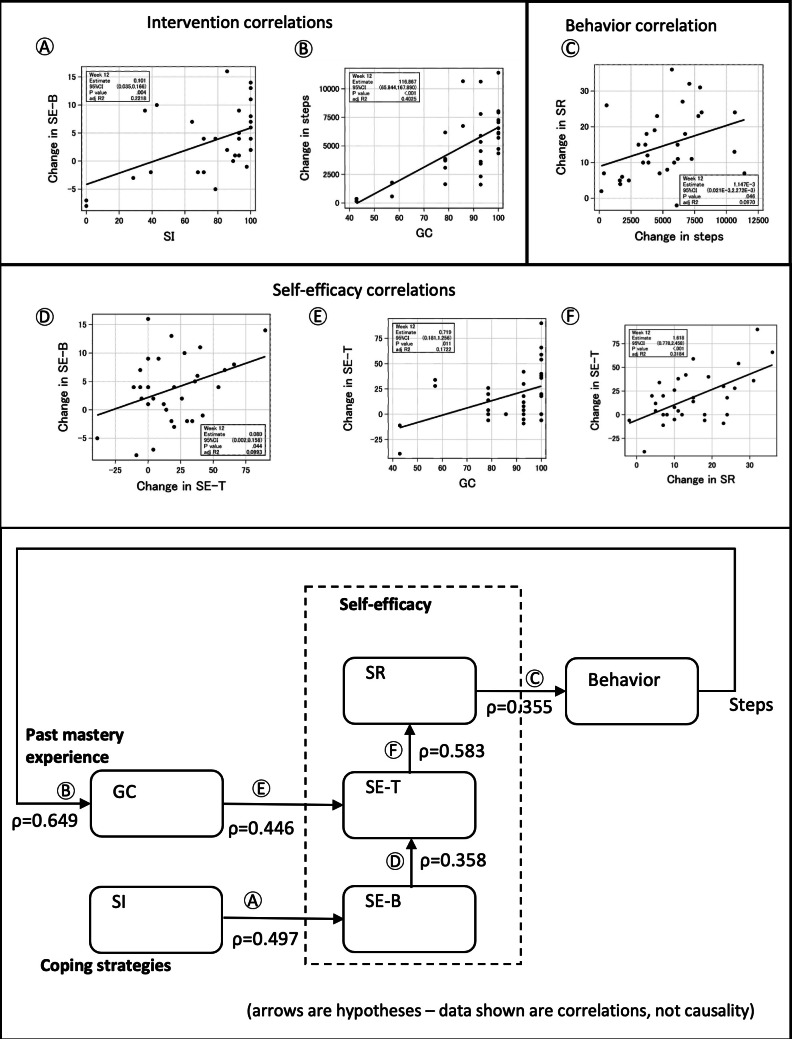
Results: We found statistically significant support for the SCT approach, including a correlation coefficient (ρ) of 0.649 between step increase and GC rate (P<.001); a ρ of 0.497 between the coping SI rate and self-efficacy increase (P=.004); a ρ of 0.446 between GC rate and self-mastery increase (P=.01); and a ρ of 0.355 between self-regulation increase and step increase (P=.046), giving us insight into why the behavior intervention succeeded. We also found significant correlations between self-efficacy for barriers and self-efficacy for task-specific behavior (ρ=0.358; P=.04), as well as self-regulation and self-efficacy for task-specific behavior (ρ=0.583; P<.001). However, a cross-lagged panel modeling analysis found no significant evidence that changes in self-efficacy preceded behavior changes in line with SCT.
Conclusions: Self-mastery and coping strategies contributed to the walking behavior change in StepAdd, supporting the SCT model of behavior change. Future research is needed to better understand the causal pathways proposed by SCT.




 京公网安备 11010802042870号
京ICP备2023020795号-1
京公网安备 11010802042870号
京ICP备2023020795号-1

 分享
分享
 求助内容:
求助内容: 应助结果提醒方式:
 扫码关注我们
