Alex F Martin, Louise E Smith, Samantha K Brooks, Madeline V Stein, Rachel Davies, Richard Amlôt, Neil Greenberg, Gideon James Rubin
{"title":"The impact of self-isolation on psychological wellbeing in adults and how to reduce it: A systematic review.","authors":"Alex F Martin, Louise E Smith, Samantha K Brooks, Madeline V Stein, Rachel Davies, Richard Amlôt, Neil Greenberg, Gideon James Rubin","doi":"10.1371/journal.pone.0310851","DOIUrl":null,"url":null,"abstract":"<p><strong>Objective: </strong>To synthesise evidence on the impact of self-isolation at home on the psychological and emotional wellbeing of adults in the general population during the COVID-19 pandemic.</p><p><strong>Methods: </strong>This systematic review was registered on PROSPERO (CRD42022378140). We searched Medline, PsycINFO, Web of Science, Embase, and grey literature. Wellbeing included adverse mental health outcomes and adaptive wellbeing. We followed PRISMA and synthesis without meta-analysis (SWiM) guidelines. We extracted data on the impact of self-isolation on wellbeing, and factors associated with and interventions targeting wellbeing during self-isolation.</p><p><strong>Results: </strong>Thirty-six studies were included. The mode quality rating was 'high-risk'. Depressive and anxiety symptoms were most investigated. Evidence for an impact of self-isolation on wellbeing was often inconsistent in quantitative studies, although qualitative studies consistently reported a negative impact. People with pre-existing mental and physical health needs reported increased symptoms of mental ill health during self-isolation. Studies reported modifiable stressors that have been reported in previous infectious disease contexts, such as inadequate support, poor coping strategies, inadequate and conflicting information, and highlighted the importance of regular contact from trusted healthcare professionals. Interventions targeting psychological wellbeing were rare and evaluative studies of these had high or very high risk of bias.</p><p><strong>Conclusion: </strong>When implementing self-isolation directives, public health officials should prioritise support for individuals who have pre-existing mental or physical health needs, lack support, or who are facing significant life stressors. Focus should be directed toward interventions that address loneliness, worries, and misinformation, whilst monitoring and identifying individuals in need of additional support.</p>","PeriodicalId":20189,"journal":{"name":"PLoS ONE","volume":"20 3","pages":"e0310851"},"PeriodicalIF":2.6000,"publicationDate":"2025-03-28","publicationTypes":"Journal Article","fieldsOfStudy":null,"isOpenAccess":false,"openAccessPdf":"https://www.ncbi.nlm.nih.gov/pmc/articles/PMC11952258/pdf/","citationCount":"0","resultStr":null,"platform":"Semanticscholar","paperid":null,"PeriodicalName":"PLoS ONE","FirstCategoryId":"103","ListUrlMain":"https://doi.org/10.1371/journal.pone.0310851","RegionNum":3,"RegionCategory":"综合性期刊","ArticlePicture":[],"TitleCN":null,"AbstractTextCN":null,"PMCID":null,"EPubDate":"2025/1/1 0:00:00","PubModel":"eCollection","JCR":"Q1","JCRName":"MULTIDISCIPLINARY SCIENCES","Score":null,"Total":0}
引用次数: 0
Abstract
Objective: To synthesise evidence on the impact of self-isolation at home on the psychological and emotional wellbeing of adults in the general population during the COVID-19 pandemic.
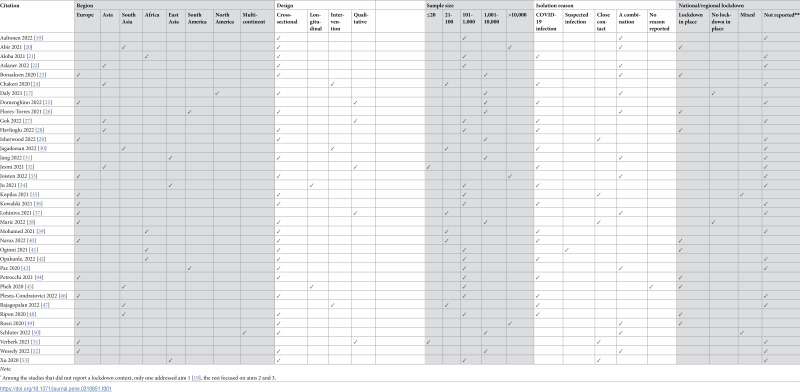
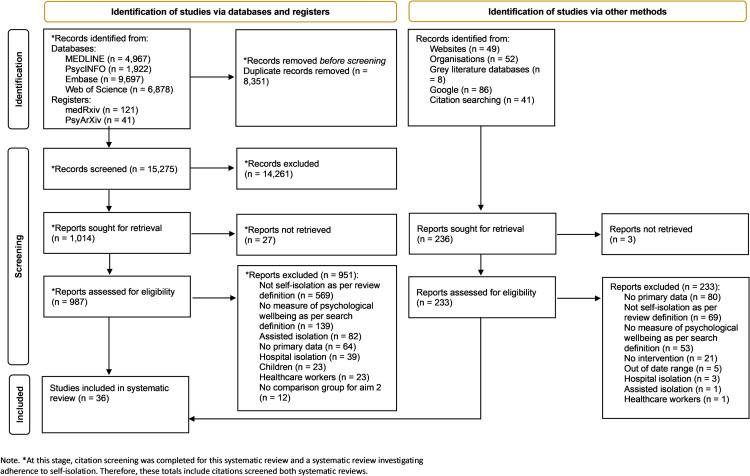
Methods: This systematic review was registered on PROSPERO (CRD42022378140). We searched Medline, PsycINFO, Web of Science, Embase, and grey literature. Wellbeing included adverse mental health outcomes and adaptive wellbeing. We followed PRISMA and synthesis without meta-analysis (SWiM) guidelines. We extracted data on the impact of self-isolation on wellbeing, and factors associated with and interventions targeting wellbeing during self-isolation.
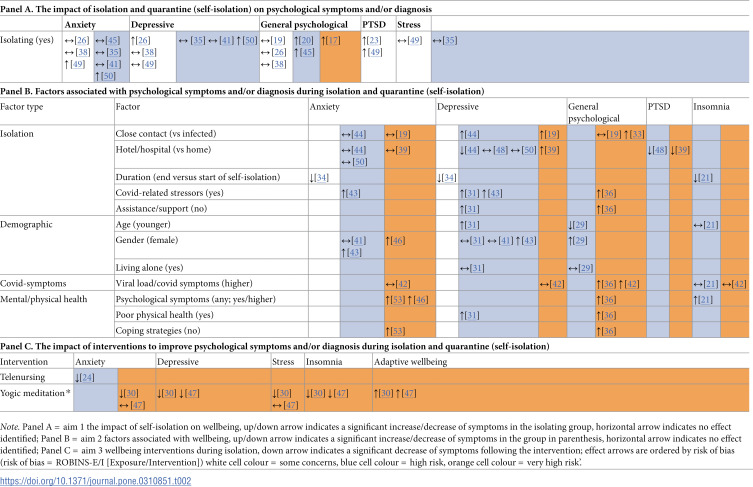
Results: Thirty-six studies were included. The mode quality rating was 'high-risk'. Depressive and anxiety symptoms were most investigated. Evidence for an impact of self-isolation on wellbeing was often inconsistent in quantitative studies, although qualitative studies consistently reported a negative impact. People with pre-existing mental and physical health needs reported increased symptoms of mental ill health during self-isolation. Studies reported modifiable stressors that have been reported in previous infectious disease contexts, such as inadequate support, poor coping strategies, inadequate and conflicting information, and highlighted the importance of regular contact from trusted healthcare professionals. Interventions targeting psychological wellbeing were rare and evaluative studies of these had high or very high risk of bias.
Conclusion: When implementing self-isolation directives, public health officials should prioritise support for individuals who have pre-existing mental or physical health needs, lack support, or who are facing significant life stressors. Focus should be directed toward interventions that address loneliness, worries, and misinformation, whilst monitoring and identifying individuals in need of additional support.
目的:综合新冠肺炎大流行期间居家自我隔离对普通人群心理和情绪健康影响的证据。方法:本系统评价在PROSPERO注册(CRD42022378140)。我们检索了Medline, PsycINFO, Web of Science, Embase和灰色文献。健康包括不良心理健康结果和适应性健康。我们遵循PRISMA和综合无荟萃分析(SWiM)指南。我们提取了有关自我隔离对幸福感影响的数据,以及与自我隔离期间的幸福感相关的因素和干预措施。结果:纳入36项研究。模式质量评级为“高风险”。抑郁和焦虑症状被调查最多。定量研究中关于自我隔离对幸福感影响的证据往往不一致,尽管定性研究一致报告了负面影响。先前有精神和身体健康需要的人报告说,在自我隔离期间,精神疾病症状增加。研究报告了在以前的传染病背景下报告的可改变的压力因素,如支持不足、应对策略差、信息不充分和相互矛盾,并强调了与可信赖的医疗保健专业人员定期联系的重要性。针对心理健康的干预措施很少,对这些干预的评估研究有很高或非常高的偏倚风险。结论:在实施自我隔离指令时,公共卫生官员应优先支持已有精神或身体健康需求、缺乏支持或面临重大生活压力的个人。重点应放在解决孤独、担忧和错误信息的干预措施上,同时监测和识别需要额外支持的个人。
期刊介绍:
PLOS ONE is an international, peer-reviewed, open-access, online publication. PLOS ONE welcomes reports on primary research from any scientific discipline. It provides:
* Open-access—freely accessible online, authors retain copyright
* Fast publication times
* Peer review by expert, practicing researchers
* Post-publication tools to indicate quality and impact
* Community-based dialogue on articles
* Worldwide media coverage



 京公网安备 11010802042870号
京ICP备2023020795号-1
京公网安备 11010802042870号
京ICP备2023020795号-1

 分享
分享
 求助内容:
求助内容: 应助结果提醒方式:
 扫码关注我们
