{"title":"Tuning the performance of Thin-Film nanocomposite forward osmosis membrane using ordered nanoporous silica (LUS-1) with different functional groups","authors":"Rozgol bonsale , Alireza Shakeri , Hasan Salehi , Reza Razavi , Zahra Bahmani , Alireza Badiei","doi":"10.1016/j.apsusc.2025.163007","DOIUrl":null,"url":null,"abstract":"<div><div>Ordered nanoporous silica materials (LUS-1) with three different functional groups (bare LUS-1, LUS-NH<sub>2</sub>: modified with amine groups, and LUS-TA: modified with tannic acid) were synthesized and used to fabricate thin-film nanocomposite (TFN) membranes using interfacial polymerization. The effect of functional groups and the quantity of LUS nanofiller on the physicochemical characteristics and separation performance of TFN membranes is investigated. During interfacial polymerization, organic and aqueous monomers can be absorbed into the porous structure of LUS, allowing polyamide to form within its pores. The polyamide chains extend and strongly bind with the polyamide matrix, resulting in a significant alteration of the membrane’s morphology. The findings show that all LUS-modified TFN membranes have higher water flux in the forward osmosis process than the unmodified membrane. The TFN membrane modified by 800 ppm LUS-TA exhibited a water flux of 21.7 LMH, which was higher than the membrane prepared by LUS-NH<sub>2</sub> and LUS-1 with a water flux of 20.1 and 18.1 LMH, respectively. This is because LUS-TA considerably slows the interfacial polymerization rate rather than LUS-1 and LUS-NH<sub>2</sub>, resulting in a porous and thin polyamide selective layer. In addition, the TFN membrane modified with LUS-TA presented a better antifouling ability than the one modified with LUS-1 and LUS-NH<sub>2</sub>, owing to its improved hydrophilicity and morphology. However, LUS-NH<sub>2</sub>-based TFN membranes presented higher heavy metal ion rejection than other TFN membranes since amine groups could participate in the interfacial polymerization reaction. In this study, a novel nanoporous material for modification of TFN-FO membrane was introduced, and a relationship between the functional groups of nanofiller and unique physicochemical properties and performance of modified membranes was established.</div></div>","PeriodicalId":247,"journal":{"name":"Applied Surface Science","volume":"698 ","pages":"Article 163007"},"PeriodicalIF":6.6000,"publicationDate":"2025-07-30","publicationTypes":"Journal Article","fieldsOfStudy":null,"isOpenAccess":false,"openAccessPdf":"","citationCount":"0","resultStr":null,"platform":"Semanticscholar","paperid":null,"PeriodicalName":"Applied Surface Science","FirstCategoryId":"88","ListUrlMain":"https://www.sciencedirect.com/science/article/pii/S0169433225007214","RegionNum":2,"RegionCategory":"材料科学","ArticlePicture":[],"TitleCN":null,"AbstractTextCN":null,"PMCID":null,"EPubDate":"2025/3/30 0:00:00","PubModel":"Epub","JCR":"Q2","JCRName":"CHEMISTRY, PHYSICAL","Score":null,"Total":0}
引用次数: 0
Abstract
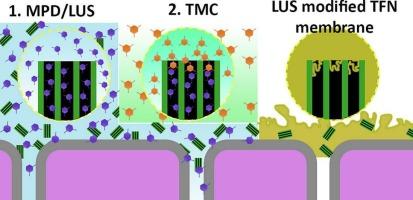
Ordered nanoporous silica materials (LUS-1) with three different functional groups (bare LUS-1, LUS-NH2: modified with amine groups, and LUS-TA: modified with tannic acid) were synthesized and used to fabricate thin-film nanocomposite (TFN) membranes using interfacial polymerization. The effect of functional groups and the quantity of LUS nanofiller on the physicochemical characteristics and separation performance of TFN membranes is investigated. During interfacial polymerization, organic and aqueous monomers can be absorbed into the porous structure of LUS, allowing polyamide to form within its pores. The polyamide chains extend and strongly bind with the polyamide matrix, resulting in a significant alteration of the membrane’s morphology. The findings show that all LUS-modified TFN membranes have higher water flux in the forward osmosis process than the unmodified membrane. The TFN membrane modified by 800 ppm LUS-TA exhibited a water flux of 21.7 LMH, which was higher than the membrane prepared by LUS-NH2 and LUS-1 with a water flux of 20.1 and 18.1 LMH, respectively. This is because LUS-TA considerably slows the interfacial polymerization rate rather than LUS-1 and LUS-NH2, resulting in a porous and thin polyamide selective layer. In addition, the TFN membrane modified with LUS-TA presented a better antifouling ability than the one modified with LUS-1 and LUS-NH2, owing to its improved hydrophilicity and morphology. However, LUS-NH2-based TFN membranes presented higher heavy metal ion rejection than other TFN membranes since amine groups could participate in the interfacial polymerization reaction. In this study, a novel nanoporous material for modification of TFN-FO membrane was introduced, and a relationship between the functional groups of nanofiller and unique physicochemical properties and performance of modified membranes was established.
期刊介绍:
Applied Surface Science covers topics contributing to a better understanding of surfaces, interfaces, nanostructures and their applications. The journal is concerned with scientific research on the atomic and molecular level of material properties determined with specific surface analytical techniques and/or computational methods, as well as the processing of such structures.




 京公网安备 11010802042870号
京ICP备2023020795号-1
京公网安备 11010802042870号
京ICP备2023020795号-1

 分享
分享
 求助内容:
求助内容: 应助结果提醒方式:
 扫码关注我们
