Chuang Chen, Ao Chen, Shuai Shao, Yang Lian, Wei Zheng
{"title":"Photoanode/electrolyte interface modification in solar PEC cells sensitized with Cd0.8Zn0.2S quantum dots for efficient dye degradation","authors":"Chuang Chen, Ao Chen, Shuai Shao, Yang Lian, Wei Zheng","doi":"10.1016/j.apsusc.2025.163123","DOIUrl":null,"url":null,"abstract":"<div><div>Quantum dot (QD) sensitized solar photoelectrochemical (PEC) cells can be used to degrade organic dyes efficiently with the advantages of no secondary pollution and energy conservation. Ternary TiO<sub>2</sub>/Cd<sub>0.8</sub>Zn<sub>0.2</sub>S/ZnS photoanodes in heterojunction structure were designed in PEC cells for degradation of several organic dyes. The molar ratio of Cd to Zn in alloy CdZnS colloid QDs as solar sensitizer was optimized through the computation based on modified DFT to meet carrier transfer thermodynamic requirement in ternary TiO<sub>2</sub>/CdZnS/ZnS photoanode. ZnS QDs as passivation layer can inhibit reverse photocurrent and improve the wettability in electrolytes simultaneously. The TiO<sub>2</sub>/CdZnS/6ZnS photoanode cell device exhibited the current density maximum of 0.3235 mA/cm<sup>2</sup> under one sun (AM 1.5, 100 mw/cm<sup>2</sup>) and achieved 89 % decoloration rate for methylene blue (MB) after 3-hour degradation at 0.8 V applied bias, comparing with 0.059 mA/cm<sup>2</sup> and 78 % decolorization rate of TiO<sub>2</sub>/CdZnS photoanode cell. Furthermore, the device showed high PEC stability that decolorization rate decreased from 89 % to 84 % after five cycles of 3-hour degradation. The effects of applied bias, ZnS content and dye type on PEC performance and decoloration rate were investigated systematically for clarifying degradation mechanism of organic dyes in PEC cells.</div></div>","PeriodicalId":247,"journal":{"name":"Applied Surface Science","volume":"698 ","pages":"Article 163123"},"PeriodicalIF":6.9000,"publicationDate":"2025-07-30","publicationTypes":"Journal Article","fieldsOfStudy":null,"isOpenAccess":false,"openAccessPdf":"","citationCount":"0","resultStr":null,"platform":"Semanticscholar","paperid":null,"PeriodicalName":"Applied Surface Science","FirstCategoryId":"88","ListUrlMain":"https://www.sciencedirect.com/science/article/pii/S0169433225008372","RegionNum":2,"RegionCategory":"材料科学","ArticlePicture":[],"TitleCN":null,"AbstractTextCN":null,"PMCID":null,"EPubDate":"2025/3/30 0:00:00","PubModel":"Epub","JCR":"Q2","JCRName":"CHEMISTRY, PHYSICAL","Score":null,"Total":0}
引用次数: 0
Abstract
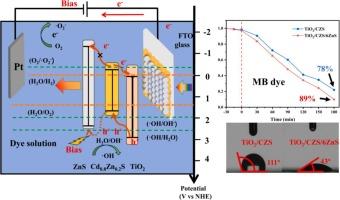
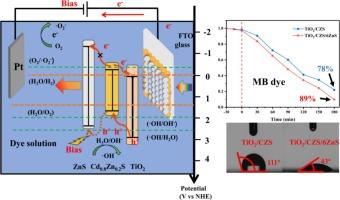
Quantum dot (QD) sensitized solar photoelectrochemical (PEC) cells can be used to degrade organic dyes efficiently with the advantages of no secondary pollution and energy conservation. Ternary TiO2/Cd0.8Zn0.2S/ZnS photoanodes in heterojunction structure were designed in PEC cells for degradation of several organic dyes. The molar ratio of Cd to Zn in alloy CdZnS colloid QDs as solar sensitizer was optimized through the computation based on modified DFT to meet carrier transfer thermodynamic requirement in ternary TiO2/CdZnS/ZnS photoanode. ZnS QDs as passivation layer can inhibit reverse photocurrent and improve the wettability in electrolytes simultaneously. The TiO2/CdZnS/6ZnS photoanode cell device exhibited the current density maximum of 0.3235 mA/cm2 under one sun (AM 1.5, 100 mw/cm2) and achieved 89 % decoloration rate for methylene blue (MB) after 3-hour degradation at 0.8 V applied bias, comparing with 0.059 mA/cm2 and 78 % decolorization rate of TiO2/CdZnS photoanode cell. Furthermore, the device showed high PEC stability that decolorization rate decreased from 89 % to 84 % after five cycles of 3-hour degradation. The effects of applied bias, ZnS content and dye type on PEC performance and decoloration rate were investigated systematically for clarifying degradation mechanism of organic dyes in PEC cells.
期刊介绍:
Applied Surface Science covers topics contributing to a better understanding of surfaces, interfaces, nanostructures and their applications. The journal is concerned with scientific research on the atomic and molecular level of material properties determined with specific surface analytical techniques and/or computational methods, as well as the processing of such structures.



 京公网安备 11010802042870号
京ICP备2023020795号-1
京公网安备 11010802042870号
京ICP备2023020795号-1

 分享
分享
 求助内容:
求助内容: 应助结果提醒方式:
 扫码关注我们
