{"title":"Colloidal-quantum-dot nanolaser oscillating at a bound-state-in-the-continuum with planar surface topography for a high Q-factor","authors":"Tae-Yun Lee, Hansol Lee, Heonsu Jeon","doi":"10.1515/nanoph-2024-0730","DOIUrl":null,"url":null,"abstract":"Solution-based optical gain materials offer a cost-effective path to coherent light sources. Further, bound states in the continuum (BICs) have garnered great interest owing to their diverging quality (<jats:italic>Q</jats:italic>) factors. Therefore, a hybrid of these – a solution-based material for optical gain and a BIC structure for the lasing mode – should constitute an ideal form factor for low-cost and low-threshold nanolasers. However, the nonuniform surface topography induced during the thin-film formation of a solution-based material, especially on top of a prepatterned substrate, can easily disrupt the structural symmetry required for a high-<jats:italic>Q</jats:italic> BIC, resulting in a degradation of <jats:italic>Q</jats:italic>. Thus, in this study, a simple surface-flattening technique utilizing a soft and flexible squeegee was applied, which realized the planar surface topography crucial for preserving the high <jats:italic>Q</jats:italic> promised by the BIC and achieving low-threshold lasing. We fabricated BIC nanolasers by incorporating colloidal quantum dots (CQDs) for optical gain into a two-dimensional photonic crystal backbone layer composed of Si<jats:sub>3</jats:sub>N<jats:sub>4</jats:sub>. By leveraging the unique properties of the BIC mode with a well-ordered surface, our CQD-based BIC laser exhibited a lasing threshold as low as 10.5 kW/cm<jats:sup>2</jats:sup>, which is significantly lower than those reported in previous studies.","PeriodicalId":19027,"journal":{"name":"Nanophotonics","volume":"93 1","pages":""},"PeriodicalIF":6.6000,"publicationDate":"2025-03-29","publicationTypes":"Journal Article","fieldsOfStudy":null,"isOpenAccess":false,"openAccessPdf":"","citationCount":"0","resultStr":null,"platform":"Semanticscholar","paperid":null,"PeriodicalName":"Nanophotonics","FirstCategoryId":"101","ListUrlMain":"https://doi.org/10.1515/nanoph-2024-0730","RegionNum":2,"RegionCategory":"物理与天体物理","ArticlePicture":[],"TitleCN":null,"AbstractTextCN":null,"PMCID":null,"EPubDate":"","PubModel":"","JCR":"Q1","JCRName":"MATERIALS SCIENCE, MULTIDISCIPLINARY","Score":null,"Total":0}
引用次数: 0
Abstract
Solution-based optical gain materials offer a cost-effective path to coherent light sources. Further, bound states in the continuum (BICs) have garnered great interest owing to their diverging quality (Q) factors. Therefore, a hybrid of these – a solution-based material for optical gain and a BIC structure for the lasing mode – should constitute an ideal form factor for low-cost and low-threshold nanolasers. However, the nonuniform surface topography induced during the thin-film formation of a solution-based material, especially on top of a prepatterned substrate, can easily disrupt the structural symmetry required for a high-Q BIC, resulting in a degradation of Q. Thus, in this study, a simple surface-flattening technique utilizing a soft and flexible squeegee was applied, which realized the planar surface topography crucial for preserving the high Q promised by the BIC and achieving low-threshold lasing. We fabricated BIC nanolasers by incorporating colloidal quantum dots (CQDs) for optical gain into a two-dimensional photonic crystal backbone layer composed of Si3N4. By leveraging the unique properties of the BIC mode with a well-ordered surface, our CQD-based BIC laser exhibited a lasing threshold as low as 10.5 kW/cm2, which is significantly lower than those reported in previous studies.
期刊介绍:
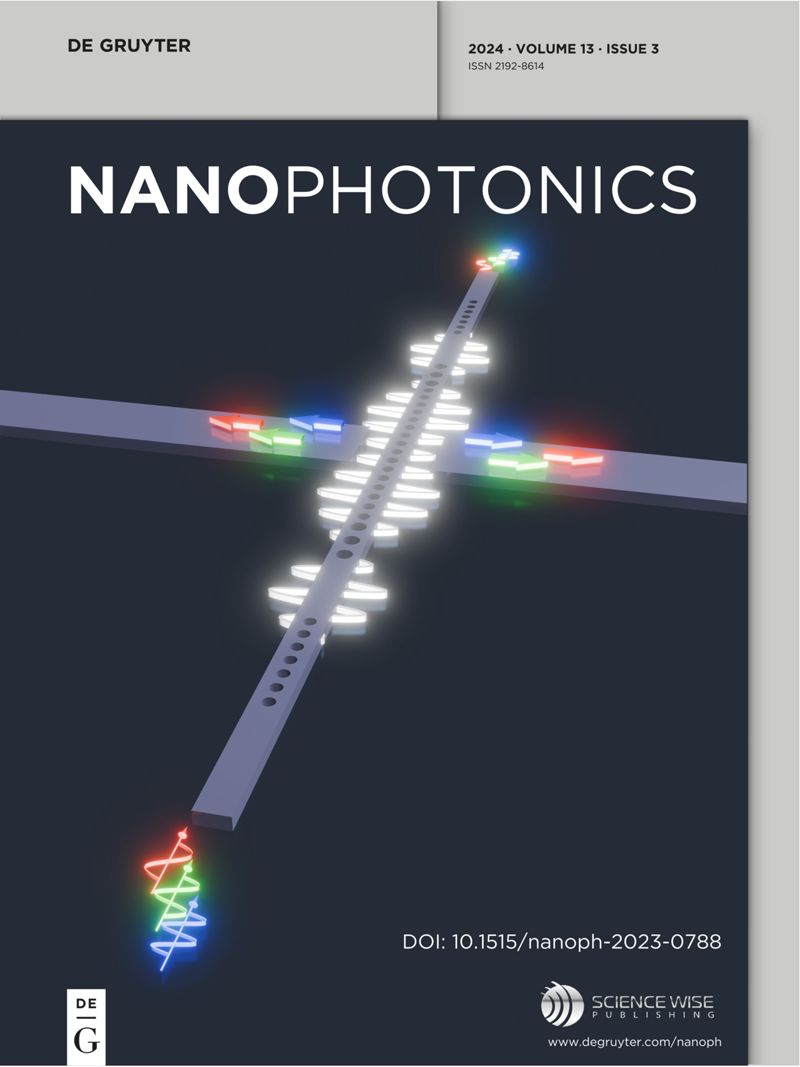
Nanophotonics, published in collaboration with Sciencewise, is a prestigious journal that showcases recent international research results, notable advancements in the field, and innovative applications. It is regarded as one of the leading publications in the realm of nanophotonics and encompasses a range of article types including research articles, selectively invited reviews, letters, and perspectives.
The journal specifically delves into the study of photon interaction with nano-structures, such as carbon nano-tubes, nano metal particles, nano crystals, semiconductor nano dots, photonic crystals, tissue, and DNA. It offers comprehensive coverage of the most up-to-date discoveries, making it an essential resource for physicists, engineers, and material scientists.



 京公网安备 11010802042870号
京ICP备2023020795号-1
京公网安备 11010802042870号
京ICP备2023020795号-1

 分享
分享
 求助内容:
求助内容: 应助结果提醒方式:
 扫码关注我们
