{"title":"Tailoring Diels–Alder Cross-Linked Liquid Crystal Elastomers for Spatially Programmable Monolithic Actuators","authors":"Yue Liu, Qing Yang, Qing Liu, Jun-Bo Hou, Jing Zhao, Ying Zhang, Qiongyao Peng, Zhi-Chao Jiang, Yao-Yu Xiao, Hongbo Zeng","doi":"10.1021/acsmacrolett.5c00117","DOIUrl":null,"url":null,"abstract":"Liquid crystal elastomers with thermo-reversible Diels–Alder cross-links (DALCEs) offer exceptional reprocessability and mild-temperature reprogrammability, enabling repeated fabrication of diverse actuators. However, optimizing their molecular design and refabrication protocols remains crucial to further unlocking their potential. This work systematically investigates DALCEs synthesized via aza-Michael addition reactions between RM82, furfurylamine, and various chain extenders (phenylethylamine, ethylamine, butylamine, hexylamine, octylamine, and 6-amino-1-hexanol). The effects of cross-linking density and chain extender selection on phase behavior, thermomechanical properties, and actuation performance have been thoroughly examined. The results show that a PEA-based formulation with moderate cross-linking density achieves the most balanced performance. Based on this optimized formulation, a novel (re)fabrication strategy is introduced by harnessing DALCEs’ intrinsic reprocessability, reprogrammability, and self-healing properties. This strategy employs multilevel fiber programming before monolithic actuator formation, enabling spatially controlled liquid crystal alignment and facilitating iterative actuator refinement through reconstruction. Consequently, complex morphing behaviors in disk films and stress-modulating functions in tubular actuators were demonstrated. This work establishes a versatile, easily synthesized material platform for spatially programmable, dynamic monolithic actuators, paving the way for advanced applications in soft robotics and adaptive devices.","PeriodicalId":18,"journal":{"name":"ACS Macro Letters","volume":"69 1","pages":"495-501"},"PeriodicalIF":5.2000,"publicationDate":"2025-03-30","publicationTypes":"Journal Article","fieldsOfStudy":null,"isOpenAccess":false,"openAccessPdf":"","citationCount":"0","resultStr":null,"platform":"Semanticscholar","paperid":null,"PeriodicalName":"ACS Macro Letters","FirstCategoryId":"92","ListUrlMain":"https://doi.org/10.1021/acsmacrolett.5c00117","RegionNum":0,"RegionCategory":null,"ArticlePicture":[],"TitleCN":null,"AbstractTextCN":null,"PMCID":null,"EPubDate":"","PubModel":"","JCR":"Q1","JCRName":"POLYMER SCIENCE","Score":null,"Total":0}
引用次数: 0
Abstract
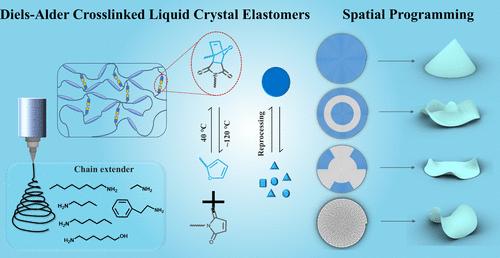
Liquid crystal elastomers with thermo-reversible Diels–Alder cross-links (DALCEs) offer exceptional reprocessability and mild-temperature reprogrammability, enabling repeated fabrication of diverse actuators. However, optimizing their molecular design and refabrication protocols remains crucial to further unlocking their potential. This work systematically investigates DALCEs synthesized via aza-Michael addition reactions between RM82, furfurylamine, and various chain extenders (phenylethylamine, ethylamine, butylamine, hexylamine, octylamine, and 6-amino-1-hexanol). The effects of cross-linking density and chain extender selection on phase behavior, thermomechanical properties, and actuation performance have been thoroughly examined. The results show that a PEA-based formulation with moderate cross-linking density achieves the most balanced performance. Based on this optimized formulation, a novel (re)fabrication strategy is introduced by harnessing DALCEs’ intrinsic reprocessability, reprogrammability, and self-healing properties. This strategy employs multilevel fiber programming before monolithic actuator formation, enabling spatially controlled liquid crystal alignment and facilitating iterative actuator refinement through reconstruction. Consequently, complex morphing behaviors in disk films and stress-modulating functions in tubular actuators were demonstrated. This work establishes a versatile, easily synthesized material platform for spatially programmable, dynamic monolithic actuators, paving the way for advanced applications in soft robotics and adaptive devices.
期刊介绍:
ACS Macro Letters publishes research in all areas of contemporary soft matter science in which macromolecules play a key role, including nanotechnology, self-assembly, supramolecular chemistry, biomaterials, energy generation and storage, and renewable/sustainable materials. Submissions to ACS Macro Letters should justify clearly the rapid disclosure of the key elements of the study. The scope of the journal includes high-impact research of broad interest in all areas of polymer science and engineering, including cross-disciplinary research that interfaces with polymer science.
With the launch of ACS Macro Letters, all Communications that were formerly published in Macromolecules and Biomacromolecules will be published as Letters in ACS Macro Letters.




 京公网安备 11010802042870号
京ICP备2023020795号-1
京公网安备 11010802042870号
京ICP备2023020795号-1

 分享
分享
 求助内容:
求助内容: 应助结果提醒方式:
 扫码关注我们
