Samantha G. Malone, Christal N. Davis, Zachary Piserchia, Michael R. Setzer, Sylvanus Toikumo, Hang Zhou, Emma L. Winterlind, Joel Gelernter, Amy Justice, Lorenzo Leggio, Christopher T. Rentsch, Henry R. Kranzler, Joshua C. Gray
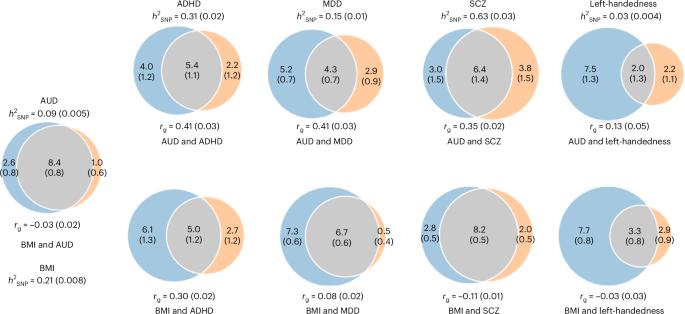
{"title":"Alcohol use disorder and body mass index show genetic pleiotropy and shared neural associations","authors":"Samantha G. Malone, Christal N. Davis, Zachary Piserchia, Michael R. Setzer, Sylvanus Toikumo, Hang Zhou, Emma L. Winterlind, Joel Gelernter, Amy Justice, Lorenzo Leggio, Christopher T. Rentsch, Henry R. Kranzler, Joshua C. Gray","doi":"10.1038/s41562-025-02148-y","DOIUrl":null,"url":null,"abstract":"Despite neurobiological overlap, alcohol use disorder (AUD) and body mass index (BMI) show minimal genetic correlation (rg), possibly due to mixed directions of shared variants. Here we applied MiXeR to investigate shared genetic architecture between AUD and BMI, conjunctional false discovery rate to detect shared loci and their directional effect, local analysis of (co)variant association for local rg, functional mapping and annotation to identify lead single-nucleotide polymorphisms, Genotype-Tissue Expression (GTEx) to examine tissue enrichment and BrainXcan to assess associations with brain phenotypes. MiXeR indicated 82.2% polygenic overlap, despite an rg of −0.03. The conjuctional false discovery rate method identified 132 shared lead single-nucleotide polymorphisms, with 53 novel, showing both concordant and discordant effects. GTEx analyses identified overexpression in multiple brain regions. Amygdala and caudate nucleus volumes were associated with AUD and BMI. Opposing variant effects explain the minimal rg between AUD and BMI, with implicated brain regions involved in executive function and reward, clarifying their polygenic overlap and neurobiological mechanisms. Gray et al. find that the genetic overlap between alcohol use disorder and body mass index consists of variants with mixed directions of effect and implicates brain regions involved in executive functioning, reward and food intake regulation.","PeriodicalId":19074,"journal":{"name":"Nature Human Behaviour","volume":"9 5","pages":"1056-1066"},"PeriodicalIF":15.9000,"publicationDate":"2025-03-31","publicationTypes":"Journal Article","fieldsOfStudy":null,"isOpenAccess":false,"openAccessPdf":"","citationCount":"0","resultStr":null,"platform":"Semanticscholar","paperid":null,"PeriodicalName":"Nature Human Behaviour","FirstCategoryId":"102","ListUrlMain":"https://www.nature.com/articles/s41562-025-02148-y","RegionNum":1,"RegionCategory":"心理学","ArticlePicture":[],"TitleCN":null,"AbstractTextCN":null,"PMCID":null,"EPubDate":"","PubModel":"","JCR":"Q1","JCRName":"MULTIDISCIPLINARY SCIENCES","Score":null,"Total":0}
引用次数: 0
Abstract
Despite neurobiological overlap, alcohol use disorder (AUD) and body mass index (BMI) show minimal genetic correlation (rg), possibly due to mixed directions of shared variants. Here we applied MiXeR to investigate shared genetic architecture between AUD and BMI, conjunctional false discovery rate to detect shared loci and their directional effect, local analysis of (co)variant association for local rg, functional mapping and annotation to identify lead single-nucleotide polymorphisms, Genotype-Tissue Expression (GTEx) to examine tissue enrichment and BrainXcan to assess associations with brain phenotypes. MiXeR indicated 82.2% polygenic overlap, despite an rg of −0.03. The conjuctional false discovery rate method identified 132 shared lead single-nucleotide polymorphisms, with 53 novel, showing both concordant and discordant effects. GTEx analyses identified overexpression in multiple brain regions. Amygdala and caudate nucleus volumes were associated with AUD and BMI. Opposing variant effects explain the minimal rg between AUD and BMI, with implicated brain regions involved in executive function and reward, clarifying their polygenic overlap and neurobiological mechanisms. Gray et al. find that the genetic overlap between alcohol use disorder and body mass index consists of variants with mixed directions of effect and implicates brain regions involved in executive functioning, reward and food intake regulation.
期刊介绍:
Nature Human Behaviour is a journal that focuses on publishing research of outstanding significance into any aspect of human behavior.The research can cover various areas such as psychological, biological, and social bases of human behavior.It also includes the study of origins, development, and disorders related to human behavior.The primary aim of the journal is to increase the visibility of research in the field and enhance its societal reach and impact.




 京公网安备 11010802042870号
京ICP备2023020795号-1
京公网安备 11010802042870号
京ICP备2023020795号-1

 分享
分享
 求助内容:
求助内容: 应助结果提醒方式:
 扫码关注我们
