Seán R. Kavanagh, Rasmus S. Nielsen, John L. Hansen, Rasmus S. Davidsen, Ole Hansen, Alp E. Samli, Peter C. K. Vesborg, David O. Scanlon and Aron Walsh
{"title":"Intrinsic point defect tolerance in selenium for indoor and tandem photovoltaics†","authors":"Seán R. Kavanagh, Rasmus S. Nielsen, John L. Hansen, Rasmus S. Davidsen, Ole Hansen, Alp E. Samli, Peter C. K. Vesborg, David O. Scanlon and Aron Walsh","doi":"10.1039/D4EE04647A","DOIUrl":null,"url":null,"abstract":"<p >Selenium has reemerged as a promising absorber material for tandem and indoor photovoltaic (PV) devices due to its elemental simplicity, unique structural features, and wide band gap. However, despite rapid recent improvements, record Se solar cells only reach a third of their achievable efficiencies at the radiative limit, primarily due to a low open-circuit voltage relative to the band gap. The origins of this voltage deficit, along with the high doping densities often reported for trigonal selenium (t-Se), remain unclear. Here, we explore the point defect chemistry of t-Se combining first-principles calculations with experimental studies of thin-films from state-of-the-art PV devices. Our findings reveal a remarkable ability of the helical t-Se chains to reconstruct and form low-energy <em>amphoteric</em> defects, particularly in the case of self-vacancies and hydrogen, pnictogen, and halogen impurities. While chalcogen impurities and self-interstitials also form low-energy defects, these are electrically neutral. We also find that both intrinsic and extrinsic point defects do not contribute significantly to doping, either due to electrical inactivity (chalcogens) or self-compensation (hydrogen, halogens, pnictogens). Finally, we show that intrinsic point defects do not form detrimental non-radiative recombination centres and propose that PV performance is instead limited by other factors. These findings highlight the potential of Se as a defect-tolerant absorber, while optimising interfaces and extended structural imperfections is key to unlocking its full performance potential.</p>","PeriodicalId":72,"journal":{"name":"Energy & Environmental Science","volume":" 9","pages":" 4431-4446"},"PeriodicalIF":30.8000,"publicationDate":"2025-03-31","publicationTypes":"Journal Article","fieldsOfStudy":null,"isOpenAccess":false,"openAccessPdf":"https://pubs.rsc.org/en/content/articlepdf/2025/ee/d4ee04647a?page=search","citationCount":"0","resultStr":null,"platform":"Semanticscholar","paperid":null,"PeriodicalName":"Energy & Environmental Science","FirstCategoryId":"88","ListUrlMain":"https://pubs.rsc.org/en/content/articlelanding/2025/ee/d4ee04647a","RegionNum":1,"RegionCategory":"材料科学","ArticlePicture":[],"TitleCN":null,"AbstractTextCN":null,"PMCID":null,"EPubDate":"","PubModel":"","JCR":"Q1","JCRName":"CHEMISTRY, MULTIDISCIPLINARY","Score":null,"Total":0}
引用次数: 0
Abstract
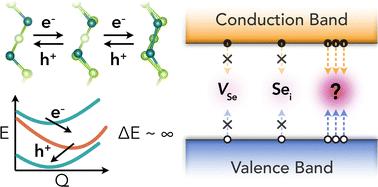
Selenium has reemerged as a promising absorber material for tandem and indoor photovoltaic (PV) devices due to its elemental simplicity, unique structural features, and wide band gap. However, despite rapid recent improvements, record Se solar cells only reach a third of their achievable efficiencies at the radiative limit, primarily due to a low open-circuit voltage relative to the band gap. The origins of this voltage deficit, along with the high doping densities often reported for trigonal selenium (t-Se), remain unclear. Here, we explore the point defect chemistry of t-Se combining first-principles calculations with experimental studies of thin-films from state-of-the-art PV devices. Our findings reveal a remarkable ability of the helical t-Se chains to reconstruct and form low-energy amphoteric defects, particularly in the case of self-vacancies and hydrogen, pnictogen, and halogen impurities. While chalcogen impurities and self-interstitials also form low-energy defects, these are electrically neutral. We also find that both intrinsic and extrinsic point defects do not contribute significantly to doping, either due to electrical inactivity (chalcogens) or self-compensation (hydrogen, halogens, pnictogens). Finally, we show that intrinsic point defects do not form detrimental non-radiative recombination centres and propose that PV performance is instead limited by other factors. These findings highlight the potential of Se as a defect-tolerant absorber, while optimising interfaces and extended structural imperfections is key to unlocking its full performance potential.
期刊介绍:
Energy & Environmental Science, a peer-reviewed scientific journal, publishes original research and review articles covering interdisciplinary topics in the (bio)chemical and (bio)physical sciences, as well as chemical engineering disciplines. Published monthly by the Royal Society of Chemistry (RSC), a not-for-profit publisher, Energy & Environmental Science is recognized as a leading journal. It boasts an impressive impact factor of 8.500 as of 2009, ranking 8th among 140 journals in the category "Chemistry, Multidisciplinary," second among 71 journals in "Energy & Fuels," second among 128 journals in "Engineering, Chemical," and first among 181 scientific journals in "Environmental Sciences."
Energy & Environmental Science publishes various types of articles, including Research Papers (original scientific work), Review Articles, Perspectives, and Minireviews (feature review-type articles of broad interest), Communications (original scientific work of an urgent nature), Opinions (personal, often speculative viewpoints or hypotheses on current topics), and Analysis Articles (in-depth examination of energy-related issues).



 京公网安备 11010802042870号
京ICP备2023020795号-1
京公网安备 11010802042870号
京ICP备2023020795号-1

 分享
分享
 求助内容:
求助内容: 应助结果提醒方式:
 扫码关注我们
