Jeonguk Hwang, Min Hoon Myung, Jee Ho Ha, Seungwoo Choi, Soon-Jae Jung, Seunghyun Lee, Jinwoo Park, Young-Ryul Kim, Hyo Jin, Nyung Joo Kong, Youngsik Kim, Hyun-Wook Lee, Hyunhyub Ko, Tae Joo Shin, Seok Ju Kang, Myung-Jin Baek and Dong Woog Lee
{"title":"A semi-crystalline polymer binder with enhanced electrical conductivity and strong underwater adhesion in aqueous sodium–air batteries†","authors":"Jeonguk Hwang, Min Hoon Myung, Jee Ho Ha, Seungwoo Choi, Soon-Jae Jung, Seunghyun Lee, Jinwoo Park, Young-Ryul Kim, Hyo Jin, Nyung Joo Kong, Youngsik Kim, Hyun-Wook Lee, Hyunhyub Ko, Tae Joo Shin, Seok Ju Kang, Myung-Jin Baek and Dong Woog Lee","doi":"10.1039/D5EE01350J","DOIUrl":null,"url":null,"abstract":"<p >Common polymer binders are insulators, which significantly diminish the battery performance owing to their low electron mobility. For aqueous sodium–air batteries (SABs) to exhibit reliable performance as energy storage systems, polymer binders should possess high electrolyte wettability, strong underwater adhesion, high crystallinity, and conductivity to efficiently transport electrons to current collectors without degradation or dissolution over time. In this study, the electrochemical performance of SABs was significantly improved using a newly developed binder containing poly(ethylene glycol), catechol, and anthracene (At) functional groups. Versatile analysis of the polymer, including two-dimensional grazing incidence-wide-angle X-ray diffraction and polarized optical microscopy, showed that the enhanced SAB performance can be attributed to the At groups which have high crystallinity due to π–π stacking, thereby lowering the resistance and increasing the electrical conductivity. Because of the catechol and PEG groups, the binder also exhibited reliable underwater adhesion, and electrolyte wettability, which are essential for aqueous SAB binders. Moreover, the binder effectively prevented carbon corrosion of the carbon current collector in the air electrode. We believe that the synthesized semi-crystalline polymer binder can be applied to various batteries to improve their electrochemical performance and stability.</p>","PeriodicalId":72,"journal":{"name":"Energy & Environmental Science","volume":" 9","pages":" 4447-4459"},"PeriodicalIF":30.8000,"publicationDate":"2025-03-31","publicationTypes":"Journal Article","fieldsOfStudy":null,"isOpenAccess":false,"openAccessPdf":"https://pubs.rsc.org/en/content/articlepdf/2025/ee/d5ee01350j?page=search","citationCount":"0","resultStr":null,"platform":"Semanticscholar","paperid":null,"PeriodicalName":"Energy & Environmental Science","FirstCategoryId":"88","ListUrlMain":"https://pubs.rsc.org/en/content/articlelanding/2025/ee/d5ee01350j","RegionNum":1,"RegionCategory":"材料科学","ArticlePicture":[],"TitleCN":null,"AbstractTextCN":null,"PMCID":null,"EPubDate":"","PubModel":"","JCR":"Q1","JCRName":"CHEMISTRY, MULTIDISCIPLINARY","Score":null,"Total":0}
引用次数: 0
Abstract
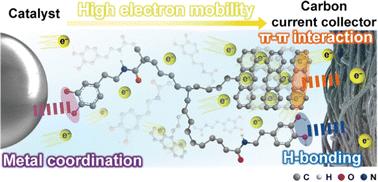
Common polymer binders are insulators, which significantly diminish the battery performance owing to their low electron mobility. For aqueous sodium–air batteries (SABs) to exhibit reliable performance as energy storage systems, polymer binders should possess high electrolyte wettability, strong underwater adhesion, high crystallinity, and conductivity to efficiently transport electrons to current collectors without degradation or dissolution over time. In this study, the electrochemical performance of SABs was significantly improved using a newly developed binder containing poly(ethylene glycol), catechol, and anthracene (At) functional groups. Versatile analysis of the polymer, including two-dimensional grazing incidence-wide-angle X-ray diffraction and polarized optical microscopy, showed that the enhanced SAB performance can be attributed to the At groups which have high crystallinity due to π–π stacking, thereby lowering the resistance and increasing the electrical conductivity. Because of the catechol and PEG groups, the binder also exhibited reliable underwater adhesion, and electrolyte wettability, which are essential for aqueous SAB binders. Moreover, the binder effectively prevented carbon corrosion of the carbon current collector in the air electrode. We believe that the synthesized semi-crystalline polymer binder can be applied to various batteries to improve their electrochemical performance and stability.
期刊介绍:
Energy & Environmental Science, a peer-reviewed scientific journal, publishes original research and review articles covering interdisciplinary topics in the (bio)chemical and (bio)physical sciences, as well as chemical engineering disciplines. Published monthly by the Royal Society of Chemistry (RSC), a not-for-profit publisher, Energy & Environmental Science is recognized as a leading journal. It boasts an impressive impact factor of 8.500 as of 2009, ranking 8th among 140 journals in the category "Chemistry, Multidisciplinary," second among 71 journals in "Energy & Fuels," second among 128 journals in "Engineering, Chemical," and first among 181 scientific journals in "Environmental Sciences."
Energy & Environmental Science publishes various types of articles, including Research Papers (original scientific work), Review Articles, Perspectives, and Minireviews (feature review-type articles of broad interest), Communications (original scientific work of an urgent nature), Opinions (personal, often speculative viewpoints or hypotheses on current topics), and Analysis Articles (in-depth examination of energy-related issues).



 京公网安备 11010802042870号
京ICP备2023020795号-1
京公网安备 11010802042870号
京ICP备2023020795号-1

 分享
分享
 求助内容:
求助内容: 应助结果提醒方式:
 扫码关注我们
