Ming Chen, Li Gong, Igor Zhitomirsky and Kaiyuan Shi
{"title":"Unraveling the dynamic transformation of azobenzene-driven redox electrolytes for Zn-ion hybrid capacitors†","authors":"Ming Chen, Li Gong, Igor Zhitomirsky and Kaiyuan Shi","doi":"10.1039/D4EE05696E","DOIUrl":null,"url":null,"abstract":"<p >The incorporation of redox-active molecules into aqueous electrolytes addressed the challenges in the development of energy storage devices by enhancing energy density, expanding voltage windows, and improving cycling stability. Aqueous zinc-ion hybrid capacitors (ZICs), which combine the characteristics of metal-ion batteries and supercapacitors, have emerged to meet high energy-power demands. Herein, we investigate the irreversible and reversible dynamics of azobenzene compounds in the development of redox electrolytes for ZIC applications. The results reveal that Sunset Yellow (SY) additives promote reversible Zn<small><sup>2+</sup></small> stripping/plating at the Zn anode through ion–ligand coordination, while the redox behavior of the –N<img>N– group enhances the interfacial charge transfer. The passivation behavior of redox electrolytes, derived by SY molecules, was investigated using <em>in situ</em> electrochemical atomic force microscopy. Morphology evolution, coupled with nanomechanical tests, shed light on the transformation of SY-containing electrolytes. The redox electrolytes improve the lifespan of Zn//Zn cells from 50 to 1700 cycles at 2 mA cm<small><sup>−2</sup></small> and 1 mA h cm<small><sup>−2</sup></small> by suppressing parasitic reactions and mitigating by-product formation. The redox-enhanced ZIC delivers an increased capacity of 113.3 mA h g<small><sup>−1</sup></small> with improved cycling stability, compared to 75.2 mA h g<small><sup>−1</sup></small> of ZnSO<small><sub>4</sub></small> electrolytes without SY molecules at 0.6 mA g<small><sup>−1</sup></small>. A range of azobenzene-based compounds with varying structures were investigated to demonstrate the synergistic modulating effects. The results demonstrate the molecular engineering of redox electrolytes and provide fundamental insights into electrochemical interphase transformation.</p>","PeriodicalId":72,"journal":{"name":"Energy & Environmental Science","volume":" 9","pages":" 4460-4469"},"PeriodicalIF":30.8000,"publicationDate":"2025-03-31","publicationTypes":"Journal Article","fieldsOfStudy":null,"isOpenAccess":false,"openAccessPdf":"","citationCount":"0","resultStr":null,"platform":"Semanticscholar","paperid":null,"PeriodicalName":"Energy & Environmental Science","FirstCategoryId":"88","ListUrlMain":"https://pubs.rsc.org/en/content/articlelanding/2025/ee/d4ee05696e","RegionNum":1,"RegionCategory":"材料科学","ArticlePicture":[],"TitleCN":null,"AbstractTextCN":null,"PMCID":null,"EPubDate":"","PubModel":"","JCR":"Q1","JCRName":"CHEMISTRY, MULTIDISCIPLINARY","Score":null,"Total":0}
引用次数: 0
Abstract
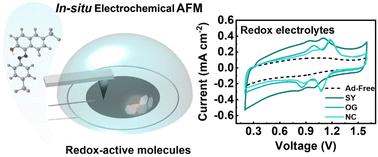
The incorporation of redox-active molecules into aqueous electrolytes addressed the challenges in the development of energy storage devices by enhancing energy density, expanding voltage windows, and improving cycling stability. Aqueous zinc-ion hybrid capacitors (ZICs), which combine the characteristics of metal-ion batteries and supercapacitors, have emerged to meet high energy-power demands. Herein, we investigate the irreversible and reversible dynamics of azobenzene compounds in the development of redox electrolytes for ZIC applications. The results reveal that Sunset Yellow (SY) additives promote reversible Zn2+ stripping/plating at the Zn anode through ion–ligand coordination, while the redox behavior of the –NN– group enhances the interfacial charge transfer. The passivation behavior of redox electrolytes, derived by SY molecules, was investigated using in situ electrochemical atomic force microscopy. Morphology evolution, coupled with nanomechanical tests, shed light on the transformation of SY-containing electrolytes. The redox electrolytes improve the lifespan of Zn//Zn cells from 50 to 1700 cycles at 2 mA cm−2 and 1 mA h cm−2 by suppressing parasitic reactions and mitigating by-product formation. The redox-enhanced ZIC delivers an increased capacity of 113.3 mA h g−1 with improved cycling stability, compared to 75.2 mA h g−1 of ZnSO4 electrolytes without SY molecules at 0.6 mA g−1. A range of azobenzene-based compounds with varying structures were investigated to demonstrate the synergistic modulating effects. The results demonstrate the molecular engineering of redox electrolytes and provide fundamental insights into electrochemical interphase transformation.
将氧化还原活性分子掺入水溶液电解质,通过提高能量密度、扩大电压窗和改善循环稳定性,解决了能量存储设备发展中的挑战。水锌离子混合电容器(ZICs)结合了金属离子电池和超级电容器的特性,是满足高能量电力需求的新兴材料。在此,我们研究了偶氮苯化合物在制备氧化还原电解质中的不可逆和可逆动力学。结果表明,日落黄(SY)添加剂通过离子配位促进Zn阳极Zn2+的可逆剥离/镀,而-N=N-基团的氧化还原行为增强了界面电荷转移。采用原位电化学原子力显微镜研究了SY分子制备的氧化还原电解质的钝化行为。形貌演变与纳米力学测试相结合,揭示了含sy电解质的转变。氧化还原电解质通过抑制寄生反应和减少副产物的形成,在2ma cm - 2和1mah cm - 2下,将Zn//Zn电池的寿命从50次提高到1700次。氧化还原增强ZIC的容量增加到113.3 mAh g-1,循环稳定性得到改善,而不含SY分子的ZnSO4电解质的容量为75.2 mAh g-1,为0.6 mA g-1。研究了一系列具有不同结构的偶氮苯基化合物,以证明其协同调节作用。研究结果证明了氧化还原电解质的分子工程,并为电化学相间转化提供了基本的见解。
期刊介绍:
Energy & Environmental Science, a peer-reviewed scientific journal, publishes original research and review articles covering interdisciplinary topics in the (bio)chemical and (bio)physical sciences, as well as chemical engineering disciplines. Published monthly by the Royal Society of Chemistry (RSC), a not-for-profit publisher, Energy & Environmental Science is recognized as a leading journal. It boasts an impressive impact factor of 8.500 as of 2009, ranking 8th among 140 journals in the category "Chemistry, Multidisciplinary," second among 71 journals in "Energy & Fuels," second among 128 journals in "Engineering, Chemical," and first among 181 scientific journals in "Environmental Sciences."
Energy & Environmental Science publishes various types of articles, including Research Papers (original scientific work), Review Articles, Perspectives, and Minireviews (feature review-type articles of broad interest), Communications (original scientific work of an urgent nature), Opinions (personal, often speculative viewpoints or hypotheses on current topics), and Analysis Articles (in-depth examination of energy-related issues).



 京公网安备 11010802042870号
京ICP备2023020795号-1
京公网安备 11010802042870号
京ICP备2023020795号-1

 分享
分享
 求助内容:
求助内容: 应助结果提醒方式:
 扫码关注我们
