Shizhuo Zhang , Feng Liu , Senlin Rao , Gary J. Cheng
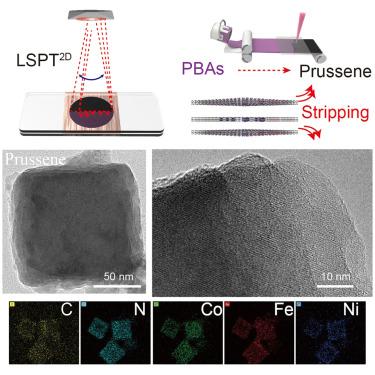
{"title":"Prussene: Transforming ancient pigments into magnetic nanoalloyed 2D layers","authors":"Shizhuo Zhang , Feng Liu , Senlin Rao , Gary J. Cheng","doi":"10.1016/j.matt.2025.102090","DOIUrl":null,"url":null,"abstract":"<div><div>This study redefines Prussian blue analogs (PBAs), transforming them into Prussene—a two-dimensional (2D) layered nanomaterial—via laser-shock-induced 2D phase transition synthesis (LSPT<sup>2D</sup>). This scalable nanomanufacturing technique harnesses high-temperature/pressure plasmas to drive phase transitions, converting PBA nanocubes into N-doped carbon nanosheets embedded with ultrafine magnetic nanoalloys. Unlike conventional exfoliation method, LSPT<sup>2D</sup> enables chemical phase engineering, preserving structural integrity while imparting exceptional properties. Prussene exhibits a high saturation magnetization (108.3 emu/g) and enhanced conductivity due to its conductive carbon matrix. Demonstrating transformative electromagnetic wave absorption, it achieves a reflection loss of −51.7 dB and a 5.87 GHz effective bandwidth across GHz–THz frequencies, surpassing state-of-the-art absorbers. These attributes position Prussene as a breakthrough for stealth technologies and ultrahigh-frequency communications. This work establishes a scalable paradigm for synthesizing chemically modified 2D materials, unlocking applications in catalysis, energy storage, and multifunctional nanoelectronics. Prussene’s innovation lies in its synthesis-process-property triad, heralding a new era in high-performance nanomaterials.</div></div>","PeriodicalId":388,"journal":{"name":"Matter","volume":"8 6","pages":"Article 102090"},"PeriodicalIF":17.5000,"publicationDate":"2025-06-04","publicationTypes":"Journal Article","fieldsOfStudy":null,"isOpenAccess":false,"openAccessPdf":"","citationCount":"0","resultStr":null,"platform":"Semanticscholar","paperid":null,"PeriodicalName":"Matter","FirstCategoryId":"88","ListUrlMain":"https://www.sciencedirect.com/science/article/pii/S259023852500133X","RegionNum":1,"RegionCategory":"材料科学","ArticlePicture":[],"TitleCN":null,"AbstractTextCN":null,"PMCID":null,"EPubDate":"2025/3/31 0:00:00","PubModel":"Epub","JCR":"Q1","JCRName":"MATERIALS SCIENCE, MULTIDISCIPLINARY","Score":null,"Total":0}
引用次数: 0
Abstract
This study redefines Prussian blue analogs (PBAs), transforming them into Prussene—a two-dimensional (2D) layered nanomaterial—via laser-shock-induced 2D phase transition synthesis (LSPT2D). This scalable nanomanufacturing technique harnesses high-temperature/pressure plasmas to drive phase transitions, converting PBA nanocubes into N-doped carbon nanosheets embedded with ultrafine magnetic nanoalloys. Unlike conventional exfoliation method, LSPT2D enables chemical phase engineering, preserving structural integrity while imparting exceptional properties. Prussene exhibits a high saturation magnetization (108.3 emu/g) and enhanced conductivity due to its conductive carbon matrix. Demonstrating transformative electromagnetic wave absorption, it achieves a reflection loss of −51.7 dB and a 5.87 GHz effective bandwidth across GHz–THz frequencies, surpassing state-of-the-art absorbers. These attributes position Prussene as a breakthrough for stealth technologies and ultrahigh-frequency communications. This work establishes a scalable paradigm for synthesizing chemically modified 2D materials, unlocking applications in catalysis, energy storage, and multifunctional nanoelectronics. Prussene’s innovation lies in its synthesis-process-property triad, heralding a new era in high-performance nanomaterials.
期刊介绍:
Matter, a monthly journal affiliated with Cell, spans the broad field of materials science from nano to macro levels,covering fundamentals to applications. Embracing groundbreaking technologies,it includes full-length research articles,reviews, perspectives,previews, opinions, personnel stories, and general editorial content.
Matter aims to be the primary resource for researchers in academia and industry, inspiring the next generation of materials scientists.





 京公网安备 11010802042870号
京ICP备2023020795号-1
京公网安备 11010802042870号
京ICP备2023020795号-1

 分享
分享
 求助内容:
求助内容: 应助结果提醒方式:
 扫码关注我们
