Comparative study on crystallization behaviour of poly(3-hydroxybutyrate-co-3-hydroxyvalerate) (PHBV) nucleated with different nucleating agents - Crystallization, thermal, and mechanical properties
Bouxali Keohavong , Lubing Xiang , Jiaxin Liu , Xining Wang , Yunxuan Weng , Xiaoying Zhao
{"title":"Comparative study on crystallization behaviour of poly(3-hydroxybutyrate-co-3-hydroxyvalerate) (PHBV) nucleated with different nucleating agents - Crystallization, thermal, and mechanical properties","authors":"Bouxali Keohavong , Lubing Xiang , Jiaxin Liu , Xining Wang , Yunxuan Weng , Xiaoying Zhao","doi":"10.1016/j.polymer.2025.128319","DOIUrl":null,"url":null,"abstract":"<div><div>Poly(3-hydroxybutyrate-co-3-hydroxyvalerate) (PHBV), a biodegradable thermoplastic, holds significant potential for sustainable applications. However, its inherent limitations, including poor crystallization behaviour, low thermal stability, and inadequate mechanical properties, hinder its widespread use. To address these challenges, we investigated the impact of nucleating agents, TMC-200 and TMC-300, on PHBV crystallization behaviour, thermal stability, and mechanical performance. Both TMC-200 and TMC-300 effectively nucleated PHBV, but their effects differed significantly due to their different chemical structures. TMC-200 promoted PHBV crystallization by increasing nucleation sites and ordering of crystalline regions. TMC-200, at 1 phr, increased PHBV crystallinity from 59 % to 64 % and enhanced the thermal stability, with T<sub>5wt%</sub> rising from 271 °C to 286 °C and T<sub>50 wt%</sub> increasing from 277 °C to 297 °C. TMC-300 interacted with PHBV through hydrogen bonding, restricting the mobility of polymer chains and slowing down the crystallization process. Both TMC-200 and TMC-300 enhanced the mechanical properties of PHBV. These differences in crystallization and properties highlight the distinct roles of these nucleating agents and provide valuable insights for optimizing PHBV-based materials for more sustainable and environmentally friendly applications.</div></div>","PeriodicalId":405,"journal":{"name":"Polymer","volume":"326 ","pages":"Article 128319"},"PeriodicalIF":4.5000,"publicationDate":"2025-05-09","publicationTypes":"Journal Article","fieldsOfStudy":null,"isOpenAccess":false,"openAccessPdf":"","citationCount":"0","resultStr":null,"platform":"Semanticscholar","paperid":null,"PeriodicalName":"Polymer","FirstCategoryId":"92","ListUrlMain":"https://www.sciencedirect.com/science/article/pii/S0032386125003052","RegionNum":2,"RegionCategory":"化学","ArticlePicture":[],"TitleCN":null,"AbstractTextCN":null,"PMCID":null,"EPubDate":"2025/3/31 0:00:00","PubModel":"Epub","JCR":"Q2","JCRName":"POLYMER SCIENCE","Score":null,"Total":0}
引用次数: 0
Abstract
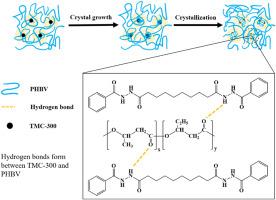
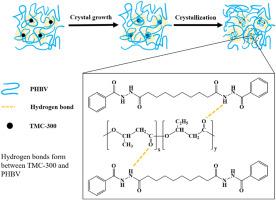
Poly(3-hydroxybutyrate-co-3-hydroxyvalerate) (PHBV), a biodegradable thermoplastic, holds significant potential for sustainable applications. However, its inherent limitations, including poor crystallization behaviour, low thermal stability, and inadequate mechanical properties, hinder its widespread use. To address these challenges, we investigated the impact of nucleating agents, TMC-200 and TMC-300, on PHBV crystallization behaviour, thermal stability, and mechanical performance. Both TMC-200 and TMC-300 effectively nucleated PHBV, but their effects differed significantly due to their different chemical structures. TMC-200 promoted PHBV crystallization by increasing nucleation sites and ordering of crystalline regions. TMC-200, at 1 phr, increased PHBV crystallinity from 59 % to 64 % and enhanced the thermal stability, with T5wt% rising from 271 °C to 286 °C and T50 wt% increasing from 277 °C to 297 °C. TMC-300 interacted with PHBV through hydrogen bonding, restricting the mobility of polymer chains and slowing down the crystallization process. Both TMC-200 and TMC-300 enhanced the mechanical properties of PHBV. These differences in crystallization and properties highlight the distinct roles of these nucleating agents and provide valuable insights for optimizing PHBV-based materials for more sustainable and environmentally friendly applications.
期刊介绍:
Polymer is an interdisciplinary journal dedicated to publishing innovative and significant advances in Polymer Physics, Chemistry and Technology. We welcome submissions on polymer hybrids, nanocomposites, characterisation and self-assembly. Polymer also publishes work on the technological application of polymers in energy and optoelectronics.
The main scope is covered but not limited to the following core areas:
Polymer Materials
Nanocomposites and hybrid nanomaterials
Polymer blends, films, fibres, networks and porous materials
Physical Characterization
Characterisation, modelling and simulation* of molecular and materials properties in bulk, solution, and thin films
Polymer Engineering
Advanced multiscale processing methods
Polymer Synthesis, Modification and Self-assembly
Including designer polymer architectures, mechanisms and kinetics, and supramolecular polymerization
Technological Applications
Polymers for energy generation and storage
Polymer membranes for separation technology
Polymers for opto- and microelectronics.



 京公网安备 11010802042870号
京ICP备2023020795号-1
京公网安备 11010802042870号
京ICP备2023020795号-1

 分享
分享
 求助内容:
求助内容: 应助结果提醒方式:
 扫码关注我们
