XueLian Yu, ZhengXian Wang, Jia Niu, YanQian Sun, XiuFang li
{"title":"Quantitative Phase Imaging Based on the Coded Aperture Correlation Holography Cross-Correlation Reconstruction Method","authors":"XueLian Yu, ZhengXian Wang, Jia Niu, YanQian Sun, XiuFang li","doi":"10.1002/lpor.202402175","DOIUrl":null,"url":null,"abstract":"<p>Interference-free coded aperture correlation holography (I-COACH) is an innovative incoherent digital holography method capable of recording 3D scenes without lasers or dual-wave interference, offering significant potential in diverse applications. quantitative phase imaging (QPI) is a noninvasive optical technique for extracting phase information of transparent samples, often requiring interference or diffraction combined with phase reconstruction algorithms. However, I-COACH's partially coherent illumination and noninterference recording limit its phase extraction capability. A complex amplitude cross-correlation method is introduced to overcome these limitations. This method avoids dual-wave interference, numerical inversion, diffraction distance considerations, and coded phase mask (CPM) modulation effects. It reconstructs the sample's complex amplitude by determining the complex amplitudes of the point source hologram (PSH) and object hologram (OH) and applying cross-correlation. Experimental results from I-COACH and coherent diffraction imaging confirm its ability to reconstruct phase distributions effectively. The method also offers excellent 3D digital refocusing and remains applicable under coherent illumination. This approach expands the utility of I-COACH, particularly for biomedical imaging.</p>","PeriodicalId":204,"journal":{"name":"Laser & Photonics Reviews","volume":"19 11","pages":""},"PeriodicalIF":10.0000,"publicationDate":"2025-03-31","publicationTypes":"Journal Article","fieldsOfStudy":null,"isOpenAccess":false,"openAccessPdf":"","citationCount":"0","resultStr":null,"platform":"Semanticscholar","paperid":null,"PeriodicalName":"Laser & Photonics Reviews","FirstCategoryId":"101","ListUrlMain":"https://onlinelibrary.wiley.com/doi/10.1002/lpor.202402175","RegionNum":1,"RegionCategory":"物理与天体物理","ArticlePicture":[],"TitleCN":null,"AbstractTextCN":null,"PMCID":null,"EPubDate":"","PubModel":"","JCR":"Q1","JCRName":"OPTICS","Score":null,"Total":0}
引用次数: 0
Abstract
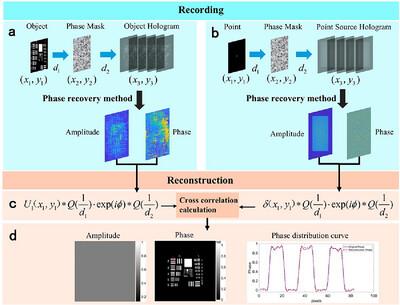
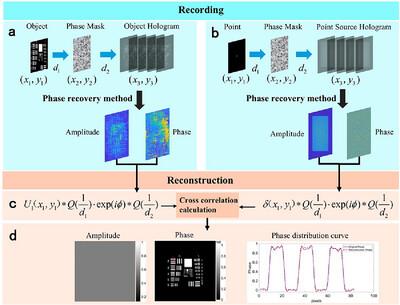
Interference-free coded aperture correlation holography (I-COACH) is an innovative incoherent digital holography method capable of recording 3D scenes without lasers or dual-wave interference, offering significant potential in diverse applications. quantitative phase imaging (QPI) is a noninvasive optical technique for extracting phase information of transparent samples, often requiring interference or diffraction combined with phase reconstruction algorithms. However, I-COACH's partially coherent illumination and noninterference recording limit its phase extraction capability. A complex amplitude cross-correlation method is introduced to overcome these limitations. This method avoids dual-wave interference, numerical inversion, diffraction distance considerations, and coded phase mask (CPM) modulation effects. It reconstructs the sample's complex amplitude by determining the complex amplitudes of the point source hologram (PSH) and object hologram (OH) and applying cross-correlation. Experimental results from I-COACH and coherent diffraction imaging confirm its ability to reconstruct phase distributions effectively. The method also offers excellent 3D digital refocusing and remains applicable under coherent illumination. This approach expands the utility of I-COACH, particularly for biomedical imaging.
期刊介绍:
Laser & Photonics Reviews is a reputable journal that publishes high-quality Reviews, original Research Articles, and Perspectives in the field of photonics and optics. It covers both theoretical and experimental aspects, including recent groundbreaking research, specific advancements, and innovative applications.
As evidence of its impact and recognition, Laser & Photonics Reviews boasts a remarkable 2022 Impact Factor of 11.0, according to the Journal Citation Reports from Clarivate Analytics (2023). Moreover, it holds impressive rankings in the InCites Journal Citation Reports: in 2021, it was ranked 6th out of 101 in the field of Optics, 15th out of 161 in Applied Physics, and 12th out of 69 in Condensed Matter Physics.
The journal uses the ISSN numbers 1863-8880 for print and 1863-8899 for online publications.



 京公网安备 11010802042870号
京ICP备2023020795号-1
京公网安备 11010802042870号
京ICP备2023020795号-1

 分享
分享
 求助内容:
求助内容: 应助结果提醒方式:
 扫码关注我们
