{"title":"Multifunctional Polyurethane Exhibiting High Mechanical Performance and Shape-Memory-Assisted Self-Healing","authors":"Xiaoyue Wang, Song Li, Zenghui Yang, Yaoming Zhang, Qihua Wang, Tingmei Wang, Xinrui Zhang","doi":"10.1002/smll.202500847","DOIUrl":null,"url":null,"abstract":"<p>Polymeric materials often face inherent trade-offs between mechanical performance and self-healing capabilities, which presents significant challenges to their development and practical application. Here, an effective strategy is reported to overcome these limitations. By introducing a highly crystalline polyol—characterized by its chain folding and storage chain length—and coordination bonds into polyurethane, an exceptional balance of high tensile strength (47.18 ± 2.35 MPa), exceptional elongation at break (5952.72 ± 254.20%), outstanding toughness (1396.39 ± 90.05 MJ m<sup>−3</sup>), and high hardness (shore D hardness 43.8 ± 0.8) is achieved, while also maintaining intrinsic self-healing properties. The material's self-healing is facilitated by the water solubility of polyol (polyethylene glycol, PEG), which enables rapid healing and welding at low temperatures (4 °C) with the aid of water. Additionally, the shape-memory recovery force further enhances crack closure and healing, contributing to the material's durability. This unique combination of mechanical performance and self-healing capabilities underscores the potential of this material for advanced applications that require both high mechanical properties and robust self-healing functionality.</p>","PeriodicalId":228,"journal":{"name":"Small","volume":"21 21","pages":""},"PeriodicalIF":12.1000,"publicationDate":"2025-03-30","publicationTypes":"Journal Article","fieldsOfStudy":null,"isOpenAccess":false,"openAccessPdf":"","citationCount":"0","resultStr":null,"platform":"Semanticscholar","paperid":null,"PeriodicalName":"Small","FirstCategoryId":"88","ListUrlMain":"https://onlinelibrary.wiley.com/doi/10.1002/smll.202500847","RegionNum":2,"RegionCategory":"材料科学","ArticlePicture":[],"TitleCN":null,"AbstractTextCN":null,"PMCID":null,"EPubDate":"","PubModel":"","JCR":"Q1","JCRName":"CHEMISTRY, MULTIDISCIPLINARY","Score":null,"Total":0}
引用次数: 0
Abstract
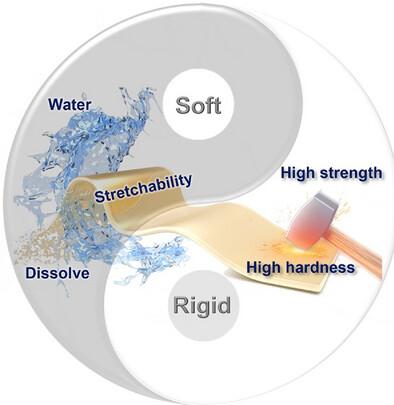
Polymeric materials often face inherent trade-offs between mechanical performance and self-healing capabilities, which presents significant challenges to their development and practical application. Here, an effective strategy is reported to overcome these limitations. By introducing a highly crystalline polyol—characterized by its chain folding and storage chain length—and coordination bonds into polyurethane, an exceptional balance of high tensile strength (47.18 ± 2.35 MPa), exceptional elongation at break (5952.72 ± 254.20%), outstanding toughness (1396.39 ± 90.05 MJ m−3), and high hardness (shore D hardness 43.8 ± 0.8) is achieved, while also maintaining intrinsic self-healing properties. The material's self-healing is facilitated by the water solubility of polyol (polyethylene glycol, PEG), which enables rapid healing and welding at low temperatures (4 °C) with the aid of water. Additionally, the shape-memory recovery force further enhances crack closure and healing, contributing to the material's durability. This unique combination of mechanical performance and self-healing capabilities underscores the potential of this material for advanced applications that require both high mechanical properties and robust self-healing functionality.
期刊介绍:
Small serves as an exceptional platform for both experimental and theoretical studies in fundamental and applied interdisciplinary research at the nano- and microscale. The journal offers a compelling mix of peer-reviewed Research Articles, Reviews, Perspectives, and Comments.
With a remarkable 2022 Journal Impact Factor of 13.3 (Journal Citation Reports from Clarivate Analytics, 2023), Small remains among the top multidisciplinary journals, covering a wide range of topics at the interface of materials science, chemistry, physics, engineering, medicine, and biology.
Small's readership includes biochemists, biologists, biomedical scientists, chemists, engineers, information technologists, materials scientists, physicists, and theoreticians alike.




 京公网安备 11010802042870号
京ICP备2023020795号-1
京公网安备 11010802042870号
京ICP备2023020795号-1

 分享
分享
 求助内容:
求助内容: 应助结果提醒方式:
 扫码关注我们
