Nickel hyperaccumulation is independent of the leaf economics spectrum, although it may be linked to plant water balance in an ultramafic plant community from Sabah (Malaysia)
Celestino Quintela-Sabarís, Michel-Pierre Faucon, Béatrice Gervais-Bergeron, Sukaibin Sumail, Antony van der Ent, Rimi Repin, John Sugau, Reuben Nilus, Thomas Rigaudier, Guillaume Echevarria, Sophie Leguédois
{"title":"Nickel hyperaccumulation is independent of the leaf economics spectrum, although it may be linked to plant water balance in an ultramafic plant community from Sabah (Malaysia)","authors":"Celestino Quintela-Sabarís, Michel-Pierre Faucon, Béatrice Gervais-Bergeron, Sukaibin Sumail, Antony van der Ent, Rimi Repin, John Sugau, Reuben Nilus, Thomas Rigaudier, Guillaume Echevarria, Sophie Leguédois","doi":"10.1007/s11104-025-07325-6","DOIUrl":null,"url":null,"abstract":"<h3 data-test=\"abstract-sub-heading\">Background and aims</h3><p>Nickel (Ni) hyperaccumulators are a group of plants able to store elevated amounts of this element in their leaves. Some studies indicate that hyperaccumulation may be associated with traits favouring fast resource capture or with traits favouring nutrient and water conservation, but there is no evidence for the role of nickel hyperaccumulation in the leaf economics spectrum. Our study aims to assess the differences in the leaf economics spectrum between Ni hyperaccumulators and non-hyperaccumulators.</p><h3 data-test=\"abstract-sub-heading\">Methods</h3><p>We have conducted a field study involving five hyperaccumulators and ten non-hyperaccumulators growing on the same ultramafic community in Sabah (Malaysia). We measured two structural and seven chemical leaf traits and computed a Principal Component Analysis, which was complemented by a test of the phylogenetic signal of each trait and linear mixed models to assess the influence of each leaf trait on nickel accumulation.</p><h3 data-test=\"abstract-sub-heading\">Results</h3><p>Our analyses inferred three principal components that reflected the main environmental constraints that shape the resource acquisition strategies of the studied ultramafic plant community: leaf economics spectrum, hyperaccumulation and water-use efficiency, and calcium to magnesium balance. Moreover, the linear mixed models indicated that carbon isotope discrimination and potassium concentrations had a significant effect on Ni accumulation, suggesting that nickel might replace partially potassium in its role in plant water balance.</p><h3 data-test=\"abstract-sub-heading\">Conclusion</h3><p>Overall, the data suggest that in the community studied, Ni hyperaccumulation is independent of the leaf economics spectrum and related to plant water economy. More studies with other hyperaccumulator plants are needed to confirm these findings.</p>","PeriodicalId":20223,"journal":{"name":"Plant and Soil","volume":"41 1","pages":""},"PeriodicalIF":4.1000,"publicationDate":"2025-03-31","publicationTypes":"Journal Article","fieldsOfStudy":null,"isOpenAccess":false,"openAccessPdf":"","citationCount":"0","resultStr":null,"platform":"Semanticscholar","paperid":null,"PeriodicalName":"Plant and Soil","FirstCategoryId":"97","ListUrlMain":"https://doi.org/10.1007/s11104-025-07325-6","RegionNum":2,"RegionCategory":"农林科学","ArticlePicture":[],"TitleCN":null,"AbstractTextCN":null,"PMCID":null,"EPubDate":"","PubModel":"","JCR":"Q1","JCRName":"AGRONOMY","Score":null,"Total":0}
引用次数: 0
Abstract
Background and aims
Nickel (Ni) hyperaccumulators are a group of plants able to store elevated amounts of this element in their leaves. Some studies indicate that hyperaccumulation may be associated with traits favouring fast resource capture or with traits favouring nutrient and water conservation, but there is no evidence for the role of nickel hyperaccumulation in the leaf economics spectrum. Our study aims to assess the differences in the leaf economics spectrum between Ni hyperaccumulators and non-hyperaccumulators.
Methods
We have conducted a field study involving five hyperaccumulators and ten non-hyperaccumulators growing on the same ultramafic community in Sabah (Malaysia). We measured two structural and seven chemical leaf traits and computed a Principal Component Analysis, which was complemented by a test of the phylogenetic signal of each trait and linear mixed models to assess the influence of each leaf trait on nickel accumulation.
Results
Our analyses inferred three principal components that reflected the main environmental constraints that shape the resource acquisition strategies of the studied ultramafic plant community: leaf economics spectrum, hyperaccumulation and water-use efficiency, and calcium to magnesium balance. Moreover, the linear mixed models indicated that carbon isotope discrimination and potassium concentrations had a significant effect on Ni accumulation, suggesting that nickel might replace partially potassium in its role in plant water balance.
Conclusion
Overall, the data suggest that in the community studied, Ni hyperaccumulation is independent of the leaf economics spectrum and related to plant water economy. More studies with other hyperaccumulator plants are needed to confirm these findings.
期刊介绍:
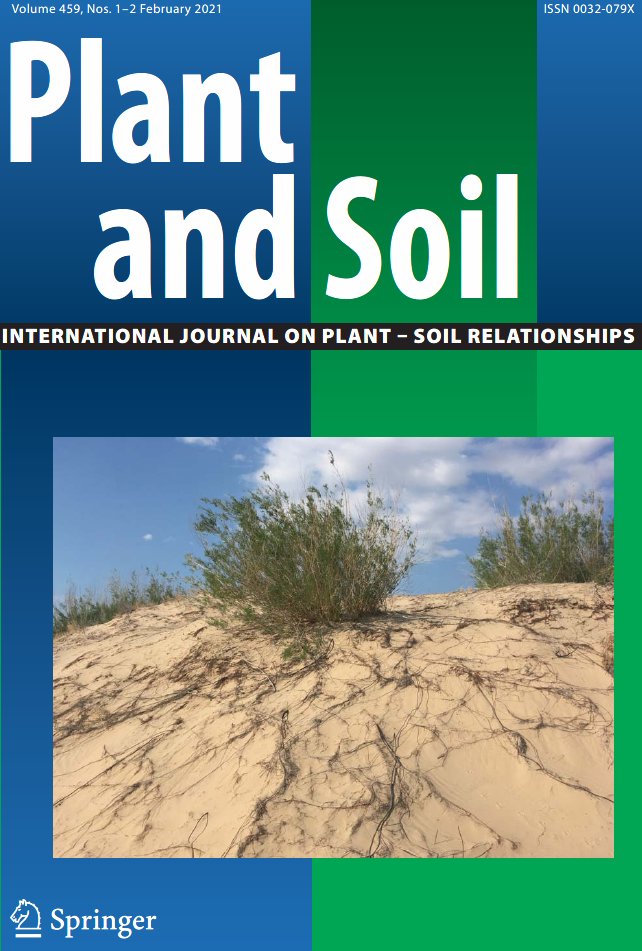
Plant and Soil publishes original papers and review articles exploring the interface of plant biology and soil sciences, and that enhance our mechanistic understanding of plant-soil interactions. We focus on the interface of plant biology and soil sciences, and seek those manuscripts with a strong mechanistic component which develop and test hypotheses aimed at understanding underlying mechanisms of plant-soil interactions. Manuscripts can include both fundamental and applied aspects of mineral nutrition, plant water relations, symbiotic and pathogenic plant-microbe interactions, root anatomy and morphology, soil biology, ecology, agrochemistry and agrophysics, as long as they are hypothesis-driven and enhance our mechanistic understanding. Articles including a major molecular or modelling component also fall within the scope of the journal. All contributions appear in the English language, with consistent spelling, using either American or British English.



 京公网安备 11010802042870号
京ICP备2023020795号-1
京公网安备 11010802042870号
京ICP备2023020795号-1

 分享
分享
 求助内容:
求助内容: 应助结果提醒方式:
 扫码关注我们
