Ziyang Zhou, Huichun Zhang, Liming Bian, Lei Zhou, Yufeng Ge
{"title":"Integrating sensor fusion with machine learning for comprehensive assessment of phenotypic traits and drought response in poplar species","authors":"Ziyang Zhou, Huichun Zhang, Liming Bian, Lei Zhou, Yufeng Ge","doi":"10.1111/pbi.70039","DOIUrl":null,"url":null,"abstract":"<p>Increased drought frequency and severity in a warming climate threaten the health and stability of forest ecosystems, influencing the structure and functioning of forests while having far-reaching implications for global carbon storage and climate regulation. To effectively address the challenges posed by drought, it is imperative to monitor and assess the degree of drought stress in trees in a timely and accurate manner. In this study, a gradient drought stress experiment was conducted with poplar as the research object, and multimodal data were collected for subsequent analysis. A machine learning-based poplar drought monitoring model was constructed, thereby enabling the monitoring of drought severity and duration in poplar trees. Four data processing methods, namely data decomposition, data layer fusion, feature layer fusion and decision layer fusion, were employed to comprehensively evaluate poplar drought monitoring. Additionally, the potential of new phenotypic features obtained by different data processing methods for poplar drought monitoring was discussed. The results demonstrate that the optimal machine learning poplar drought monitoring model, constructed under feature layer fusion, exhibits the best performance, with average accuracy, average precision, average recall and average F1 score reaching 0.85, 0.86, 0.85 and 0.85, respectively. Conversely, the novel phenotypic features derived through data decomposition and data layer fusion methods as supplementary features did not further augment the model precision. This indicates that the feature layer fusion approach has clear advantages in drought monitoring. This research offers a robust theoretical foundation and practical guidance for future tree health monitoring and drought response assessment.</p>","PeriodicalId":221,"journal":{"name":"Plant Biotechnology Journal","volume":"23 7","pages":"2464-2481"},"PeriodicalIF":10.5000,"publicationDate":"2025-03-30","publicationTypes":"Journal Article","fieldsOfStudy":null,"isOpenAccess":false,"openAccessPdf":"https://onlinelibrary.wiley.com/doi/epdf/10.1111/pbi.70039","citationCount":"0","resultStr":null,"platform":"Semanticscholar","paperid":null,"PeriodicalName":"Plant Biotechnology Journal","FirstCategoryId":"5","ListUrlMain":"https://onlinelibrary.wiley.com/doi/10.1111/pbi.70039","RegionNum":1,"RegionCategory":"生物学","ArticlePicture":[],"TitleCN":null,"AbstractTextCN":null,"PMCID":null,"EPubDate":"","PubModel":"","JCR":"Q1","JCRName":"BIOTECHNOLOGY & APPLIED MICROBIOLOGY","Score":null,"Total":0}
引用次数: 0
Abstract
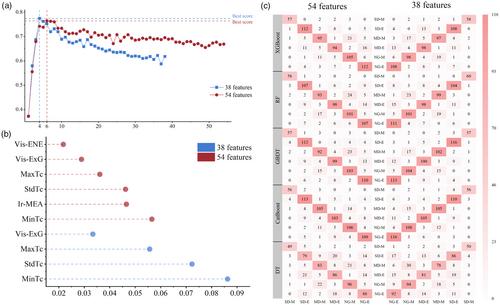
Increased drought frequency and severity in a warming climate threaten the health and stability of forest ecosystems, influencing the structure and functioning of forests while having far-reaching implications for global carbon storage and climate regulation. To effectively address the challenges posed by drought, it is imperative to monitor and assess the degree of drought stress in trees in a timely and accurate manner. In this study, a gradient drought stress experiment was conducted with poplar as the research object, and multimodal data were collected for subsequent analysis. A machine learning-based poplar drought monitoring model was constructed, thereby enabling the monitoring of drought severity and duration in poplar trees. Four data processing methods, namely data decomposition, data layer fusion, feature layer fusion and decision layer fusion, were employed to comprehensively evaluate poplar drought monitoring. Additionally, the potential of new phenotypic features obtained by different data processing methods for poplar drought monitoring was discussed. The results demonstrate that the optimal machine learning poplar drought monitoring model, constructed under feature layer fusion, exhibits the best performance, with average accuracy, average precision, average recall and average F1 score reaching 0.85, 0.86, 0.85 and 0.85, respectively. Conversely, the novel phenotypic features derived through data decomposition and data layer fusion methods as supplementary features did not further augment the model precision. This indicates that the feature layer fusion approach has clear advantages in drought monitoring. This research offers a robust theoretical foundation and practical guidance for future tree health monitoring and drought response assessment.
期刊介绍:
Plant Biotechnology Journal aspires to publish original research and insightful reviews of high impact, authored by prominent researchers in applied plant science. The journal places a special emphasis on molecular plant sciences and their practical applications through plant biotechnology. Our goal is to establish a platform for showcasing significant advances in the field, encompassing curiosity-driven studies with potential applications, strategic research in plant biotechnology, scientific analysis of crucial issues for the beneficial utilization of plant sciences, and assessments of the performance of plant biotechnology products in practical applications.



 京公网安备 11010802042870号
京ICP备2023020795号-1
京公网安备 11010802042870号
京ICP备2023020795号-1

 分享
分享
 求助内容:
求助内容: 应助结果提醒方式:
 扫码关注我们
