Yukun Li , Hao Luo , Shuzhe Yang , Xiaoxiao Pan , Hongwei Cai , Qingqing Gao , Yujin Tong , Tiefeng Liu , Mi Lu
{"title":"An ultra-thick solvent-free electrode based on non-conservative pulsed shear field mixing","authors":"Yukun Li , Hao Luo , Shuzhe Yang , Xiaoxiao Pan , Hongwei Cai , Qingqing Gao , Yujin Tong , Tiefeng Liu , Mi Lu","doi":"10.1016/j.ensm.2025.104218","DOIUrl":null,"url":null,"abstract":"<div><div>Despite being extensively expected as an eco-friendly and cost-effective electrode manufacturing technique in batteries, the solvent-free (SF) technique still suffers from poor mechanical stability and inhomogeneous mixing, especially for ultra-thick electrode. Herein, we pivot from unusual shear force field regulation, proposing a pulsed mixing (PM) strategy to redefine energy release criterion. Mechanical evaluation and X-ray Nano-CT tomography demonstrate that PM strategy can construct uniform and robust SF ultra-thick electrode with 3D charge transfer highway and deeply interconnected charge carrier permeable network by optimizing dynamic connections among electroactive materials. As a proof of concept, an unprecedented ultra-high mass loading of 121 mg cm<sup>−2</sup> can be achieved in a SF LiMn<sub>2</sub>O<sub>4</sub> (LMO) electrode with a capacity of 11.6 mA h cm<sup>−2</sup>, and appealing cyclability over 30 times. Furthermore, the thick SF LMO (58 mg cm<sup>−2</sup>) displays a high-capacity retention of 93 % over 100 cycles at 0.1 C. Even the assembled SF LMO||Si/C full cell also exhibits good cycle stability with a capacity retention of 87.5 % after 100 cycles. The finding signifies a paradigm innovate and introduces transformative opportunities for the design of high-performance and green batteries.</div></div>","PeriodicalId":306,"journal":{"name":"Energy Storage Materials","volume":"77 ","pages":"Article 104218"},"PeriodicalIF":20.2000,"publicationDate":"2025-04-01","publicationTypes":"Journal Article","fieldsOfStudy":null,"isOpenAccess":false,"openAccessPdf":"","citationCount":"0","resultStr":null,"platform":"Semanticscholar","paperid":null,"PeriodicalName":"Energy Storage Materials","FirstCategoryId":"88","ListUrlMain":"https://www.sciencedirect.com/science/article/pii/S2405829725002181","RegionNum":1,"RegionCategory":"材料科学","ArticlePicture":[],"TitleCN":null,"AbstractTextCN":null,"PMCID":null,"EPubDate":"2025/3/31 0:00:00","PubModel":"Epub","JCR":"Q1","JCRName":"CHEMISTRY, PHYSICAL","Score":null,"Total":0}
引用次数: 0
Abstract
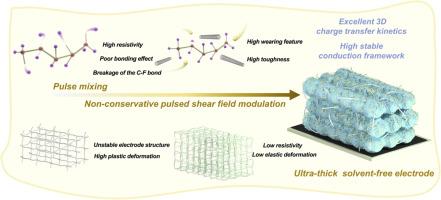
Despite being extensively expected as an eco-friendly and cost-effective electrode manufacturing technique in batteries, the solvent-free (SF) technique still suffers from poor mechanical stability and inhomogeneous mixing, especially for ultra-thick electrode. Herein, we pivot from unusual shear force field regulation, proposing a pulsed mixing (PM) strategy to redefine energy release criterion. Mechanical evaluation and X-ray Nano-CT tomography demonstrate that PM strategy can construct uniform and robust SF ultra-thick electrode with 3D charge transfer highway and deeply interconnected charge carrier permeable network by optimizing dynamic connections among electroactive materials. As a proof of concept, an unprecedented ultra-high mass loading of 121 mg cm−2 can be achieved in a SF LiMn2O4 (LMO) electrode with a capacity of 11.6 mA h cm−2, and appealing cyclability over 30 times. Furthermore, the thick SF LMO (58 mg cm−2) displays a high-capacity retention of 93 % over 100 cycles at 0.1 C. Even the assembled SF LMO||Si/C full cell also exhibits good cycle stability with a capacity retention of 87.5 % after 100 cycles. The finding signifies a paradigm innovate and introduces transformative opportunities for the design of high-performance and green batteries.
期刊介绍:
Energy Storage Materials is a global interdisciplinary journal dedicated to sharing scientific and technological advancements in materials and devices for advanced energy storage and related energy conversion, such as in metal-O2 batteries. The journal features comprehensive research articles, including full papers and short communications, as well as authoritative feature articles and reviews by leading experts in the field.
Energy Storage Materials covers a wide range of topics, including the synthesis, fabrication, structure, properties, performance, and technological applications of energy storage materials. Additionally, the journal explores strategies, policies, and developments in the field of energy storage materials and devices for sustainable energy.
Published papers are selected based on their scientific and technological significance, their ability to provide valuable new knowledge, and their relevance to the international research community.




 京公网安备 11010802042870号
京ICP备2023020795号-1
京公网安备 11010802042870号
京ICP备2023020795号-1

 分享
分享
 求助内容:
求助内容: 应助结果提醒方式:
 扫码关注我们
