{"title":"Ultrafast Charge Migration and Efficient Charge Separation in Dodecahedron CsPbBr3–Semiconductor Janus Heterostructures","authors":"Kaliyamoorthy Justice Babu, Ayushi Shukla, Gurpreet Kaur, Arshdeep Kaur, Ramchandra Saha, Himanshu Bhatt, Hirendra N. Ghosh","doi":"10.1021/acsphotonics.4c02299","DOIUrl":null,"url":null,"abstract":"Fundamental knowledge of charge transfer mechanism across the interface of heterostructures has sparked a new revolution of interest for next-generation device applications owing to their strong wave function engineering, interlayer coupling, and enhanced charge separation of photogenerated excitons. Janus-type heterostructures characterized by a well-defined interface between metal halide perovskite and semiconductor quantum dots have gained immense attention in high-performance photovoltaic and optoelectronic applications. In the present investigation, dodecahedron CsPbBr<sub>3</sub>/CdS Janus heterostructure has been synthesized using a single-step colloidal hot injection route. High-resolution transmission electron microscope images clearly indicate direct growth between the (002) plane of dodecahedron CsPbBr<sub>3</sub> nanocrystals and the (200) plane of CdS quantum dots. Steady-state optical studies suggest the formation of a charge transfer (CT) complex, which in turn reconfirms the formation of a strong Janus heterostructure between CsPbBr<sub>3</sub> and CdS. Further, femtosecond transient absorption spectroscopy has been employed to unravel the ultrafast charge transfer dynamics at the interface of a CsPbBr<sub>3</sub>/CdS heterostructure after exciting the samples at 350 and 490 nm. The appearance of TA bleach after exciting the heterostructure at 490 nm at the CdS position (460 nm) due to electron transfer from CsPbBr<sub>3</sub> to CdS provides compelling evidence for the existence of type II band alignment and affirms the presence of a robust growth in the heterostructure. This study sheds light on the preparation of perovskite-based heterostructures which may pave the way toward high-performance photovoltaic and catalytic applications.","PeriodicalId":23,"journal":{"name":"ACS Photonics","volume":"88 1","pages":""},"PeriodicalIF":6.7000,"publicationDate":"2025-03-31","publicationTypes":"Journal Article","fieldsOfStudy":null,"isOpenAccess":false,"openAccessPdf":"","citationCount":"0","resultStr":null,"platform":"Semanticscholar","paperid":null,"PeriodicalName":"ACS Photonics","FirstCategoryId":"101","ListUrlMain":"https://doi.org/10.1021/acsphotonics.4c02299","RegionNum":1,"RegionCategory":"物理与天体物理","ArticlePicture":[],"TitleCN":null,"AbstractTextCN":null,"PMCID":null,"EPubDate":"","PubModel":"","JCR":"Q1","JCRName":"MATERIALS SCIENCE, MULTIDISCIPLINARY","Score":null,"Total":0}
引用次数: 0
Abstract
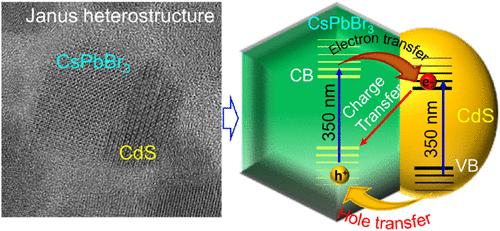
Fundamental knowledge of charge transfer mechanism across the interface of heterostructures has sparked a new revolution of interest for next-generation device applications owing to their strong wave function engineering, interlayer coupling, and enhanced charge separation of photogenerated excitons. Janus-type heterostructures characterized by a well-defined interface between metal halide perovskite and semiconductor quantum dots have gained immense attention in high-performance photovoltaic and optoelectronic applications. In the present investigation, dodecahedron CsPbBr3/CdS Janus heterostructure has been synthesized using a single-step colloidal hot injection route. High-resolution transmission electron microscope images clearly indicate direct growth between the (002) plane of dodecahedron CsPbBr3 nanocrystals and the (200) plane of CdS quantum dots. Steady-state optical studies suggest the formation of a charge transfer (CT) complex, which in turn reconfirms the formation of a strong Janus heterostructure between CsPbBr3 and CdS. Further, femtosecond transient absorption spectroscopy has been employed to unravel the ultrafast charge transfer dynamics at the interface of a CsPbBr3/CdS heterostructure after exciting the samples at 350 and 490 nm. The appearance of TA bleach after exciting the heterostructure at 490 nm at the CdS position (460 nm) due to electron transfer from CsPbBr3 to CdS provides compelling evidence for the existence of type II band alignment and affirms the presence of a robust growth in the heterostructure. This study sheds light on the preparation of perovskite-based heterostructures which may pave the way toward high-performance photovoltaic and catalytic applications.
期刊介绍:
Published as soon as accepted and summarized in monthly issues, ACS Photonics will publish Research Articles, Letters, Perspectives, and Reviews, to encompass the full scope of published research in this field.



 京公网安备 11010802042870号
京ICP备2023020795号-1
京公网安备 11010802042870号
京ICP备2023020795号-1

 分享
分享
 求助内容:
求助内容: 应助结果提醒方式:
 扫码关注我们
