Xinyan Zhang, Xingshuo Cui, Tong Cai, Weiqi Cai, Tony Low, Hongsheng Chen, Xiao Lin
{"title":"Scattering-free Plasmonic Brewster Effect via Metasurfaces","authors":"Xinyan Zhang, Xingshuo Cui, Tong Cai, Weiqi Cai, Tony Low, Hongsheng Chen, Xiao Lin","doi":"10.1021/acsphotonics.4c02263","DOIUrl":null,"url":null,"abstract":"The Brewster effect, dating back to the pioneering work of Sir David Brewster in 1815, offers a crucial route to achieve 100% energy conversion between the incident and transmitted propagating waves at an optical interface and is of fundamental importance to many practical applications, such as polarization filtering, beam steering, and optical broadband angular selectivity. However, whether the Brewster effect of surface waves can be implemented without the involvement of negative-permittivity or negative-permeability materials remains elusive. This is due to the formidable challenge to fully suppress both the parasitic scattering into propagating waves and the reflection into surface waves under the incidence of surface waves. Here, we reveal a feasible route to achieve a scattering-free plasmonic Brewster effect via isotropic metasurfaces, along with the usage of positive-permittivity and positive-permeability metamaterials with both anisotropic and magnetic responses. In essence, the anisotropic response of metamaterials is judiciously designed to fully suppress the parasitic scattering into propagating waves, while the magnetic response of metamaterials facilitates the full suppression of the reflection into surface waves supported by metasurfaces. Moreover, we find that this plasmonic Brewster effect via metasurfaces can be further engineered to occur for arbitrary incident angles, giving rise to the exotic phenomenon of all-angle scattering-free plasmonic Brewster effect.","PeriodicalId":23,"journal":{"name":"ACS Photonics","volume":"49 1","pages":""},"PeriodicalIF":6.7000,"publicationDate":"2025-03-30","publicationTypes":"Journal Article","fieldsOfStudy":null,"isOpenAccess":false,"openAccessPdf":"","citationCount":"0","resultStr":null,"platform":"Semanticscholar","paperid":null,"PeriodicalName":"ACS Photonics","FirstCategoryId":"101","ListUrlMain":"https://doi.org/10.1021/acsphotonics.4c02263","RegionNum":1,"RegionCategory":"物理与天体物理","ArticlePicture":[],"TitleCN":null,"AbstractTextCN":null,"PMCID":null,"EPubDate":"","PubModel":"","JCR":"Q1","JCRName":"MATERIALS SCIENCE, MULTIDISCIPLINARY","Score":null,"Total":0}
引用次数: 0
Abstract
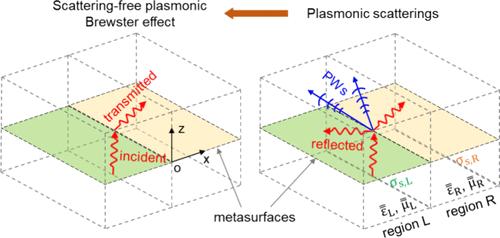
The Brewster effect, dating back to the pioneering work of Sir David Brewster in 1815, offers a crucial route to achieve 100% energy conversion between the incident and transmitted propagating waves at an optical interface and is of fundamental importance to many practical applications, such as polarization filtering, beam steering, and optical broadband angular selectivity. However, whether the Brewster effect of surface waves can be implemented without the involvement of negative-permittivity or negative-permeability materials remains elusive. This is due to the formidable challenge to fully suppress both the parasitic scattering into propagating waves and the reflection into surface waves under the incidence of surface waves. Here, we reveal a feasible route to achieve a scattering-free plasmonic Brewster effect via isotropic metasurfaces, along with the usage of positive-permittivity and positive-permeability metamaterials with both anisotropic and magnetic responses. In essence, the anisotropic response of metamaterials is judiciously designed to fully suppress the parasitic scattering into propagating waves, while the magnetic response of metamaterials facilitates the full suppression of the reflection into surface waves supported by metasurfaces. Moreover, we find that this plasmonic Brewster effect via metasurfaces can be further engineered to occur for arbitrary incident angles, giving rise to the exotic phenomenon of all-angle scattering-free plasmonic Brewster effect.
期刊介绍:
Published as soon as accepted and summarized in monthly issues, ACS Photonics will publish Research Articles, Letters, Perspectives, and Reviews, to encompass the full scope of published research in this field.



 京公网安备 11010802042870号
京ICP备2023020795号-1
京公网安备 11010802042870号
京ICP备2023020795号-1

 分享
分享
 求助内容:
求助内容: 应助结果提醒方式:
 扫码关注我们
