{"title":"Synthesis of bio-based poly(diethylene furanoate)-block-polylactide copolymers with UV blocking properties","authors":"Judit Rebeka Molnár, Yu-I Hsu, Hiroshi Uyama","doi":"10.1016/j.polymdegradstab.2025.111342","DOIUrl":null,"url":null,"abstract":"<div><div>The transition to a circular economy requires the development of bio-based polymers with enhanced functionality to compete with conventional oil-sourced materials. In this study, a bio-based furandicarboxylic acid-containing polyester, poly(diethylene furanoate) (PDEF) was directly copolymerized with polylactide (PLA) for the first time, through the polycondensation of dimethyl furan-2,5-dicarboxylate (MFDC) and diethylene glycol (DEG), used as an initiator for the ring-opening polymerization (ROP) of lactide, followed by chain extension reaction with hexamethylene diisocyanate (HDI) to obtain poly(diethylene furanoate)-block-polylactide (PDEF-b-PLA) alternating multiblock copolymers. The PDEF synthesized with different reaction times exhibited an average glass transition temperature (T<sub>g</sub>) of 33.8 °C. The copolymers had PLA segment lengths of 1000 and 300 g/mol after ROP maintaining an amorphous structure with a T<sub>g</sub> of 34.5 and 33.3 °C respectively, suggesting easy processability. Thermal stability of the copolymers was enhanced, indicated by increased decomposition temperatures and residual weight compared to neat PLA. PDEF displayed elastomer-like behavior while the copolymerization resulted in an intermediate behavior between PDEF and semi-crystalline PLA, with a high Young's modulus of 1.7 and 1.4 GPa, a balanced tensile stress at yield of 24.3 and 28.9 MPa and a significantly increased elongation at break, by 700–1100 % compared to neat PLA. All PDEF-containing samples demonstrated excellent UV-blocking ability due to the furan moiety, effectively blocking UV radiation below 300 nm while maintaining transparency in the visible range. These bio-based PDEF-b-PLA copolymers offer a sustainable alternative for applications such as food packaging and coatings, where thermal stability, mechanical resilience and UV protection are essential.</div></div>","PeriodicalId":406,"journal":{"name":"Polymer Degradation and Stability","volume":"238 ","pages":"Article 111342"},"PeriodicalIF":7.4000,"publicationDate":"2025-08-01","publicationTypes":"Journal Article","fieldsOfStudy":null,"isOpenAccess":false,"openAccessPdf":"","citationCount":"0","resultStr":null,"platform":"Semanticscholar","paperid":null,"PeriodicalName":"Polymer Degradation and Stability","FirstCategoryId":"92","ListUrlMain":"https://www.sciencedirect.com/science/article/pii/S0141391025001727","RegionNum":2,"RegionCategory":"化学","ArticlePicture":[],"TitleCN":null,"AbstractTextCN":null,"PMCID":null,"EPubDate":"2025/4/1 0:00:00","PubModel":"Epub","JCR":"Q1","JCRName":"POLYMER SCIENCE","Score":null,"Total":0}
引用次数: 0
Abstract
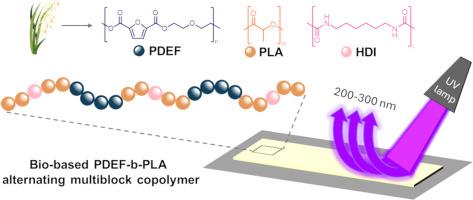
The transition to a circular economy requires the development of bio-based polymers with enhanced functionality to compete with conventional oil-sourced materials. In this study, a bio-based furandicarboxylic acid-containing polyester, poly(diethylene furanoate) (PDEF) was directly copolymerized with polylactide (PLA) for the first time, through the polycondensation of dimethyl furan-2,5-dicarboxylate (MFDC) and diethylene glycol (DEG), used as an initiator for the ring-opening polymerization (ROP) of lactide, followed by chain extension reaction with hexamethylene diisocyanate (HDI) to obtain poly(diethylene furanoate)-block-polylactide (PDEF-b-PLA) alternating multiblock copolymers. The PDEF synthesized with different reaction times exhibited an average glass transition temperature (Tg) of 33.8 °C. The copolymers had PLA segment lengths of 1000 and 300 g/mol after ROP maintaining an amorphous structure with a Tg of 34.5 and 33.3 °C respectively, suggesting easy processability. Thermal stability of the copolymers was enhanced, indicated by increased decomposition temperatures and residual weight compared to neat PLA. PDEF displayed elastomer-like behavior while the copolymerization resulted in an intermediate behavior between PDEF and semi-crystalline PLA, with a high Young's modulus of 1.7 and 1.4 GPa, a balanced tensile stress at yield of 24.3 and 28.9 MPa and a significantly increased elongation at break, by 700–1100 % compared to neat PLA. All PDEF-containing samples demonstrated excellent UV-blocking ability due to the furan moiety, effectively blocking UV radiation below 300 nm while maintaining transparency in the visible range. These bio-based PDEF-b-PLA copolymers offer a sustainable alternative for applications such as food packaging and coatings, where thermal stability, mechanical resilience and UV protection are essential.
期刊介绍:
Polymer Degradation and Stability deals with the degradation reactions and their control which are a major preoccupation of practitioners of the many and diverse aspects of modern polymer technology.
Deteriorative reactions occur during processing, when polymers are subjected to heat, oxygen and mechanical stress, and during the useful life of the materials when oxygen and sunlight are the most important degradative agencies. In more specialised applications, degradation may be induced by high energy radiation, ozone, atmospheric pollutants, mechanical stress, biological action, hydrolysis and many other influences. The mechanisms of these reactions and stabilisation processes must be understood if the technology and application of polymers are to continue to advance. The reporting of investigations of this kind is therefore a major function of this journal.
However there are also new developments in polymer technology in which degradation processes find positive applications. For example, photodegradable plastics are now available, the recycling of polymeric products will become increasingly important, degradation and combustion studies are involved in the definition of the fire hazards which are associated with polymeric materials and the microelectronics industry is vitally dependent upon polymer degradation in the manufacture of its circuitry. Polymer properties may also be improved by processes like curing and grafting, the chemistry of which can be closely related to that which causes physical deterioration in other circumstances.



 京公网安备 11010802042870号
京ICP备2023020795号-1
京公网安备 11010802042870号
京ICP备2023020795号-1

 分享
分享
 求助内容:
求助内容: 应助结果提醒方式:
 扫码关注我们
