Rui Jia , Hua-Xiang Li , Zhen-Liang Xu , Xiao-Gang Jin , Liu-Kun Wu , Hui-Hui Ping , Xiao-Hua Ma , Sun-Jie Xu
{"title":"Surfactants intervened construction of NF membranes for lithium extraction in high Mg2+/Li+ ratio and high concentration environments","authors":"Rui Jia , Hua-Xiang Li , Zhen-Liang Xu , Xiao-Gang Jin , Liu-Kun Wu , Hui-Hui Ping , Xiao-Hua Ma , Sun-Jie Xu","doi":"10.1016/j.memsci.2025.124048","DOIUrl":null,"url":null,"abstract":"<div><div>Nanofiltration (NF) membranes offer notable benefits for Li<sup>+</sup>/Mg<sup>2+</sup> separation, but their efficiency tends to diminish when exposed to mixed salt solutions with elevated Mg<sup>2+</sup> concentrations or high Mg<sup>2+</sup>/Li<sup>+</sup> ratios (MLR), restricting their practical applications. This study employed the surfactant-assisted interfacial polymerization (SIAIP) method to incorporate sodium dodecyl sulfate (SDS) and dodecyl phosphate (DDP), leading to the creation of two NF membranes with opposite surface charge characteristics. SDS promoted the <em>trans</em>-interfacial diffusion of the amine monomer while simultaneously limiting its escape from the bulk-phase solution, which was crucial for developing positively charged membranes. Conversely, DDP predominantly influenced the interfacial diffusion of the amine monomer, resulting in a membrane with a reduced pore size and a negatively charged active layer. SIAIP-DDP membranes exhibited excellent stability (S <sub>Li, Mg</sub> > 110) in environments with high MLR and Mg<sup>2+</sup> concentrations, highlighting their potential for application in harsh salt-lake brine. This work presents a detailed mechanistic analysis of the surfactant-induced interfacial polymerization process, offering new insights into the efficient separation of Li<sup>+</sup>/Mg<sup>2+</sup> under high MLR and high concentration conditions.</div></div>","PeriodicalId":368,"journal":{"name":"Journal of Membrane Science","volume":"726 ","pages":"Article 124048"},"PeriodicalIF":9.0000,"publicationDate":"2025-05-01","publicationTypes":"Journal Article","fieldsOfStudy":null,"isOpenAccess":false,"openAccessPdf":"","citationCount":"0","resultStr":null,"platform":"Semanticscholar","paperid":null,"PeriodicalName":"Journal of Membrane Science","FirstCategoryId":"5","ListUrlMain":"https://www.sciencedirect.com/science/article/pii/S0376738825003618","RegionNum":1,"RegionCategory":"工程技术","ArticlePicture":[],"TitleCN":null,"AbstractTextCN":null,"PMCID":null,"EPubDate":"2025/3/28 0:00:00","PubModel":"Epub","JCR":"Q1","JCRName":"ENGINEERING, CHEMICAL","Score":null,"Total":0}
引用次数: 0
Abstract
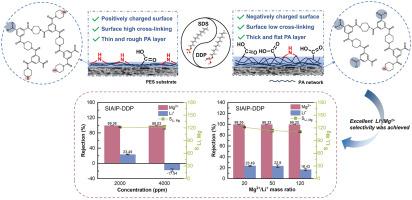
Nanofiltration (NF) membranes offer notable benefits for Li+/Mg2+ separation, but their efficiency tends to diminish when exposed to mixed salt solutions with elevated Mg2+ concentrations or high Mg2+/Li+ ratios (MLR), restricting their practical applications. This study employed the surfactant-assisted interfacial polymerization (SIAIP) method to incorporate sodium dodecyl sulfate (SDS) and dodecyl phosphate (DDP), leading to the creation of two NF membranes with opposite surface charge characteristics. SDS promoted the trans-interfacial diffusion of the amine monomer while simultaneously limiting its escape from the bulk-phase solution, which was crucial for developing positively charged membranes. Conversely, DDP predominantly influenced the interfacial diffusion of the amine monomer, resulting in a membrane with a reduced pore size and a negatively charged active layer. SIAIP-DDP membranes exhibited excellent stability (S Li, Mg > 110) in environments with high MLR and Mg2+ concentrations, highlighting their potential for application in harsh salt-lake brine. This work presents a detailed mechanistic analysis of the surfactant-induced interfacial polymerization process, offering new insights into the efficient separation of Li+/Mg2+ under high MLR and high concentration conditions.
期刊介绍:
The Journal of Membrane Science is a publication that focuses on membrane systems and is aimed at academic and industrial chemists, chemical engineers, materials scientists, and membranologists. It publishes original research and reviews on various aspects of membrane transport, membrane formation/structure, fouling, module/process design, and processes/applications. The journal primarily focuses on the structure, function, and performance of non-biological membranes but also includes papers that relate to biological membranes. The Journal of Membrane Science publishes Full Text Papers, State-of-the-Art Reviews, Letters to the Editor, and Perspectives.



 京公网安备 11010802042870号
京ICP备2023020795号-1
京公网安备 11010802042870号
京ICP备2023020795号-1

 分享
分享
 求助内容:
求助内容: 应助结果提醒方式:
 扫码关注我们
