{"title":"Facile fabrication of SiO2-ZrO2/Al2O3 ceramic hollow fiber nanofiltration membrane for hot industrial wastewater treatment","authors":"Beibei Liu , Zhigang Wang , Xiaoyao Tan","doi":"10.1016/j.memsci.2025.123983","DOIUrl":null,"url":null,"abstract":"<div><div>Ceramic nanofiltration (NF) membranes exhibit superior stability and can operate effectively under harsh conditions. However, the tedious fabrication processes always result in a high cost for ceramic NF membranes. In this work, SiO<sub>2</sub>–ZrO<sub>2</sub>/Al<sub>2</sub>O<sub>3</sub> ceramic hollow fiber NF membranes are facilely fabricated. Boehmite sol only is used to create the interlayer between the support and the SiO<sub>2</sub>–ZrO<sub>2</sub> separation layer. By optimizing the pore size and thickness of this interlayer, the modification process for the support is streamlined from multiple steps to a single step. Additionally, the required number of SiO<sub>2</sub>–ZrO<sub>2</sub> layer coatings is substantially reduced, significantly enhancing process efficiency. Meanwhile, this work also identifies the characteristics of an appropriate interlayer that meets the requirements for effectively coating the SiO<sub>2</sub>–ZrO<sub>2</sub> layer. Finally, an optimized ceramic NF membrane with a molecular weight cut-off (MWCO) of 1000 Da and an average pore size of 1.59 nm is achieved. This ceramic NF membrane reveals superior retention for most dyes and high transport for monovalent salts (retention <20 %). In the application of dye desalination for hot textile wastewater treatment, the membrane displays an excellent permeance of more than 6 LMH/bar and good selectivity for dye/salt mixture solutions at 60 °C (e.g. the separation factors for EB/NaCl, BS/NaCl, CR/NaCl, and EBT/NaCl attained 256, 872, 100 and 433, respectively). Meanwhile, the membrane exhibits outstanding hydrothermal stability and remarkable resistance to membrane fouling under harsh acid and alkali conditions, maintaining stable separation performance for dye desalination over 100 h at 60 °C.</div></div>","PeriodicalId":368,"journal":{"name":"Journal of Membrane Science","volume":"726 ","pages":"Article 123983"},"PeriodicalIF":9.0000,"publicationDate":"2025-05-01","publicationTypes":"Journal Article","fieldsOfStudy":null,"isOpenAccess":false,"openAccessPdf":"","citationCount":"0","resultStr":null,"platform":"Semanticscholar","paperid":null,"PeriodicalName":"Journal of Membrane Science","FirstCategoryId":"5","ListUrlMain":"https://www.sciencedirect.com/science/article/pii/S0376738825002960","RegionNum":1,"RegionCategory":"工程技术","ArticlePicture":[],"TitleCN":null,"AbstractTextCN":null,"PMCID":null,"EPubDate":"2025/3/26 0:00:00","PubModel":"Epub","JCR":"Q1","JCRName":"ENGINEERING, CHEMICAL","Score":null,"Total":0}
引用次数: 0
Abstract
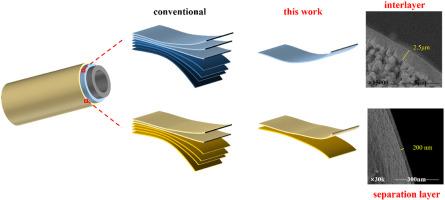
Ceramic nanofiltration (NF) membranes exhibit superior stability and can operate effectively under harsh conditions. However, the tedious fabrication processes always result in a high cost for ceramic NF membranes. In this work, SiO2–ZrO2/Al2O3 ceramic hollow fiber NF membranes are facilely fabricated. Boehmite sol only is used to create the interlayer between the support and the SiO2–ZrO2 separation layer. By optimizing the pore size and thickness of this interlayer, the modification process for the support is streamlined from multiple steps to a single step. Additionally, the required number of SiO2–ZrO2 layer coatings is substantially reduced, significantly enhancing process efficiency. Meanwhile, this work also identifies the characteristics of an appropriate interlayer that meets the requirements for effectively coating the SiO2–ZrO2 layer. Finally, an optimized ceramic NF membrane with a molecular weight cut-off (MWCO) of 1000 Da and an average pore size of 1.59 nm is achieved. This ceramic NF membrane reveals superior retention for most dyes and high transport for monovalent salts (retention <20 %). In the application of dye desalination for hot textile wastewater treatment, the membrane displays an excellent permeance of more than 6 LMH/bar and good selectivity for dye/salt mixture solutions at 60 °C (e.g. the separation factors for EB/NaCl, BS/NaCl, CR/NaCl, and EBT/NaCl attained 256, 872, 100 and 433, respectively). Meanwhile, the membrane exhibits outstanding hydrothermal stability and remarkable resistance to membrane fouling under harsh acid and alkali conditions, maintaining stable separation performance for dye desalination over 100 h at 60 °C.
期刊介绍:
The Journal of Membrane Science is a publication that focuses on membrane systems and is aimed at academic and industrial chemists, chemical engineers, materials scientists, and membranologists. It publishes original research and reviews on various aspects of membrane transport, membrane formation/structure, fouling, module/process design, and processes/applications. The journal primarily focuses on the structure, function, and performance of non-biological membranes but also includes papers that relate to biological membranes. The Journal of Membrane Science publishes Full Text Papers, State-of-the-Art Reviews, Letters to the Editor, and Perspectives.



 京公网安备 11010802042870号
京ICP备2023020795号-1
京公网安备 11010802042870号
京ICP备2023020795号-1

 分享
分享
 求助内容:
求助内容: 应助结果提醒方式:
 扫码关注我们
