Interventions to increase uptake in a fecal-immunochemical test population-based colorectal cancer screening program: A quasi-experimental study of first-time invitees
Nicholas Clarke PhD, Therese Mooney PhD, Pamela Gallagher PhD, Christian von Wagner PhD, Paul Hanly PhD, Deirdre McNamara MD, Hilary Coffey MBS, Patricia Fitzpatrick MD, Linda Sharp PhD
{"title":"Interventions to increase uptake in a fecal-immunochemical test population-based colorectal cancer screening program: A quasi-experimental study of first-time invitees","authors":"Nicholas Clarke PhD, Therese Mooney PhD, Pamela Gallagher PhD, Christian von Wagner PhD, Paul Hanly PhD, Deirdre McNamara MD, Hilary Coffey MBS, Patricia Fitzpatrick MD, Linda Sharp PhD","doi":"10.1002/cncr.35760","DOIUrl":null,"url":null,"abstract":"<div>\n \n \n <section>\n \n <h3> Background</h3>\n \n <p>Many countries have established organized colorectal cancer screening programs because they can reduce mortality and incidence from the disease; however, they rely on high participation rates, which are often suboptimal. This study examined the effectiveness of two reminder interventions on uptake rates in Ireland’s population-based BowelScreen program.</p>\n </section>\n \n <section>\n \n <h3> Methods</h3>\n \n <p>Employing a quasi-experimental design, one intervention mailed the fecal-immunochemical test (FIT) directly to clients not responding to an initial invitation; the other mailed a reminder letter modified with behavioral insights. Interventions were tested separately and in combination and compared to the standard reminder letter (1: standard reminder letter [SRL]; 2: modified reminder letter [MRL]; 3: SRL + FIT direct [FITD]; and 4: MRL + FITD). Primary outcome: overall uptake rate (test completion at 5 months); Subgroup outcome: uptake rate among only those receiving reminders. Outcomes were modeled using multivariable logistic regression with group allocation as a fixed effect, adjusted for sex and deprivation.</p>\n </section>\n \n <section>\n \n <h3> Results</h3>\n \n <p>Uptake was significantly higher in the FITD groups (SRL: 48%; MRL: 50%; SRL + FITD: 54%; MRL + FITD: 54%; <i>p</i> < .001). After adjustment, compared to the SRL group, FITD groups had significantly higher odds of uptake (MRL: odds ratio [OR], 1.09; 95% confidence interval [CI], 0.96–1.23; SRL + FITD: OR, 1.30; 95% CI, 1.14–1.48; MRL + FITD: OR, 1.26; 95% CI, 1.11–1.44). This was also the case for subgroup analysis. The MRL did not result in higher uptake compared to SRL.</p>\n </section>\n \n <section>\n \n <h3> Conclusion</h3>\n \n <p>Mailing the FIT kit directly to nonresponders resulted in improved FIT uptake. Organized FIT-based screening programs not reaching uptake targets should consider implementing this strategy if not already in place.</p>\n </section>\n </div>","PeriodicalId":138,"journal":{"name":"Cancer","volume":"131 7","pages":""},"PeriodicalIF":5.1000,"publicationDate":"2025-04-01","publicationTypes":"Journal Article","fieldsOfStudy":null,"isOpenAccess":false,"openAccessPdf":"https://onlinelibrary.wiley.com/doi/epdf/10.1002/cncr.35760","citationCount":"0","resultStr":null,"platform":"Semanticscholar","paperid":null,"PeriodicalName":"Cancer","FirstCategoryId":"3","ListUrlMain":"https://acsjournals.onlinelibrary.wiley.com/doi/10.1002/cncr.35760","RegionNum":2,"RegionCategory":"医学","ArticlePicture":[],"TitleCN":null,"AbstractTextCN":null,"PMCID":null,"EPubDate":"","PubModel":"","JCR":"Q1","JCRName":"ONCOLOGY","Score":null,"Total":0}
引用次数: 0
Abstract
Background
Many countries have established organized colorectal cancer screening programs because they can reduce mortality and incidence from the disease; however, they rely on high participation rates, which are often suboptimal. This study examined the effectiveness of two reminder interventions on uptake rates in Ireland’s population-based BowelScreen program.
Methods
Employing a quasi-experimental design, one intervention mailed the fecal-immunochemical test (FIT) directly to clients not responding to an initial invitation; the other mailed a reminder letter modified with behavioral insights. Interventions were tested separately and in combination and compared to the standard reminder letter (1: standard reminder letter [SRL]; 2: modified reminder letter [MRL]; 3: SRL + FIT direct [FITD]; and 4: MRL + FITD). Primary outcome: overall uptake rate (test completion at 5 months); Subgroup outcome: uptake rate among only those receiving reminders. Outcomes were modeled using multivariable logistic regression with group allocation as a fixed effect, adjusted for sex and deprivation.
Results
Uptake was significantly higher in the FITD groups (SRL: 48%; MRL: 50%; SRL + FITD: 54%; MRL + FITD: 54%; p < .001). After adjustment, compared to the SRL group, FITD groups had significantly higher odds of uptake (MRL: odds ratio [OR], 1.09; 95% confidence interval [CI], 0.96–1.23; SRL + FITD: OR, 1.30; 95% CI, 1.14–1.48; MRL + FITD: OR, 1.26; 95% CI, 1.11–1.44). This was also the case for subgroup analysis. The MRL did not result in higher uptake compared to SRL.
Conclusion
Mailing the FIT kit directly to nonresponders resulted in improved FIT uptake. Organized FIT-based screening programs not reaching uptake targets should consider implementing this strategy if not already in place.
期刊介绍:
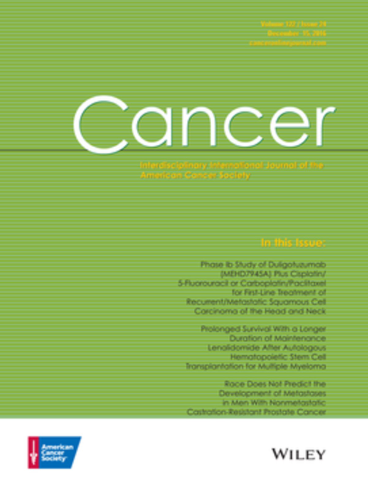
The CANCER site is a full-text, electronic implementation of CANCER, an Interdisciplinary International Journal of the American Cancer Society, and CANCER CYTOPATHOLOGY, a Journal of the American Cancer Society.
CANCER publishes interdisciplinary oncologic information according to, but not limited to, the following disease sites and disciplines: blood/bone marrow; breast disease; endocrine disorders; epidemiology; gastrointestinal tract; genitourinary disease; gynecologic oncology; head and neck disease; hepatobiliary tract; integrated medicine; lung disease; medical oncology; neuro-oncology; pathology radiation oncology; translational research





 京公网安备 11010802042870号
京ICP备2023020795号-1
京公网安备 11010802042870号
京ICP备2023020795号-1

 分享
分享
 求助内容:
求助内容: 应助结果提醒方式:
 扫码关注我们
