Healthcare-associated bloodstream infections caused by bacterial and fungal contamination of intravenous fluids and medicines in healthcare facilities in low- and middle-income countries: a scoping review.
Jemima Nyandwaro, Peter Hyland, Raffaella Ravinetto, Jan Jacobs
{"title":"Healthcare-associated bloodstream infections caused by bacterial and fungal contamination of intravenous fluids and medicines in healthcare facilities in low- and middle-income countries: a scoping review.","authors":"Jemima Nyandwaro, Peter Hyland, Raffaella Ravinetto, Jan Jacobs","doi":"10.1186/s13756-025-01536-3","DOIUrl":null,"url":null,"abstract":"<p><strong>Introduction: </strong>We reviewed culture-confirmed healthcare-associated outbreaks linked to bacterial and fungal contamination of intravenous fluids and medicines (further \"infusates\") in low-income countries and lower and upper middle-income countries (LIC, Lower-MIC and Upper-MIC). We assessed the scope, impact, risks, and gaps in knowledge.</p><p><strong>Methodology: </strong>Literature search including PubMed, Web of Science, Worldwide Database for Nosocomial Outbreaks, Global Health, and Google Scholar. National essential medicine lists (NEMLs) of sub-Saharan countries were searched for listing of pediatric infusates.</p><p><strong>Results: </strong>Between 1975 and 2023, 50 articles were retrieved. Median (range) number of patients affected was 12 (3-185); 74.2% (761/1025) of all patients affected were children. All patients presented with bloodstream infections; median case fatality ratio was 21.1% (0.0-87.5%). Upper-MIC, Lower-MIC and LIC accounted for 21, 25 and 4 articles, respectively. Most frequently affected wards were neonatal and adult intensive care units (19 and 6 articles). The 50 articles revealed 59 contaminated infusates: IV fluids (n = 37), including TPN (n = 10, of which 8 were from Upper-MIC), and IV medicines (n = 22), comprising amongst others propofol (n = 4) and Water for Injection (n = 3). The 63 isolates included Enterobacterales (46.0% (29/63) of isolates), non-fermentative Gram-negative bacteria (NFGNB, 47.6% (30/63)), fungi (4.8%, 3/63)) and Bacillus circulans (1.6% (1/63)). Among the Enterobacterales, the genera Serratia, Klebsiella, and Enterobacter represented 82.8% (24/29) of isolates. Burkholderia cepacia was the most frequent NFGNB (53.3% (16/30) isolates). Excluding TPN, 18 IV fluids and 7 IV medicines (representing half (51.0%, (25/49) of these infusates) were incorrectly used as multidose vial. A third (33.9%, 20/59) of infusates in 40.0% (20/50) of articles was intrinsically contaminated. In LIC and LMIC, staff in neonatology units turned to in-ward preparation of infusates because of lack of access to pediatric IV formulations and sizes. Less than a third (31.8%, 18/44) of the NEMLs listed neonatal IV premixtures.</p><p><strong>Conclusion: </strong>Infusate contamination is a serious, underreported risk especially for children in LICs and Lower-MIC. Outstanding issues are access to pediatric infusates and preventing in-ward preparation of IV medicines in LIC and Lower-MIC, and safe preparation and administration of TPN in Upper-MIC.</p>","PeriodicalId":7950,"journal":{"name":"Antimicrobial Resistance and Infection Control","volume":"14 1","pages":"24"},"PeriodicalIF":4.4000,"publicationDate":"2025-03-28","publicationTypes":"Journal Article","fieldsOfStudy":null,"isOpenAccess":false,"openAccessPdf":"https://www.ncbi.nlm.nih.gov/pmc/articles/PMC11951549/pdf/","citationCount":"0","resultStr":null,"platform":"Semanticscholar","paperid":null,"PeriodicalName":"Antimicrobial Resistance and Infection Control","FirstCategoryId":"3","ListUrlMain":"https://doi.org/10.1186/s13756-025-01536-3","RegionNum":2,"RegionCategory":"医学","ArticlePicture":[],"TitleCN":null,"AbstractTextCN":null,"PMCID":null,"EPubDate":"","PubModel":"","JCR":"Q1","JCRName":"INFECTIOUS DISEASES","Score":null,"Total":0}
引用次数: 0
Abstract
Introduction: We reviewed culture-confirmed healthcare-associated outbreaks linked to bacterial and fungal contamination of intravenous fluids and medicines (further "infusates") in low-income countries and lower and upper middle-income countries (LIC, Lower-MIC and Upper-MIC). We assessed the scope, impact, risks, and gaps in knowledge.
Methodology: Literature search including PubMed, Web of Science, Worldwide Database for Nosocomial Outbreaks, Global Health, and Google Scholar. National essential medicine lists (NEMLs) of sub-Saharan countries were searched for listing of pediatric infusates.
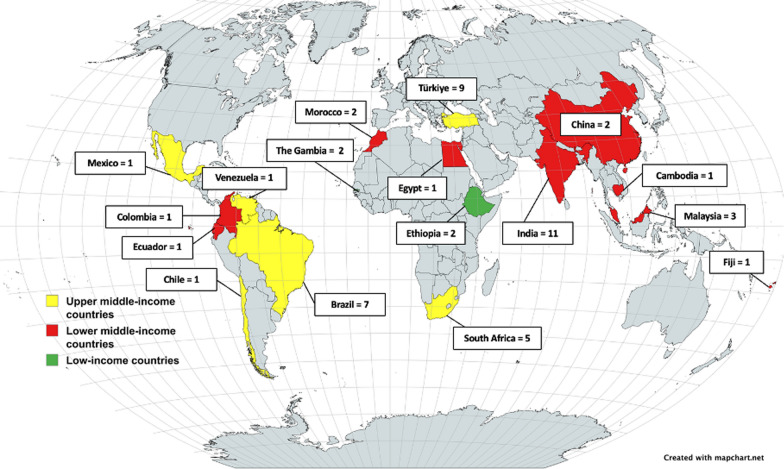
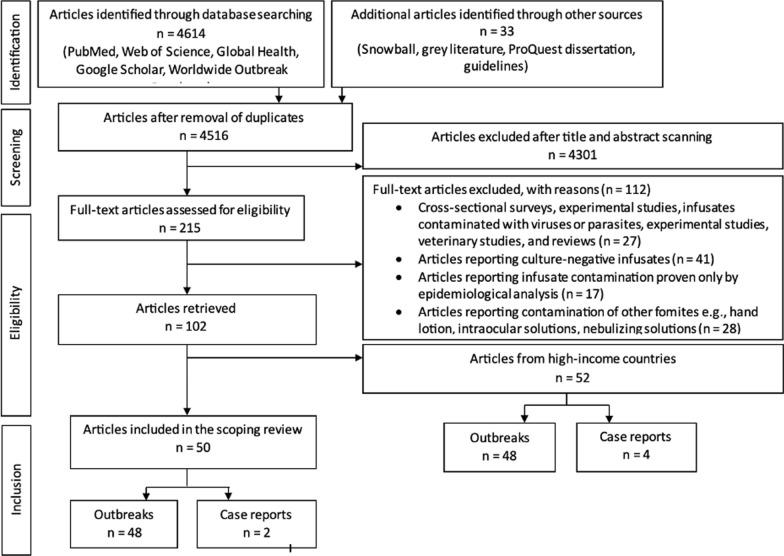
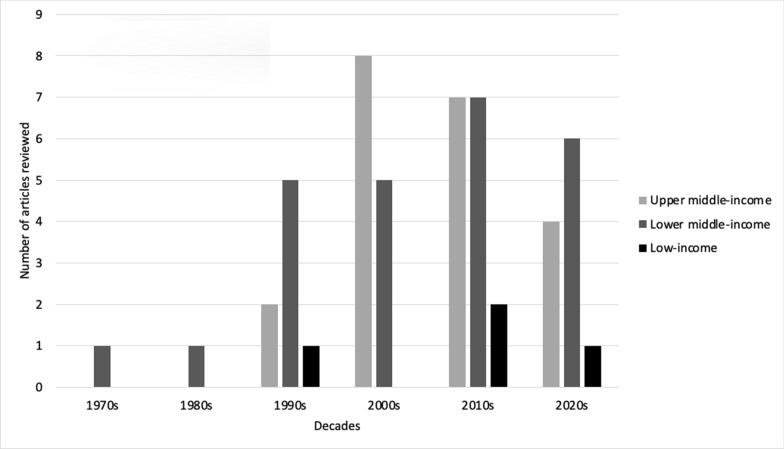
Results: Between 1975 and 2023, 50 articles were retrieved. Median (range) number of patients affected was 12 (3-185); 74.2% (761/1025) of all patients affected were children. All patients presented with bloodstream infections; median case fatality ratio was 21.1% (0.0-87.5%). Upper-MIC, Lower-MIC and LIC accounted for 21, 25 and 4 articles, respectively. Most frequently affected wards were neonatal and adult intensive care units (19 and 6 articles). The 50 articles revealed 59 contaminated infusates: IV fluids (n = 37), including TPN (n = 10, of which 8 were from Upper-MIC), and IV medicines (n = 22), comprising amongst others propofol (n = 4) and Water for Injection (n = 3). The 63 isolates included Enterobacterales (46.0% (29/63) of isolates), non-fermentative Gram-negative bacteria (NFGNB, 47.6% (30/63)), fungi (4.8%, 3/63)) and Bacillus circulans (1.6% (1/63)). Among the Enterobacterales, the genera Serratia, Klebsiella, and Enterobacter represented 82.8% (24/29) of isolates. Burkholderia cepacia was the most frequent NFGNB (53.3% (16/30) isolates). Excluding TPN, 18 IV fluids and 7 IV medicines (representing half (51.0%, (25/49) of these infusates) were incorrectly used as multidose vial. A third (33.9%, 20/59) of infusates in 40.0% (20/50) of articles was intrinsically contaminated. In LIC and LMIC, staff in neonatology units turned to in-ward preparation of infusates because of lack of access to pediatric IV formulations and sizes. Less than a third (31.8%, 18/44) of the NEMLs listed neonatal IV premixtures.
Conclusion: Infusate contamination is a serious, underreported risk especially for children in LICs and Lower-MIC. Outstanding issues are access to pediatric infusates and preventing in-ward preparation of IV medicines in LIC and Lower-MIC, and safe preparation and administration of TPN in Upper-MIC.
期刊介绍:
Antimicrobial Resistance and Infection Control is a global forum for all those working on the prevention, diagnostic and treatment of health-care associated infections and antimicrobial resistance development in all health-care settings. The journal covers a broad spectrum of preeminent practices and best available data to the top interventional and translational research, and innovative developments in the field of infection control.




 京公网安备 11010802042870号
京ICP备2023020795号-1
京公网安备 11010802042870号
京ICP备2023020795号-1

 分享
分享
 求助内容:
求助内容: 应助结果提醒方式:
 扫码关注我们
