Olav B. Smeland , Cecilie Busch , Ole A. Andreassen , Mirko Manchia
{"title":"Novel Multimodal Precision Medicine Approaches and the Relevance of Developmental Trajectories in Bipolar Disorder","authors":"Olav B. Smeland , Cecilie Busch , Ole A. Andreassen , Mirko Manchia","doi":"10.1016/j.biopsych.2025.03.010","DOIUrl":null,"url":null,"abstract":"<div><div>There is a pressing need to establish objective measures to improve diagnosis, prediction, prevention, and treatment of bipolar disorder (BD). Multimodal artificial intelligence (AI) tools could provide these means by incorporating various layers of data orthogonally related to BD, including genomics and other omics, environmental exposures, imaging measures, electronic health records, cognition, sensing devices, and clinical variables. These rapidly evolving AI models hold promise to capture the multidimensional complexity of BD and delineate clinically relevant developmental trajectories that could guide clinical care and therapeutic strategies. In this review, we describe the potential of mapping developmental trajectories that underlie BD, outline how novel multimodal models could improve the prediction of BD and related outcomes, and discuss specific clinical use cases and key ethical and practical challenges regarding the development and potential implementation of these multimodal AI solutions to advance precision medicine approaches in BD.</div></div>","PeriodicalId":8918,"journal":{"name":"Biological Psychiatry","volume":"98 4","pages":"Pages 343-353"},"PeriodicalIF":9.0000,"publicationDate":"2025-03-27","publicationTypes":"Journal Article","fieldsOfStudy":null,"isOpenAccess":false,"openAccessPdf":"","citationCount":"0","resultStr":null,"platform":"Semanticscholar","paperid":null,"PeriodicalName":"Biological Psychiatry","FirstCategoryId":"3","ListUrlMain":"https://www.sciencedirect.com/science/article/pii/S0006322325010984","RegionNum":1,"RegionCategory":"医学","ArticlePicture":[],"TitleCN":null,"AbstractTextCN":null,"PMCID":null,"EPubDate":"","PubModel":"","JCR":"Q1","JCRName":"NEUROSCIENCES","Score":null,"Total":0}
引用次数: 0
Abstract
There is a pressing need to establish objective measures to improve diagnosis, prediction, prevention, and treatment of bipolar disorder (BD). Multimodal artificial intelligence (AI) tools could provide these means by incorporating various layers of data orthogonally related to BD, including genomics and other omics, environmental exposures, imaging measures, electronic health records, cognition, sensing devices, and clinical variables. These rapidly evolving AI models hold promise to capture the multidimensional complexity of BD and delineate clinically relevant developmental trajectories that could guide clinical care and therapeutic strategies. In this review, we describe the potential of mapping developmental trajectories that underlie BD, outline how novel multimodal models could improve the prediction of BD and related outcomes, and discuss specific clinical use cases and key ethical and practical challenges regarding the development and potential implementation of these multimodal AI solutions to advance precision medicine approaches in BD.
期刊介绍:
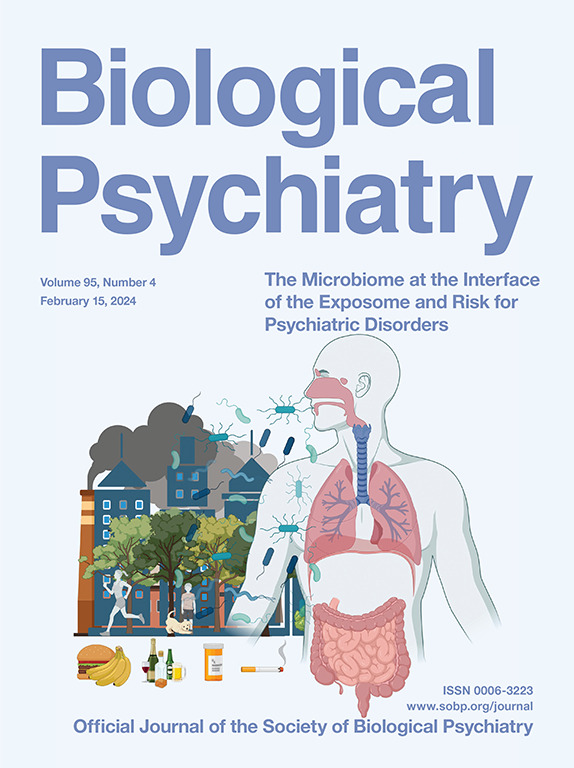
Biological Psychiatry is an official journal of the Society of Biological Psychiatry and was established in 1969. It is the first journal in the Biological Psychiatry family, which also includes Biological Psychiatry: Cognitive Neuroscience and Neuroimaging and Biological Psychiatry: Global Open Science. The Society's main goal is to promote excellence in scientific research and education in the fields related to the nature, causes, mechanisms, and treatments of disorders pertaining to thought, emotion, and behavior. To fulfill this mission, Biological Psychiatry publishes peer-reviewed, rapid-publication articles that present new findings from original basic, translational, and clinical mechanistic research, ultimately advancing our understanding of psychiatric disorders and their treatment. The journal also encourages the submission of reviews and commentaries on current research and topics of interest.



 京公网安备 11010802042870号
京ICP备2023020795号-1
京公网安备 11010802042870号
京ICP备2023020795号-1

 分享
分享
 求助内容:
求助内容: 应助结果提醒方式:
 扫码关注我们
