Trends and influences in women authorship in randomised controlled trials in rheumatology: a comprehensive analysis of all published RCTs from 2009 to 2023.
Kim Lauper, Diana Buitrago-Garcia, Delphine S Courvoisier, Michele Iudici, Denis Mongin
{"title":"Trends and influences in women authorship in randomised controlled trials in rheumatology: a comprehensive analysis of all published RCTs from 2009 to 2023.","authors":"Kim Lauper, Diana Buitrago-Garcia, Delphine S Courvoisier, Michele Iudici, Denis Mongin","doi":"10.1136/rmdopen-2024-005341","DOIUrl":null,"url":null,"abstract":"<p><strong>Objectives: </strong>We examined the evolution and influencing factors of women's authorship in randomised controlled trials (RCTs) published in rheumatology.</p><p><strong>Methods: </strong>We analysed all RCTs published in rheumatology from 2009 to 2023 determining authors' gender using the Gender API service. The percentage of women as authors in published RCTs and its association with potential factors was assessed using generalised estimating equations. We considered women's gender as the primary outcome and included the continent of the RCT, the status of international collaboration, industrial funding, intervention type, sample size, the journal's adherence to International Committee of Medical Journal Editors recommendations, impact factor, publication year, authors' non-academic affiliations and author positions as exposures of interest.</p><p><strong>Results: </strong>We included 1092 RCTs with 10 794 authors; in the overall non-adjusted estimated analysis, we found that women accounted for 39.8% (95% CI 38.4% to 41.2%) of all authors. Women authorship was higher in African-based RCTs, among pharmaceutical-affiliated authors, and when the last author was a woman (OR 2.34 (95% CI 1.02 to 5.38), +19.46 pp). It was lower in Asian and European RCTs and industry-funded RCTs (OR 0.79 (95% CI 0.66 to 0.93), -5.85 pp). Women were less often last (OR 0.63 (95% CI 0.54 to 0.74), -10.2 pp) or second-to-last authors (OR 0.73 (95% CI 0.62 to 0.85), -10.19 pp), with no differences by international status or publication year.</p><p><strong>Conclusion: </strong>The persistent under-representation of women in RCTs and their lower chances of being senior authors highlight the need for better strategies to close the gender gap. RCTs with a woman last author were more likely to have a woman first author, suggesting a potential role model effect.</p>","PeriodicalId":21396,"journal":{"name":"RMD Open","volume":"11 1","pages":""},"PeriodicalIF":4.7000,"publicationDate":"2025-03-27","publicationTypes":"Journal Article","fieldsOfStudy":null,"isOpenAccess":false,"openAccessPdf":"https://www.ncbi.nlm.nih.gov/pmc/articles/PMC12094118/pdf/","citationCount":"0","resultStr":null,"platform":"Semanticscholar","paperid":null,"PeriodicalName":"RMD Open","FirstCategoryId":"3","ListUrlMain":"https://doi.org/10.1136/rmdopen-2024-005341","RegionNum":2,"RegionCategory":"医学","ArticlePicture":[],"TitleCN":null,"AbstractTextCN":null,"PMCID":null,"EPubDate":"","PubModel":"","JCR":"Q1","JCRName":"RHEUMATOLOGY","Score":null,"Total":0}
引用次数: 0
Abstract
Objectives: We examined the evolution and influencing factors of women's authorship in randomised controlled trials (RCTs) published in rheumatology.
Methods: We analysed all RCTs published in rheumatology from 2009 to 2023 determining authors' gender using the Gender API service. The percentage of women as authors in published RCTs and its association with potential factors was assessed using generalised estimating equations. We considered women's gender as the primary outcome and included the continent of the RCT, the status of international collaboration, industrial funding, intervention type, sample size, the journal's adherence to International Committee of Medical Journal Editors recommendations, impact factor, publication year, authors' non-academic affiliations and author positions as exposures of interest.
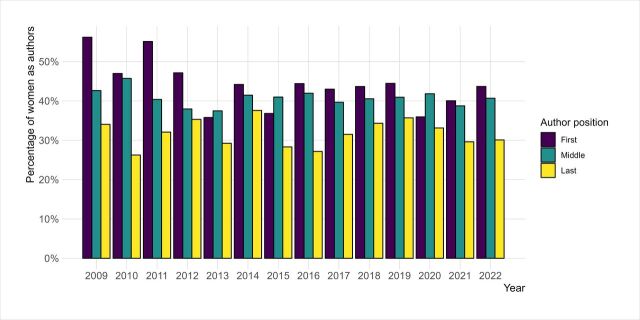
Results: We included 1092 RCTs with 10 794 authors; in the overall non-adjusted estimated analysis, we found that women accounted for 39.8% (95% CI 38.4% to 41.2%) of all authors. Women authorship was higher in African-based RCTs, among pharmaceutical-affiliated authors, and when the last author was a woman (OR 2.34 (95% CI 1.02 to 5.38), +19.46 pp). It was lower in Asian and European RCTs and industry-funded RCTs (OR 0.79 (95% CI 0.66 to 0.93), -5.85 pp). Women were less often last (OR 0.63 (95% CI 0.54 to 0.74), -10.2 pp) or second-to-last authors (OR 0.73 (95% CI 0.62 to 0.85), -10.19 pp), with no differences by international status or publication year.
Conclusion: The persistent under-representation of women in RCTs and their lower chances of being senior authors highlight the need for better strategies to close the gender gap. RCTs with a woman last author were more likely to have a woman first author, suggesting a potential role model effect.
目的:我们研究发表在《风湿病学》杂志上的随机对照试验(RCTs)中女性作者身份的演变及其影响因素。方法:我们分析了2009年至2023年风湿病学发表的所有随机对照试验,使用性别API服务确定作者的性别。使用广义估计方程评估已发表的随机对照试验中女性作者的百分比及其与潜在因素的关联。我们将女性性别作为主要结果,并将RCT的大洲、国际合作状况、行业资助、干预类型、样本量、期刊对国际医学期刊编辑委员会建议的依从性、影响因子、出版年份、作者的非学术从属关系和作者的职位作为感兴趣的暴露因素。结果:我们纳入1092项随机对照试验,10794名作者;在总体非调整估计分析中,我们发现女性占所有作者的39.8% (95% CI 38.4%至41.2%)。在基于非洲的随机对照试验中,在制药相关的作者中,当最后一位作者是女性时,女性作者的比例更高(OR 2.34 (95% CI 1.02至5.38),+19.46 pp)。亚洲和欧洲的rct以及行业资助的rct (OR 0.79 (95% CI 0.66至0.93),-5.85 pp)较低。女性作者较少出现在最后(OR 0.63 (95% CI 0.54至0.74),-10.2 pp)或倒数第二(OR 0.73 (95% CI 0.62至0.85),-10.19 pp),国际地位或出版年份没有差异。结论:女性在随机对照试验中的持续代表性不足,以及她们成为资深作者的机会较低,这突出表明需要更好的策略来缩小性别差距。最后一名女性作者的随机对照试验更有可能出现女性第一作者,这表明存在潜在的榜样效应。
期刊介绍:
RMD Open publishes high quality peer-reviewed original research covering the full spectrum of musculoskeletal disorders, rheumatism and connective tissue diseases, including osteoporosis, spine and rehabilitation. Clinical and epidemiological research, basic and translational medicine, interesting clinical cases, and smaller studies that add to the literature are all considered.



 京公网安备 11010802042870号
京ICP备2023020795号-1
京公网安备 11010802042870号
京ICP备2023020795号-1

 分享
分享
 求助内容:
求助内容: 应助结果提醒方式:
 扫码关注我们
