Removal of suspended solids from water by waste biomass-based cationized cellulose nanofibers: a comparative analysis of flocculation performance from different biomass sources†
Peng Lin, Jinglin Yuan, Mingyu Lei, Yi Jin, Sikai Chen and Han Zhang
{"title":"Removal of suspended solids from water by waste biomass-based cationized cellulose nanofibers: a comparative analysis of flocculation performance from different biomass sources†","authors":"Peng Lin, Jinglin Yuan, Mingyu Lei, Yi Jin, Sikai Chen and Han Zhang","doi":"10.1039/D4EN01120A","DOIUrl":null,"url":null,"abstract":"<p >In response to the growing focus on bio-waste valorization, this study extracted cellulose fibers from rice straw, coffee grounds, corncob, and rape straw. The extracted fibers were subsequently cationically modified into cellulose nanofibers (QCNFs) for effective flocculation in high-turbidity wastewater treatment. Scanning electron microscopy (SEM) revealed that the QCNFs derived from the four biomass sources displayed a three-dimensional network structure, with each displaying distinct fiber morphologies. The QCNFs derived from coffee grounds exhibited a flaky structure, the QCNFs derived from corncob displayed short, rod-like fibers, and the QCNFs derived from rice straw and rape straw showed chain-like structures, with rice straw fibers appearing particularly attenuated. The results indicate significant variation in the flocculation efficiency of QCNFs derived from different bio-sources. QCNFs prepared from rice straw exhibited the highest flocculation efficiency, achieving a removal rate of 90.6%. SEM analysis of the physical structure and morphology of the four types of QCNFs revealed that nanofibers with slender chain-like structures are particularly well-suited for developing biomass-based flocculants.</p>","PeriodicalId":73,"journal":{"name":"Environmental Science: Nano","volume":" 5","pages":" 2788-2798"},"PeriodicalIF":5.1000,"publicationDate":"2025-04-01","publicationTypes":"Journal Article","fieldsOfStudy":null,"isOpenAccess":false,"openAccessPdf":"","citationCount":"0","resultStr":null,"platform":"Semanticscholar","paperid":null,"PeriodicalName":"Environmental Science: Nano","FirstCategoryId":"6","ListUrlMain":"https://pubs.rsc.org/en/content/articlelanding/2025/en/d4en01120a","RegionNum":2,"RegionCategory":"环境科学与生态学","ArticlePicture":[],"TitleCN":null,"AbstractTextCN":null,"PMCID":null,"EPubDate":"","PubModel":"","JCR":"Q1","JCRName":"CHEMISTRY, MULTIDISCIPLINARY","Score":null,"Total":0}
引用次数: 0
Abstract
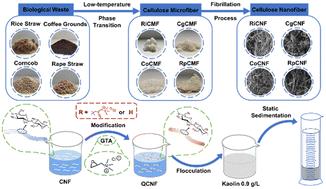
In response to the growing focus on bio-waste valorization, this study extracted cellulose fibers from rice straw, coffee grounds, corncob, and rape straw. The extracted fibers were subsequently cationically modified into cellulose nanofibers (QCNFs) for effective flocculation in high-turbidity wastewater treatment. Scanning electron microscopy (SEM) revealed that the QCNFs derived from the four biomass sources displayed a three-dimensional network structure, with each displaying distinct fiber morphologies. The QCNFs derived from coffee grounds exhibited a flaky structure, the QCNFs derived from corncob displayed short, rod-like fibers, and the QCNFs derived from rice straw and rape straw showed chain-like structures, with rice straw fibers appearing particularly attenuated. The results indicate significant variation in the flocculation efficiency of QCNFs derived from different bio-sources. QCNFs prepared from rice straw exhibited the highest flocculation efficiency, achieving a removal rate of 90.6%. SEM analysis of the physical structure and morphology of the four types of QCNFs revealed that nanofibers with slender chain-like structures are particularly well-suited for developing biomass-based flocculants.
期刊介绍:
Environmental Science: Nano serves as a comprehensive and high-impact peer-reviewed source of information on the design and demonstration of engineered nanomaterials for environment-based applications. It also covers the interactions between engineered, natural, and incidental nanomaterials with biological and environmental systems. This scope includes, but is not limited to, the following topic areas:
Novel nanomaterial-based applications for water, air, soil, food, and energy sustainability
Nanomaterial interactions with biological systems and nanotoxicology
Environmental fate, reactivity, and transformations of nanoscale materials
Nanoscale processes in the environment
Sustainable nanotechnology including rational nanomaterial design, life cycle assessment, risk/benefit analysis



 京公网安备 11010802042870号
京ICP备2023020795号-1
京公网安备 11010802042870号
京ICP备2023020795号-1

 分享
分享
 求助内容:
求助内容: 应助结果提醒方式:
 扫码关注我们
