Frank J. Lowery, Stephanie L. Goff, Billel Gasmi, Maria R. Parkhurst, Nivedita M. Ratnam, Hyunmi K. Halas, Thomas E. Shelton, Michelle M. Langhan, Aarushi Bhasin, Aaron J. Dinerman, Victoria Dulemba, Ian S. Goldlust, Alexandra M. Gustafson, Abraham A. Hakim, Kyle J. Hitscherich, Lisa M. Kenney, Lior Levy, Juliette G. Rault-Wang, Alakesh Bera, Satyajit Ray, Courtney D. Seavey, Chuong D. Hoang, Jonathan M. Hernandez, Jared J. Gartner, Sivasish Sindiri, Todd D. Prickett, Lori S. McIntyre, Sri Krishna, Paul F. Robbins, Nicholas D. Klemen, Mei Li M. Kwong, James C. Yang, Steven A. Rosenberg
{"title":"Neoantigen-specific tumor-infiltrating lymphocytes in gastrointestinal cancers: a phase 2 trial","authors":"Frank J. Lowery, Stephanie L. Goff, Billel Gasmi, Maria R. Parkhurst, Nivedita M. Ratnam, Hyunmi K. Halas, Thomas E. Shelton, Michelle M. Langhan, Aarushi Bhasin, Aaron J. Dinerman, Victoria Dulemba, Ian S. Goldlust, Alexandra M. Gustafson, Abraham A. Hakim, Kyle J. Hitscherich, Lisa M. Kenney, Lior Levy, Juliette G. Rault-Wang, Alakesh Bera, Satyajit Ray, Courtney D. Seavey, Chuong D. Hoang, Jonathan M. Hernandez, Jared J. Gartner, Sivasish Sindiri, Todd D. Prickett, Lori S. McIntyre, Sri Krishna, Paul F. Robbins, Nicholas D. Klemen, Mei Li M. Kwong, James C. Yang, Steven A. Rosenberg","doi":"10.1038/s41591-025-03627-5","DOIUrl":null,"url":null,"abstract":"Adoptive transfer of unselected autologous tumor-infiltrating lymphocytes (TILs) has mediated meaningful clinical responses in patients with metastatic melanoma but not in cancers of gastrointestinal epithelial origin. In an evolving single-arm phase 2 trial design, TILs were derived from and administered to 91 patients with treatment-refractory mismatch repair proficient metastatic gastrointestinal cancers in a schema with lymphodepleting chemotherapy and high-dose interleukin-2 (three cohorts of an ongoing trial). The primary endpoint of this study was the objective response rate as measured using Response Evaluation Criteria in Solid Tumors 1.0; safety was a descriptive secondary endpoint. In the pilot phase, no clinical responses were observed in 18 patients to bulk, unselected TILs; however, when TILs were screened and selected for neoantigen recognition (SEL-TIL), three responses were seen in 39 patients (7.7% (95% confidence interval (CI): 2.7–20.3)). Based on the high levels of programmed cell death protein 1 in the infused TILs, pembrolizumab was added to the regimen (SEL-TIL + P), and eight objective responses were seen in 34 patients (23.5% (95% CI: 12.4–40.0)). All patients experienced transient severe hematologic toxicities from chemotherapy. Seven (10%) patients required critical care support. Exploratory analyses for laboratory and clinical correlates of response were performed for the SEL-TIL and SEL-TIL + P treatment arms. Response was associated with recognition of an increased number of targeted neoantigens and an increased number of administered CD4+ neoantigen-reactive TILs. The current strategy (SEL-TIL + P) exceeded the parameters of the trial design for patients with colorectal cancer, and an expansion phase is accruing. These results could potentially provide a cell-based treatment in a population not traditionally expected to respond to immunotherapy. ClinicalTrials.gov identifier: NCT01174121 . In an iterative phase 2 trial, patients with metastatic, treatment-refractory, mismatch repair proficient gastrointestinal cancers had responses to neoantigen-reactive tumor-infiltrating lymphocytes but not bulk tumor-infiltrating lymphocytes, highlighting the potential for a refined immune cell therapy approach in this patient population.","PeriodicalId":19037,"journal":{"name":"Nature Medicine","volume":"31 6","pages":"1994-2003"},"PeriodicalIF":50.0000,"publicationDate":"2025-04-01","publicationTypes":"Journal Article","fieldsOfStudy":null,"isOpenAccess":false,"openAccessPdf":"","citationCount":"0","resultStr":null,"platform":"Semanticscholar","paperid":null,"PeriodicalName":"Nature Medicine","FirstCategoryId":"3","ListUrlMain":"https://www.nature.com/articles/s41591-025-03627-5","RegionNum":1,"RegionCategory":"医学","ArticlePicture":[],"TitleCN":null,"AbstractTextCN":null,"PMCID":null,"EPubDate":"","PubModel":"","JCR":"Q1","JCRName":"BIOCHEMISTRY & MOLECULAR BIOLOGY","Score":null,"Total":0}
引用次数: 0
Abstract
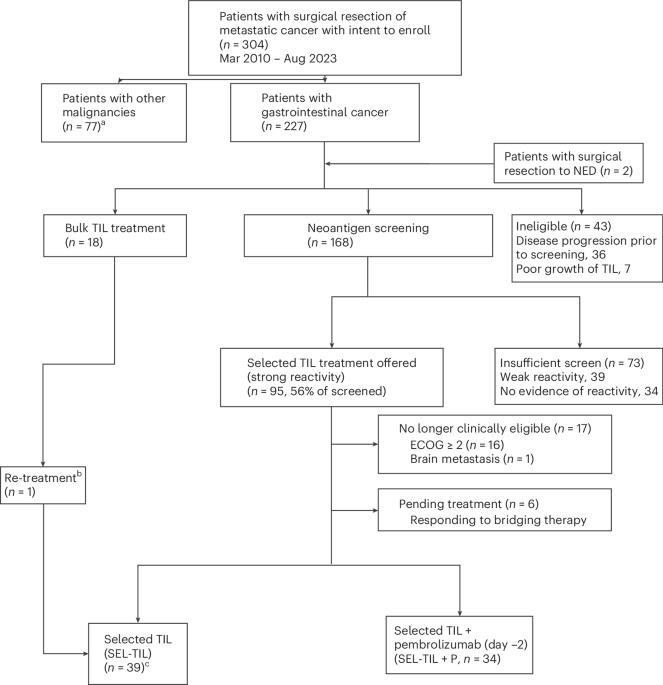
Adoptive transfer of unselected autologous tumor-infiltrating lymphocytes (TILs) has mediated meaningful clinical responses in patients with metastatic melanoma but not in cancers of gastrointestinal epithelial origin. In an evolving single-arm phase 2 trial design, TILs were derived from and administered to 91 patients with treatment-refractory mismatch repair proficient metastatic gastrointestinal cancers in a schema with lymphodepleting chemotherapy and high-dose interleukin-2 (three cohorts of an ongoing trial). The primary endpoint of this study was the objective response rate as measured using Response Evaluation Criteria in Solid Tumors 1.0; safety was a descriptive secondary endpoint. In the pilot phase, no clinical responses were observed in 18 patients to bulk, unselected TILs; however, when TILs were screened and selected for neoantigen recognition (SEL-TIL), three responses were seen in 39 patients (7.7% (95% confidence interval (CI): 2.7–20.3)). Based on the high levels of programmed cell death protein 1 in the infused TILs, pembrolizumab was added to the regimen (SEL-TIL + P), and eight objective responses were seen in 34 patients (23.5% (95% CI: 12.4–40.0)). All patients experienced transient severe hematologic toxicities from chemotherapy. Seven (10%) patients required critical care support. Exploratory analyses for laboratory and clinical correlates of response were performed for the SEL-TIL and SEL-TIL + P treatment arms. Response was associated with recognition of an increased number of targeted neoantigens and an increased number of administered CD4+ neoantigen-reactive TILs. The current strategy (SEL-TIL + P) exceeded the parameters of the trial design for patients with colorectal cancer, and an expansion phase is accruing. These results could potentially provide a cell-based treatment in a population not traditionally expected to respond to immunotherapy. ClinicalTrials.gov identifier: NCT01174121 . In an iterative phase 2 trial, patients with metastatic, treatment-refractory, mismatch repair proficient gastrointestinal cancers had responses to neoantigen-reactive tumor-infiltrating lymphocytes but not bulk tumor-infiltrating lymphocytes, highlighting the potential for a refined immune cell therapy approach in this patient population.
期刊介绍:
Nature Medicine is a monthly journal publishing original peer-reviewed research in all areas of medicine. The publication focuses on originality, timeliness, interdisciplinary interest, and the impact on improving human health. In addition to research articles, Nature Medicine also publishes commissioned content such as News, Reviews, and Perspectives. This content aims to provide context for the latest advances in translational and clinical research, reaching a wide audience of M.D. and Ph.D. readers. All editorial decisions for the journal are made by a team of full-time professional editors.
Nature Medicine consider all types of clinical research, including:
-Case-reports and small case series
-Clinical trials, whether phase 1, 2, 3 or 4
-Observational studies
-Meta-analyses
-Biomarker studies
-Public and global health studies
Nature Medicine is also committed to facilitating communication between translational and clinical researchers. As such, we consider “hybrid” studies with preclinical and translational findings reported alongside data from clinical studies.




 京公网安备 11010802042870号
京ICP备2023020795号-1
京公网安备 11010802042870号
京ICP备2023020795号-1

 分享
分享
 求助内容:
求助内容: 应助结果提醒方式:
 扫码关注我们
