{"title":"Absorptivity Inversely Proportional to Spectral Slope in CDOM","authors":"Mingquan Yan, Shansheng Mo, Zhongli Liu, Gregory Korshin","doi":"10.1021/acs.est.5c01019","DOIUrl":null,"url":null,"abstract":"The application of the Bouguer–Lambert–Beer (BLB) Law is limited to dissolved organic matter (DOM) in the environment due to the wide distribution of overlapping chromophores with different molar absorptivities (ε). Here, we report our findings demonstrating the existence of an inverse relationship between <i>ε</i> and the spectral slope (<i>S</i>) in the absorption spectra of chromophoric DOM (CDOM). Specifically, ε values at 275 and 380 nm are directly proportional to the square of the root-mean-square width of the Gaussian peak (<i>W</i><sup>2</sup>) located at 4.80 eV (258 nm) and 3.79 eV (327 nm), and <i>W</i><sup>2</sup> is inversely proportional to the values of <i>S</i> of the right half of log-transformed spectra of the Gaussian peak with respect to wavelength, corresponding to <i>S</i> at 275–295 and 380–443 nm in spectra, respectively. This finding expands the applicability and utility of the BLB Law to uniformly quantify DOC concentrations in inland, coastal, and pelagic waters (30–3000 μmol·L<sup>–1</sup>, <i>n</i> = 7745, <i>R</i><sup>2</sup> = 0.97). Furthermore, the relationship between <i>ε</i> and <i>S</i> aids in interpreting the absorbance spectra of DOM, providing valuable insights into its composition and properties. This finding represents a significant advancement in expanding the applications of UV–vis spectroscopy in CDOM monitoring from micro to global scales.","PeriodicalId":36,"journal":{"name":"环境科学与技术","volume":"38 1","pages":""},"PeriodicalIF":11.3000,"publicationDate":"2025-04-01","publicationTypes":"Journal Article","fieldsOfStudy":null,"isOpenAccess":false,"openAccessPdf":"","citationCount":"0","resultStr":null,"platform":"Semanticscholar","paperid":null,"PeriodicalName":"环境科学与技术","FirstCategoryId":"1","ListUrlMain":"https://doi.org/10.1021/acs.est.5c01019","RegionNum":1,"RegionCategory":"环境科学与生态学","ArticlePicture":[],"TitleCN":null,"AbstractTextCN":null,"PMCID":null,"EPubDate":"","PubModel":"","JCR":"Q1","JCRName":"ENGINEERING, ENVIRONMENTAL","Score":null,"Total":0}
引用次数: 0
Abstract
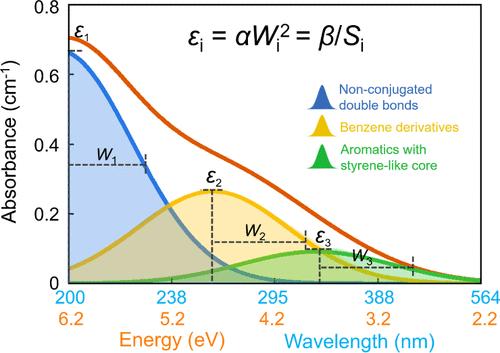
The application of the Bouguer–Lambert–Beer (BLB) Law is limited to dissolved organic matter (DOM) in the environment due to the wide distribution of overlapping chromophores with different molar absorptivities (ε). Here, we report our findings demonstrating the existence of an inverse relationship between ε and the spectral slope (S) in the absorption spectra of chromophoric DOM (CDOM). Specifically, ε values at 275 and 380 nm are directly proportional to the square of the root-mean-square width of the Gaussian peak (W2) located at 4.80 eV (258 nm) and 3.79 eV (327 nm), and W2 is inversely proportional to the values of S of the right half of log-transformed spectra of the Gaussian peak with respect to wavelength, corresponding to S at 275–295 and 380–443 nm in spectra, respectively. This finding expands the applicability and utility of the BLB Law to uniformly quantify DOC concentrations in inland, coastal, and pelagic waters (30–3000 μmol·L–1, n = 7745, R2 = 0.97). Furthermore, the relationship between ε and S aids in interpreting the absorbance spectra of DOM, providing valuable insights into its composition and properties. This finding represents a significant advancement in expanding the applications of UV–vis spectroscopy in CDOM monitoring from micro to global scales.
期刊介绍:
Environmental Science & Technology (ES&T) is a co-sponsored academic and technical magazine by the Hubei Provincial Environmental Protection Bureau and the Hubei Provincial Academy of Environmental Sciences.
Environmental Science & Technology (ES&T) holds the status of Chinese core journals, scientific papers source journals of China, Chinese Science Citation Database source journals, and Chinese Academic Journal Comprehensive Evaluation Database source journals. This publication focuses on the academic field of environmental protection, featuring articles related to environmental protection and technical advancements.



 京公网安备 11010802042870号
京ICP备2023020795号-1
京公网安备 11010802042870号
京ICP备2023020795号-1

 分享
分享
 求助内容:
求助内容: 应助结果提醒方式:
 扫码关注我们
