{"title":"Electrospun sandwich-structured C@Si/C@C as anode for advanced lithium-ion batteries","authors":"Yabing Chen, Juntong Huang, Zhi Chen, Haijun Zeng, Zhaohui Wu, Huiyong Yang, Li Chen, Qi Sun, Wentao Qian","doi":"10.1016/j.apsusc.2025.163139","DOIUrl":null,"url":null,"abstract":"<div><div>Due to its abundant deposits and high theoretical capacity, silicon (Si) has been extensively investigated as an anode material for lithium-ion batteries (LIBs). Current research is focused on solving problems such as the huge volume expansion of Si (about 300 %) and electrical conductivity. In this study, a C@Si/C@C self-supported anode material with a sandwich structure was successfully prepared by the electrostatic spinning method. This unique structure effectively modified the agglomeration, volume expansion, and low conductivity of Si nanoparticles, resulting in a more stable and substantial specific capacity. Even after 6,000 cycles at a high current density of 2 A g<sup>−1</sup>, a specific capacity of 623.4 mAh g<sup>−1</sup> was maintained. The sandwich-structured silicon-carbon composite provides a novel, efficient, and feasible solution.</div></div>","PeriodicalId":247,"journal":{"name":"Applied Surface Science","volume":"699 ","pages":"Article 163139"},"PeriodicalIF":6.9000,"publicationDate":"2025-08-01","publicationTypes":"Journal Article","fieldsOfStudy":null,"isOpenAccess":false,"openAccessPdf":"","citationCount":"0","resultStr":null,"platform":"Semanticscholar","paperid":null,"PeriodicalName":"Applied Surface Science","FirstCategoryId":"88","ListUrlMain":"https://www.sciencedirect.com/science/article/pii/S0169433225008530","RegionNum":2,"RegionCategory":"材料科学","ArticlePicture":[],"TitleCN":null,"AbstractTextCN":null,"PMCID":null,"EPubDate":"2025/4/1 0:00:00","PubModel":"Epub","JCR":"Q2","JCRName":"CHEMISTRY, PHYSICAL","Score":null,"Total":0}
引用次数: 0
Abstract
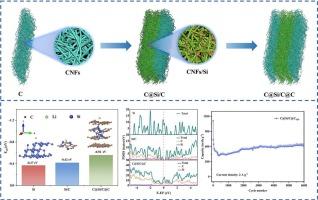
Due to its abundant deposits and high theoretical capacity, silicon (Si) has been extensively investigated as an anode material for lithium-ion batteries (LIBs). Current research is focused on solving problems such as the huge volume expansion of Si (about 300 %) and electrical conductivity. In this study, a C@Si/C@C self-supported anode material with a sandwich structure was successfully prepared by the electrostatic spinning method. This unique structure effectively modified the agglomeration, volume expansion, and low conductivity of Si nanoparticles, resulting in a more stable and substantial specific capacity. Even after 6,000 cycles at a high current density of 2 A g−1, a specific capacity of 623.4 mAh g−1 was maintained. The sandwich-structured silicon-carbon composite provides a novel, efficient, and feasible solution.
由于其丰富的储量和较高的理论容量,硅(Si)作为锂离子电池(lib)的负极材料得到了广泛的研究。目前的研究重点是解决诸如硅的巨大体积膨胀(约300 %)和导电性等问题。在本研究中,通过静电纺丝的方法成功制备了一种具有三明治结构的C@Si/C@C自支撑阳极材料。这种独特的结构有效地改变了Si纳米颗粒的团聚、体积膨胀和低电导率,从而获得了更稳定和更大的比容量。即使在2 a g−1的高电流密度下循环6000次后,比容量仍保持在623.4 mAh g−1。这种三明治结构的硅碳复合材料提供了一种新颖、高效、可行的解决方案。
期刊介绍:
Applied Surface Science covers topics contributing to a better understanding of surfaces, interfaces, nanostructures and their applications. The journal is concerned with scientific research on the atomic and molecular level of material properties determined with specific surface analytical techniques and/or computational methods, as well as the processing of such structures.





 京公网安备 11010802042870号
京ICP备2023020795号-1
京公网安备 11010802042870号
京ICP备2023020795号-1

 分享
分享
 求助内容:
求助内容: 应助结果提醒方式:
 扫码关注我们
