{"title":"Nitrogen pinning promoted highly reversible TiNb2O7-graphene anodes for lithium-ion batteries","authors":"Jiaxin Jia, Jian Gao, Yong-Chao Zhang, Tiansheng Mu, Xiaodong Zhu","doi":"10.1016/j.nanoen.2025.110948","DOIUrl":null,"url":null,"abstract":"<div><div>Breaking through charge/mass transfer capability of electrode materials is a key step in achieving high-power and high-energy density lithium-ion batteries. Herein, nitrogen pinning is introduced into TiNb<sub>2</sub>O<sub>7</sub>-graphene composite anodes (TNO@NG) to enhance heterogeneous interfacial interactions and promote intrinsic carrier transport capability. Experiments and theoretical calculations show that nitrogen pining can introduce impurity energy levels and reconstruct electron distribution at heterogeneous interface, thereby improving electronic conductivity and reducing lithium ions migration energy barrier. Therefore, N-pinning achieves accelerated reaction kinetics and electrochemical reversibility of TNO@NG anodes. As a consequence, the TNO@NG anode exhibits outstanding electrochemical lithium storage capacity and rate capability, reaching high capacity of 213.9 mAh g<sup>-1</sup> at 10<!--> <!-->C after 2000 cycles and 226.4 mAh g<sup>-1</sup> at 20<!--> <!-->C. Moreover, the TNO@NG//LiNi<sub>0.8</sub>Co<sub>0.1</sub>Mn<sub>0.1</sub>O<sub>2</sub> (NCM811) full cell can deliver a high capacity of 104.2 mAh g<sup>-1</sup> at 10<!--> <!-->C. Importantly, this work will provide guidance for the construction and design of oxide-carbonaceous composites.</div></div>","PeriodicalId":394,"journal":{"name":"Nano Energy","volume":"139 ","pages":"Article 110948"},"PeriodicalIF":17.1000,"publicationDate":"2025-04-01","publicationTypes":"Journal Article","fieldsOfStudy":null,"isOpenAccess":false,"openAccessPdf":"","citationCount":"0","resultStr":null,"platform":"Semanticscholar","paperid":null,"PeriodicalName":"Nano Energy","FirstCategoryId":"88","ListUrlMain":"https://www.sciencedirect.com/science/article/pii/S2211285525003076","RegionNum":1,"RegionCategory":"材料科学","ArticlePicture":[],"TitleCN":null,"AbstractTextCN":null,"PMCID":null,"EPubDate":"","PubModel":"","JCR":"Q1","JCRName":"CHEMISTRY, PHYSICAL","Score":null,"Total":0}
引用次数: 0
Abstract
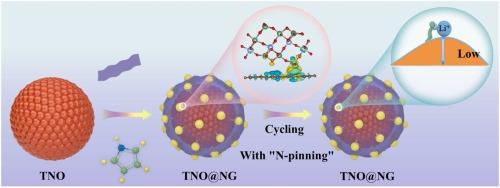
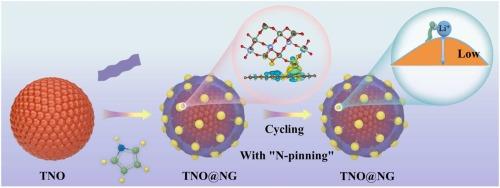
Breaking through charge/mass transfer capability of electrode materials is a key step in achieving high-power and high-energy density lithium-ion batteries. Herein, nitrogen pinning is introduced into TiNb2O7-graphene composite anodes (TNO@NG) to enhance heterogeneous interfacial interactions and promote intrinsic carrier transport capability. Experiments and theoretical calculations show that nitrogen pining can introduce impurity energy levels and reconstruct electron distribution at heterogeneous interface, thereby improving electronic conductivity and reducing lithium ions migration energy barrier. Therefore, N-pinning achieves accelerated reaction kinetics and electrochemical reversibility of TNO@NG anodes. As a consequence, the TNO@NG anode exhibits outstanding electrochemical lithium storage capacity and rate capability, reaching high capacity of 213.9 mAh g-1 at 10 C after 2000 cycles and 226.4 mAh g-1 at 20 C. Moreover, the TNO@NG//LiNi0.8Co0.1Mn0.1O2 (NCM811) full cell can deliver a high capacity of 104.2 mAh g-1 at 10 C. Importantly, this work will provide guidance for the construction and design of oxide-carbonaceous composites.
突破电极材料的电荷/传质能力是实现高功率、高能量密度锂离子电池的关键一步。本文将氮钉钉引入到tinb2o7 -石墨烯复合阳极(TNO@NG)中,以增强非均相界面相互作用并提高固有载流子传输能力。实验和理论计算表明,氮螯合可以引入杂质能级,重构非均相界面的电子分布,从而提高电子电导率,降低锂离子迁移能垒。因此,n -pin实现了TNO@NG阳极的加速反应动力学和电化学可逆性。结果表明,TNO@NG阳极表现出优异的电化学锂存储能力和倍率能力,经过2000次循环,在10℃下达到213.9 mAh g-1,在20℃下达到226.4 mAh g-1,并且TNO@NG//LiNi0.8Co0.1Mn0.1O2 (NCM811)全电池在10℃下可以提供104.2 mAh g-1的高容量。
期刊介绍:
Nano Energy is a multidisciplinary, rapid-publication forum of original peer-reviewed contributions on the science and engineering of nanomaterials and nanodevices used in all forms of energy harvesting, conversion, storage, utilization and policy. Through its mixture of articles, reviews, communications, research news, and information on key developments, Nano Energy provides a comprehensive coverage of this exciting and dynamic field which joins nanoscience and nanotechnology with energy science. The journal is relevant to all those who are interested in nanomaterials solutions to the energy problem.
Nano Energy publishes original experimental and theoretical research on all aspects of energy-related research which utilizes nanomaterials and nanotechnology. Manuscripts of four types are considered: review articles which inform readers of the latest research and advances in energy science; rapid communications which feature exciting research breakthroughs in the field; full-length articles which report comprehensive research developments; and news and opinions which comment on topical issues or express views on the developments in related fields.




 京公网安备 11010802042870号
京ICP备2023020795号-1
京公网安备 11010802042870号
京ICP备2023020795号-1

 分享
分享
 求助内容:
求助内容: 应助结果提醒方式:
 扫码关注我们
