Li-Yun Su , Yi-Ling Zhou , Yu-Ting Chen , Guan-Lin Chen , Kai-Wei Tseng , Nikita Tukachev , Andriy Zhugayevych , Sergei Tretiak , Leeyih Wang
{"title":"Fluorinated polythiophenes with ester side chains for boosting the Voc and efficiency in non-fullerene polymer solar cells","authors":"Li-Yun Su , Yi-Ling Zhou , Yu-Ting Chen , Guan-Lin Chen , Kai-Wei Tseng , Nikita Tukachev , Andriy Zhugayevych , Sergei Tretiak , Leeyih Wang","doi":"10.1016/j.polymer.2025.128336","DOIUrl":null,"url":null,"abstract":"<div><div>As the power conversion efficiency (PCE) of organic photovoltaics (OPVs) approximates the 19 % threshold, wide bandgap (WBG) polythiophenes (PTs) have gained increasing attention due to their simple chemical structures and ease of synthesis, making them promising candidates for large-scale production. However, the benchmark polymer poly(3-hexylthiophene) (P3HT) is limited by its high-lying HOMO energy level, which restricts the open-circuit voltage (<em>V</em><sub><em>OC</em></sub>) in solar cells. In this study, we introduce a novel series of PT derivatives (<strong>PDC8-T</strong>, <strong>PDC8-3T</strong>, <strong>PDC16-3T</strong>, and <strong>PDC16-3T-2F</strong>) featuring ester side chains designed to fine-tune electronic properties through a streamlined three-step synthesis. Additionally, we incorporated a π-spacer to reduce steric hindrance and elongated alkyl side chains to improve solubility and processability. Compared to P3HT, these PT derivatives demonstrate a significant reduction in HOMO energy levels, lowering by approximately 0.3–0.4 eV. Among them, <strong>PDC16-3T-2F</strong>—with fluorine atom substitution—achieves the lowest HOMO energy level, induces a coplanar molecular conformation, and enhances polymer aggregation behavior.</div><div>We evaluated these PT derivatives in inverted non-fullerene bulk-heterojunction (NFA BHJ) OPVs. The <strong>PDC8-3T</strong> device showed a relatively low PCE of 0.69 %, with a <em>V</em><sub><em>OC</em></sub> of 0.76 V, a short-circuit current density (<em>J</em><sub><em>SC</em></sub>) of 3.32 mA/cm<sup>2</sup>, and a fill factor (<em>FF</em>) of 27.3 %. In contrast, the <strong>PDC16-3T-2F</strong> device achieved an impressive PCE of 7.21 %, with a <em>V</em><sub><em>OC</em></sub> of 0.85 V, a <em>J</em><sub><em>SC</em></sub> of 14.60 mA/cm<sup>2</sup>, and an <em>FF</em> of 58.4 %. This remarkable improvement is attributed to the fluorine substitution, which not only enhances molecular orientation but also downshifts the HOMO energy level and further boosts the <em>V</em><sub><em>OC</em></sub>. Hence, these molecular design strategies have led to a fibrillar bicontinuous interpenetrating network with optimal nanoscale phase separation within the active layer.</div></div>","PeriodicalId":405,"journal":{"name":"Polymer","volume":"326 ","pages":"Article 128336"},"PeriodicalIF":4.5000,"publicationDate":"2025-05-09","publicationTypes":"Journal Article","fieldsOfStudy":null,"isOpenAccess":false,"openAccessPdf":"","citationCount":"0","resultStr":null,"platform":"Semanticscholar","paperid":null,"PeriodicalName":"Polymer","FirstCategoryId":"92","ListUrlMain":"https://www.sciencedirect.com/science/article/pii/S0032386125003222","RegionNum":2,"RegionCategory":"化学","ArticlePicture":[],"TitleCN":null,"AbstractTextCN":null,"PMCID":null,"EPubDate":"2025/3/31 0:00:00","PubModel":"Epub","JCR":"Q2","JCRName":"POLYMER SCIENCE","Score":null,"Total":0}
引用次数: 0
Abstract
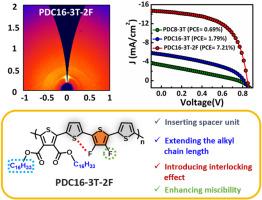
As the power conversion efficiency (PCE) of organic photovoltaics (OPVs) approximates the 19 % threshold, wide bandgap (WBG) polythiophenes (PTs) have gained increasing attention due to their simple chemical structures and ease of synthesis, making them promising candidates for large-scale production. However, the benchmark polymer poly(3-hexylthiophene) (P3HT) is limited by its high-lying HOMO energy level, which restricts the open-circuit voltage (VOC) in solar cells. In this study, we introduce a novel series of PT derivatives (PDC8-T, PDC8-3T, PDC16-3T, and PDC16-3T-2F) featuring ester side chains designed to fine-tune electronic properties through a streamlined three-step synthesis. Additionally, we incorporated a π-spacer to reduce steric hindrance and elongated alkyl side chains to improve solubility and processability. Compared to P3HT, these PT derivatives demonstrate a significant reduction in HOMO energy levels, lowering by approximately 0.3–0.4 eV. Among them, PDC16-3T-2F—with fluorine atom substitution—achieves the lowest HOMO energy level, induces a coplanar molecular conformation, and enhances polymer aggregation behavior.
We evaluated these PT derivatives in inverted non-fullerene bulk-heterojunction (NFA BHJ) OPVs. The PDC8-3T device showed a relatively low PCE of 0.69 %, with a VOC of 0.76 V, a short-circuit current density (JSC) of 3.32 mA/cm2, and a fill factor (FF) of 27.3 %. In contrast, the PDC16-3T-2F device achieved an impressive PCE of 7.21 %, with a VOC of 0.85 V, a JSC of 14.60 mA/cm2, and an FF of 58.4 %. This remarkable improvement is attributed to the fluorine substitution, which not only enhances molecular orientation but also downshifts the HOMO energy level and further boosts the VOC. Hence, these molecular design strategies have led to a fibrillar bicontinuous interpenetrating network with optimal nanoscale phase separation within the active layer.
期刊介绍:
Polymer is an interdisciplinary journal dedicated to publishing innovative and significant advances in Polymer Physics, Chemistry and Technology. We welcome submissions on polymer hybrids, nanocomposites, characterisation and self-assembly. Polymer also publishes work on the technological application of polymers in energy and optoelectronics.
The main scope is covered but not limited to the following core areas:
Polymer Materials
Nanocomposites and hybrid nanomaterials
Polymer blends, films, fibres, networks and porous materials
Physical Characterization
Characterisation, modelling and simulation* of molecular and materials properties in bulk, solution, and thin films
Polymer Engineering
Advanced multiscale processing methods
Polymer Synthesis, Modification and Self-assembly
Including designer polymer architectures, mechanisms and kinetics, and supramolecular polymerization
Technological Applications
Polymers for energy generation and storage
Polymer membranes for separation technology
Polymers for opto- and microelectronics.




 京公网安备 11010802042870号
京ICP备2023020795号-1
京公网安备 11010802042870号
京ICP备2023020795号-1

 分享
分享
 求助内容:
求助内容: 应助结果提醒方式:
 扫码关注我们
