Tailored chain interaction of binary and ternary PVDF-HFP and PVDF-TrFE-CTFE / graphene nanoplatelets on dielectric properties and charge density capability
{"title":"Tailored chain interaction of binary and ternary PVDF-HFP and PVDF-TrFE-CTFE / graphene nanoplatelets on dielectric properties and charge density capability","authors":"Suphita Chaipo , Ponkrit Itsaradamkoeng , Subhan Salaeh , Komkrisd Wongtimnoi , Chatchai Putson , Jia-Wei Zhang","doi":"10.1016/j.polymer.2025.128339","DOIUrl":null,"url":null,"abstract":"<div><div>In this study, a semi-crystalline copolymer, Poly(vinylidene fluoride-co-hexafluoropropylene) (PVDF-HFP), was blended with Poly(vinylidene fluoride-trifluoroethylene-chlorotrifluoroethylene) (PVDF-TrFE-CTFE) and Graphene Nanoplatelets (GNP) to fabricate 2-phase and 3-phase composite films. The heterostructure blending enhanced the dielectric constant and polarization. Moreover, the chain interaction between the terpolymer and copolymer improved compatibility with the GNP, reducing charge accumulation and leakage current. The films were prepared using the tape-casting solution method with varying terpolymer loadings. Their bonding, surface structure, and morphology were analyzed using SEM, FTIR, AFM, and contact angle measurements. Electrical properties and energy storage capabilities were evaluated using an LCR meter and a ferroelectric measurement setup. The combination of PVDF-TrFE-CTFE induced significant changes in the morphology, crystallinity, dielectric properties and electrical breakdown strength. Notably, blending with the terpolymer increased the energy storage density from 0.14 J/cm<sup>3</sup> (T0) to 0.26 J/cm<sup>3</sup> (T70) at 40 kV/mm. Additionally, adding 1 wt% GNP enhanced interfacial polarization, with the T30 + GNP composite nearly 2 times the energy storage density compared to the neat T30 film (0.14 J/cm<sup>3</sup> vs. 0.22 J/cm<sup>3</sup> at 40 kV/mm). The combination of copolymer and terpolymer also improved the electrical breakdown strength, with T70 reaching 540 kV/mm. These enhancements in polymer-GNP interactions, charge carrier dynamics, and electrical breakdown strength demonstrate the potential of this composite material for high-performance dielectric applications, particularly in capacitive energy storage systems.</div></div>","PeriodicalId":405,"journal":{"name":"Polymer","volume":"326 ","pages":"Article 128339"},"PeriodicalIF":4.5000,"publicationDate":"2025-05-09","publicationTypes":"Journal Article","fieldsOfStudy":null,"isOpenAccess":false,"openAccessPdf":"","citationCount":"0","resultStr":null,"platform":"Semanticscholar","paperid":null,"PeriodicalName":"Polymer","FirstCategoryId":"92","ListUrlMain":"https://www.sciencedirect.com/science/article/pii/S0032386125003258","RegionNum":2,"RegionCategory":"化学","ArticlePicture":[],"TitleCN":null,"AbstractTextCN":null,"PMCID":null,"EPubDate":"2025/4/1 0:00:00","PubModel":"Epub","JCR":"Q2","JCRName":"POLYMER SCIENCE","Score":null,"Total":0}
引用次数: 0
Abstract
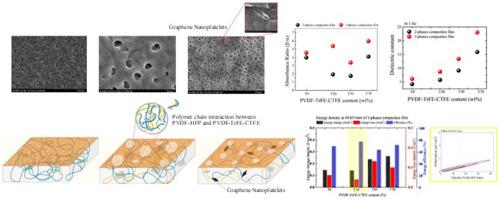
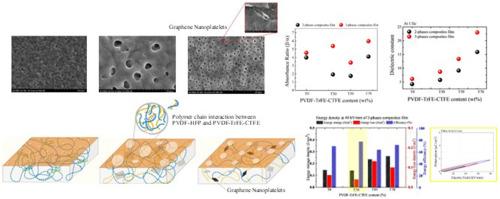
In this study, a semi-crystalline copolymer, Poly(vinylidene fluoride-co-hexafluoropropylene) (PVDF-HFP), was blended with Poly(vinylidene fluoride-trifluoroethylene-chlorotrifluoroethylene) (PVDF-TrFE-CTFE) and Graphene Nanoplatelets (GNP) to fabricate 2-phase and 3-phase composite films. The heterostructure blending enhanced the dielectric constant and polarization. Moreover, the chain interaction between the terpolymer and copolymer improved compatibility with the GNP, reducing charge accumulation and leakage current. The films were prepared using the tape-casting solution method with varying terpolymer loadings. Their bonding, surface structure, and morphology were analyzed using SEM, FTIR, AFM, and contact angle measurements. Electrical properties and energy storage capabilities were evaluated using an LCR meter and a ferroelectric measurement setup. The combination of PVDF-TrFE-CTFE induced significant changes in the morphology, crystallinity, dielectric properties and electrical breakdown strength. Notably, blending with the terpolymer increased the energy storage density from 0.14 J/cm3 (T0) to 0.26 J/cm3 (T70) at 40 kV/mm. Additionally, adding 1 wt% GNP enhanced interfacial polarization, with the T30 + GNP composite nearly 2 times the energy storage density compared to the neat T30 film (0.14 J/cm3 vs. 0.22 J/cm3 at 40 kV/mm). The combination of copolymer and terpolymer also improved the electrical breakdown strength, with T70 reaching 540 kV/mm. These enhancements in polymer-GNP interactions, charge carrier dynamics, and electrical breakdown strength demonstrate the potential of this composite material for high-performance dielectric applications, particularly in capacitive energy storage systems.
期刊介绍:
Polymer is an interdisciplinary journal dedicated to publishing innovative and significant advances in Polymer Physics, Chemistry and Technology. We welcome submissions on polymer hybrids, nanocomposites, characterisation and self-assembly. Polymer also publishes work on the technological application of polymers in energy and optoelectronics.
The main scope is covered but not limited to the following core areas:
Polymer Materials
Nanocomposites and hybrid nanomaterials
Polymer blends, films, fibres, networks and porous materials
Physical Characterization
Characterisation, modelling and simulation* of molecular and materials properties in bulk, solution, and thin films
Polymer Engineering
Advanced multiscale processing methods
Polymer Synthesis, Modification and Self-assembly
Including designer polymer architectures, mechanisms and kinetics, and supramolecular polymerization
Technological Applications
Polymers for energy generation and storage
Polymer membranes for separation technology
Polymers for opto- and microelectronics.



 京公网安备 11010802042870号
京ICP备2023020795号-1
京公网安备 11010802042870号
京ICP备2023020795号-1

 分享
分享
 求助内容:
求助内容: 应助结果提醒方式:
 扫码关注我们
