Bharath Somalapura Prakasha, Peng Xiao, María José Esplandiu, JiaQi Yang, Daniel Navarro-Urrios, Javier Rodríguez-Viejo, Marianna Sledzinska
{"title":"Impedance-Assisted Multivariate Analysis Technique for Enhanced Gas Sensing with 2D Dichalcogenides","authors":"Bharath Somalapura Prakasha, Peng Xiao, María José Esplandiu, JiaQi Yang, Daniel Navarro-Urrios, Javier Rodríguez-Viejo, Marianna Sledzinska","doi":"10.1021/acssensors.4c03325","DOIUrl":null,"url":null,"abstract":"Semiconducting two-dimensional (2D) materials have emerged as promising candidates for gas sensors due to their exceptional sensitivity and rapid response/recovery times. However, these sensors often face significant challenges, including baseline drift, nonlinearity, cross-sensitivity to multiple gases, and early response saturation, all of which compromise their accuracy and reliability. Conventional resistive sensing approaches, which rely on a single output signal for gas concentration estimation, fail to capture the complex interactions inherent to 2D materials, such as charge carrier generation, transport, and polarization. This work addresses these limitations by utilizing impedance measurements across multiple frequencies for MoS<sub>2</sub>- and WS<sub>2</sub>-based sensors, coupled with machine learning-assisted data processing for accurate relative humidity (RH) quantification. By leveraging the impedance domain, we effectively mitigated baseline drift over extended periods and identified mutually exclusive phase behavior for the WS<sub>2</sub>-based sensor. The MoS<sub>2</sub>-based sensor exhibited long-term stability, motivating the application of a neural network-based multilayer perceptron (MLP), one-dimensional convolutional network (1D-CNN), and long short-term memory (LSTM) models to interpret multifrequency impedance data for precise RH measurements. Our approach enabled robust humidity sensing over a wide range (0–90%) with significantly faster response and recovery times than commercial sensors. Additionally, the neural network-assisted WS<sub>2</sub> sensor effectively minimized cross-sensitivity between humidity and CO<sub>2</sub>. This work showcases the potential of multifrequency impedance-based sensing, combined with machine learning, to overcome the traditional limitations of 2D material-based sensors, offering a pathway toward more reliable, stable, and precise gas-sensing technologies.","PeriodicalId":24,"journal":{"name":"ACS Sensors","volume":"32 1","pages":""},"PeriodicalIF":9.1000,"publicationDate":"2025-03-31","publicationTypes":"Journal Article","fieldsOfStudy":null,"isOpenAccess":false,"openAccessPdf":"","citationCount":"0","resultStr":null,"platform":"Semanticscholar","paperid":null,"PeriodicalName":"ACS Sensors","FirstCategoryId":"92","ListUrlMain":"https://doi.org/10.1021/acssensors.4c03325","RegionNum":1,"RegionCategory":"化学","ArticlePicture":[],"TitleCN":null,"AbstractTextCN":null,"PMCID":null,"EPubDate":"","PubModel":"","JCR":"Q1","JCRName":"CHEMISTRY, ANALYTICAL","Score":null,"Total":0}
引用次数: 0
Abstract
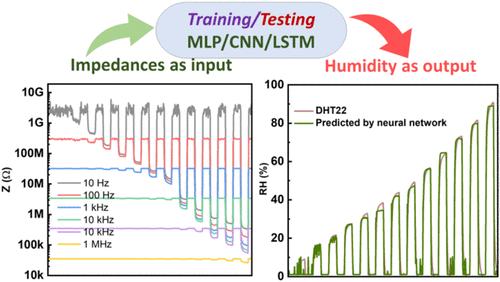
Semiconducting two-dimensional (2D) materials have emerged as promising candidates for gas sensors due to their exceptional sensitivity and rapid response/recovery times. However, these sensors often face significant challenges, including baseline drift, nonlinearity, cross-sensitivity to multiple gases, and early response saturation, all of which compromise their accuracy and reliability. Conventional resistive sensing approaches, which rely on a single output signal for gas concentration estimation, fail to capture the complex interactions inherent to 2D materials, such as charge carrier generation, transport, and polarization. This work addresses these limitations by utilizing impedance measurements across multiple frequencies for MoS2- and WS2-based sensors, coupled with machine learning-assisted data processing for accurate relative humidity (RH) quantification. By leveraging the impedance domain, we effectively mitigated baseline drift over extended periods and identified mutually exclusive phase behavior for the WS2-based sensor. The MoS2-based sensor exhibited long-term stability, motivating the application of a neural network-based multilayer perceptron (MLP), one-dimensional convolutional network (1D-CNN), and long short-term memory (LSTM) models to interpret multifrequency impedance data for precise RH measurements. Our approach enabled robust humidity sensing over a wide range (0–90%) with significantly faster response and recovery times than commercial sensors. Additionally, the neural network-assisted WS2 sensor effectively minimized cross-sensitivity between humidity and CO2. This work showcases the potential of multifrequency impedance-based sensing, combined with machine learning, to overcome the traditional limitations of 2D material-based sensors, offering a pathway toward more reliable, stable, and precise gas-sensing technologies.
期刊介绍:
ACS Sensors is a peer-reviewed research journal that focuses on the dissemination of new and original knowledge in the field of sensor science, particularly those that selectively sense chemical or biological species or processes. The journal covers a broad range of topics, including but not limited to biosensors, chemical sensors, gas sensors, intracellular sensors, single molecule sensors, cell chips, and microfluidic devices. It aims to publish articles that address conceptual advances in sensing technology applicable to various types of analytes or application papers that report on the use of existing sensing concepts in new ways or for new analytes.




 京公网安备 11010802042870号
京ICP备2023020795号-1
京公网安备 11010802042870号
京ICP备2023020795号-1

 分享
分享
 求助内容:
求助内容: 应助结果提醒方式:
 扫码关注我们
