Mateusz Król, Mitko Oldfield, Matthias Wurdack, Eliezer Estrecho, Gary Beane, Yihui Hou, Andrew G. Truscott, Agustin Schiffrin, Elena A. Ostrovskaya
{"title":"Robust Room-Temperature Polariton Condensation and Lasing in Scalable FAPbBr3 Perovskite Microcavities","authors":"Mateusz Król, Mitko Oldfield, Matthias Wurdack, Eliezer Estrecho, Gary Beane, Yihui Hou, Andrew G. Truscott, Agustin Schiffrin, Elena A. Ostrovskaya","doi":"10.1021/acsphotonics.4c02458","DOIUrl":null,"url":null,"abstract":"Exciton-polariton condensation in direct bandgap semiconductors strongly coupled to light enables a broad range of fundamental studies and applications such as low-threshold and electrically driven lasing. Yet, materials hosting exciton-polariton condensation in ambient conditions are rare, with fabrication protocols that are often inefficient and nonscalable. Here, room-temperature exciton-polariton condensation and lasing is observed in a microcavity with embedded formamidinium lead bromide (FAPbBr<sub>3</sub>) perovskite film. This optically active material is spin-coated onto the microcavity mirror, which makes the whole device scalable up to large lateral sizes. The sub-μm granulation of the polycrystalline FAPbBr<sub>3</sub> film allows for observation of polariton lasing in a single quantum-confined mode of a polaritonic “quantum dot”. Compared to random photon lasing, observed in bare FAPbBr<sub>3</sub> films, polariton lasing exhibits a lower threshold, narrower line width, and an order of magnitude longer coherence time. Both polariton and random photon lasing are observed under the conditions of pulsed optical pumping and persist without significant degradation for up to 6 and 17 h of a continuous experimental run, respectively. This study demonstrates the excellent potential of the FAPbBr<sub>3</sub> perovskite as a new material for room-temperature polaritonics, with the added value of efficient and scalable fabrication offered by the solution-based spin-coating process.","PeriodicalId":23,"journal":{"name":"ACS Photonics","volume":"16 1","pages":""},"PeriodicalIF":6.7000,"publicationDate":"2025-03-31","publicationTypes":"Journal Article","fieldsOfStudy":null,"isOpenAccess":false,"openAccessPdf":"","citationCount":"0","resultStr":null,"platform":"Semanticscholar","paperid":null,"PeriodicalName":"ACS Photonics","FirstCategoryId":"101","ListUrlMain":"https://doi.org/10.1021/acsphotonics.4c02458","RegionNum":1,"RegionCategory":"物理与天体物理","ArticlePicture":[],"TitleCN":null,"AbstractTextCN":null,"PMCID":null,"EPubDate":"","PubModel":"","JCR":"Q1","JCRName":"MATERIALS SCIENCE, MULTIDISCIPLINARY","Score":null,"Total":0}
引用次数: 0
Abstract
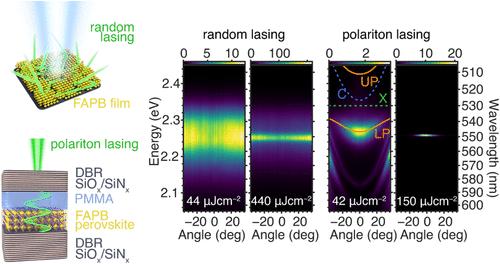
Exciton-polariton condensation in direct bandgap semiconductors strongly coupled to light enables a broad range of fundamental studies and applications such as low-threshold and electrically driven lasing. Yet, materials hosting exciton-polariton condensation in ambient conditions are rare, with fabrication protocols that are often inefficient and nonscalable. Here, room-temperature exciton-polariton condensation and lasing is observed in a microcavity with embedded formamidinium lead bromide (FAPbBr3) perovskite film. This optically active material is spin-coated onto the microcavity mirror, which makes the whole device scalable up to large lateral sizes. The sub-μm granulation of the polycrystalline FAPbBr3 film allows for observation of polariton lasing in a single quantum-confined mode of a polaritonic “quantum dot”. Compared to random photon lasing, observed in bare FAPbBr3 films, polariton lasing exhibits a lower threshold, narrower line width, and an order of magnitude longer coherence time. Both polariton and random photon lasing are observed under the conditions of pulsed optical pumping and persist without significant degradation for up to 6 and 17 h of a continuous experimental run, respectively. This study demonstrates the excellent potential of the FAPbBr3 perovskite as a new material for room-temperature polaritonics, with the added value of efficient and scalable fabrication offered by the solution-based spin-coating process.
期刊介绍:
Published as soon as accepted and summarized in monthly issues, ACS Photonics will publish Research Articles, Letters, Perspectives, and Reviews, to encompass the full scope of published research in this field.



 京公网安备 11010802042870号
京ICP备2023020795号-1
京公网安备 11010802042870号
京ICP备2023020795号-1

 分享
分享
 求助内容:
求助内容: 应助结果提醒方式:
 扫码关注我们
